Gluten-Free Angel Food Cake
Meta Description: This gluten-free angel food cake is impossibly light and fluffy with a tender crumb and delicate vanilla-almond flavor. A perfect spring cake that’s naturally fat-free!
My grandmother made angel food cake for every birthday in our family. She’d pull that towering, cloud-like creation from her ancient tube pan, and we’d gather around while she sliced it with her mother’s serrated knife. The cake seemed almost magical—impossibly tall, impossibly light, dissolving on the tongue like sweet, vanilla-scented air.
Well… when I had to go gluten-free, I convinced myself that memory was gone forever. Angel food cake depends entirely on structure—there’s no butter to mask mistakes, no heavy batter to hide a collapsed center. Surely gluten-free flour couldn’t achieve that ethereal lift.
I was gloriously wrong. This gluten-free angel food cake rises tall and proud, with that signature light cake texture and tender crumb that defines the classic. The secret lies in technique more than ingredients—and I’m about to share every detail. What could be more fitting for spring celebrations than a fluffy cake that tastes like a cloud wrapped in vanilla?
Table of Contents
Why You’ll Love This Gluten-Free Angel Food Cake
Naturally fat-free and dairy-free – angel food cake contains no butter, oil, or egg yolks, making it one of the lightest desserts you can bake.
Tall, impressive presentation without complicated decorating – the cake’s height and delicate texture speak for themselves.
Subtle vanilla-almond flavor that pairs with everything – top with berries, whipped cream, lemon curd, or enjoy completely plain.
Proves gluten-free baking can achieve the impossible – this spring cake demonstrates that even the most technically demanding recipes work without wheat.
The Secret to Perfect Fluffy Cake
Room temperature egg whites whip to greater volume. Cold whites are denser and more resistant to incorporating air. Separating your eggs 30 minutes before baking allows them to warm up, resulting in a higher, more stable foam. According to Stella Parks at Serious Eats, room temperature whites can achieve up to 8 times their original volume.
Processing the dry ingredients creates a finer texture. Pulsing the flour, cornstarch, and powdered sugar in a food processor breaks down any lumps and creates an ultra-fine powder that folds into the egg whites without deflating them. This step is non-negotiable for light cake success.
Cream of tartar stabilizes the egg white foam. This acidic ingredient strengthens the protein structure of whipped whites, helping them hold their shape during folding and baking. Without it, your foam is more likely to collapse.
Folding requires patience and a gentle hand. Every aggressive stir deflates precious air bubbles. Fold in thirds, using slow, deliberate movements from the bottom of the bowl up and over. The technique matters more than the speed.
Ingredients
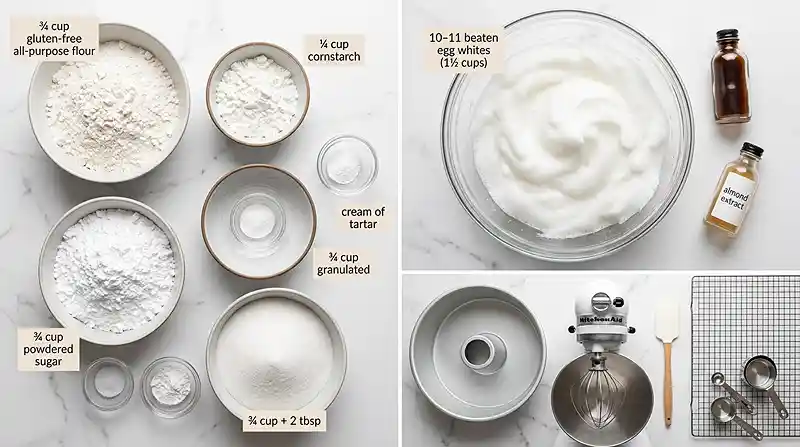
Dry Ingredients
- 3/4 cup gluten-free all-purpose flour
- 1/4 cup cornstarch
- 3/4 cup powdered sugar
Egg White Foam
- 1 1/2 cups egg whites (from 10-11 large eggs)
- 3/4 cup plus 2 tablespoons granulated sugar
- 1/4 teaspoon salt
- 1 1/2 teaspoons cream of tartar
- 1 tablespoon vanilla extract
- 1/4 teaspoon almond extract
Equipment You’ll Need
A 10-inch tube pan (angel food cake pan) is essential—do not substitute a bundt pan, as the decorative ridges trap the batter and prevent proper release. You’ll also need a stand mixer with whisk attachment (or hand mixer with significant patience), a food processor or blender, a rubber spatula, a wire cooling rack, and a thin knife for releasing the cake.
Pro Tip: Your tube pan must be ungreased. The batter needs to cling to the sides as it rises, then hang inverted without falling out during cooling. Greasing causes collapse.
Step-by-Step Instructions
Prepare the Egg Whites
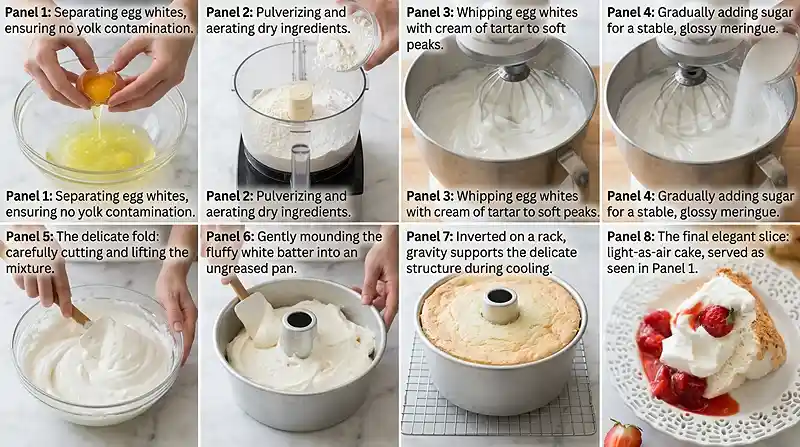
Separate 10-11 large eggs, placing the whites in a large clean bowl. Even a tiny speck of yolk will prevent the whites from whipping properly—if a yolk breaks, start fresh with that egg.
Allow the egg whites to sit at room temperature for at least 30 minutes, or up to 2 hours. Cover loosely with a clean towel to prevent a skin from forming.
Pro Tip: Eggs separate most easily when cold, so separate them straight from the refrigerator, then let the whites warm up. Save those yolks for lemon curd, custard, or homemade pasta.
Process the Dry Ingredients
Preheat your oven to 350°F (175°C). Position a rack in the lower third of the oven—angel food cake rises significantly and needs headroom.
Add the gluten-free flour, cornstarch, and powdered sugar to a food processor or blender. Process for about 30 seconds until the mixture is completely smooth and uniform, with no visible lumps or granules.
Pour this processed flour mixture into a bowl and set aside. You know… this step seems fussy, but it transforms the texture from good to ethereal.
Pulse the Granulated Sugar
Add the granulated sugar to the empty food processor or blender. Pulse 5-7 times to create a slightly finer texture—you’re not making powdered sugar, just refining the granules somewhat.
Finer sugar dissolves more readily into the egg whites, creating a more stable, glossy foam. Set this aside separately from the flour mixture.
Whip the Egg Whites
Pour the room temperature egg whites into the bowl of a stand mixer fitted with the whisk attachment. Begin beating on high speed until the whites start to foam and turn opaque, about 1 minute.
Add the salt and cream of tartar. Continue beating on high speed. The foam will become thicker and whiter.
Add the vanilla extract and almond extract while the mixer runs. The almond extract adds a subtle background note that elevates the vanilla—it shouldn’t taste distinctly like almonds.
Add the Sugar Gradually
With the mixer still running on high, begin adding the processed granulated sugar. Add 1 tablespoon at a time, allowing each addition to incorporate fully before adding the next.
This slow addition takes 3-5 minutes but is essential. Dumping all the sugar at once would deflate your carefully built foam. Patience here creates the glossy, stable meringue that makes angel food cake possible.
Continue beating until the meringue reaches soft peaks—when you lift the whisk, the peaks should curl over gently rather than standing straight up. The mixture should be thick, glossy, and marshmallow-like.
Man, oh man… there’s something deeply satisfying about watching egg whites transform into this billowy, cloud-like mass.
Fold in the Flour Mixture
This step requires your gentlest touch. Using a large rubber spatula, add one-third of the flour mixture to the meringue.
Fold by cutting down through the center of the bowl, sweeping along the bottom, and bringing the spatula up the side while rotating the bowl. Repeat until no streaks of flour remain, about 10-12 folds.
Add the second third of flour and fold the same way. Then the final third. The total folding should take 30-40 gentle strokes. The batter should be light, airy, and uniformly colored.
Pro Tip: It’s better to have a few small flour streaks than to overfold and deflate the batter. The streaks will disappear during baking.
Fill and Bake
Gently scoop the batter into an ungreased 10-inch tube pan. Use the spatula to spread it evenly, but don’t press or compact it.
Run a knife through the batter in a zigzag pattern to release any large air pockets. This prevents holes in your finished cake.
Bake for 35-40 minutes until the top is lightly golden and springs back when gently pressed. A toothpick inserted into the center should come out clean.
Cool Inverted (Critical Step)
Immediately upon removing from the oven, flip the tube pan upside down. Most tube pans have feet or a center cone that holds the pan elevated; if yours doesn’t, invert it over a bottle neck or funnel.
Leave the cake inverted until completely cool—at least 1-2 hours, or overnight. This inverted cooling prevents the delicate structure from collapsing under its own weight while it sets.
Well… skipping this step results in a dense, compressed cake that bears no resemblance to angel food. Don’t be tempted to rush.
Release and Serve
Once completely cool, run a thin knife around the outer edge and the center tube, pressing against the pan rather than the cake.
Gently tap the pan on the counter to help release the cake. Invert onto a serving plate—the golden top becomes the bottom, revealing the pristine white surface.
Slice with a serrated knife using a gentle sawing motion. Pressing down will compress the delicate crumb.
Make It Your Own
Lemon angel food cake brightens the flavor. Add 2 tablespoons fresh lemon juice and 1 tablespoon lemon zest with the extracts. Reduce vanilla to 1 teaspoon and omit the almond extract.
Chocolate swirl creates visual drama. Divide the batter in half. Fold 2 tablespoons cocoa powder into one portion, then alternate spoonfuls of plain and chocolate batter in the pan and swirl gently.
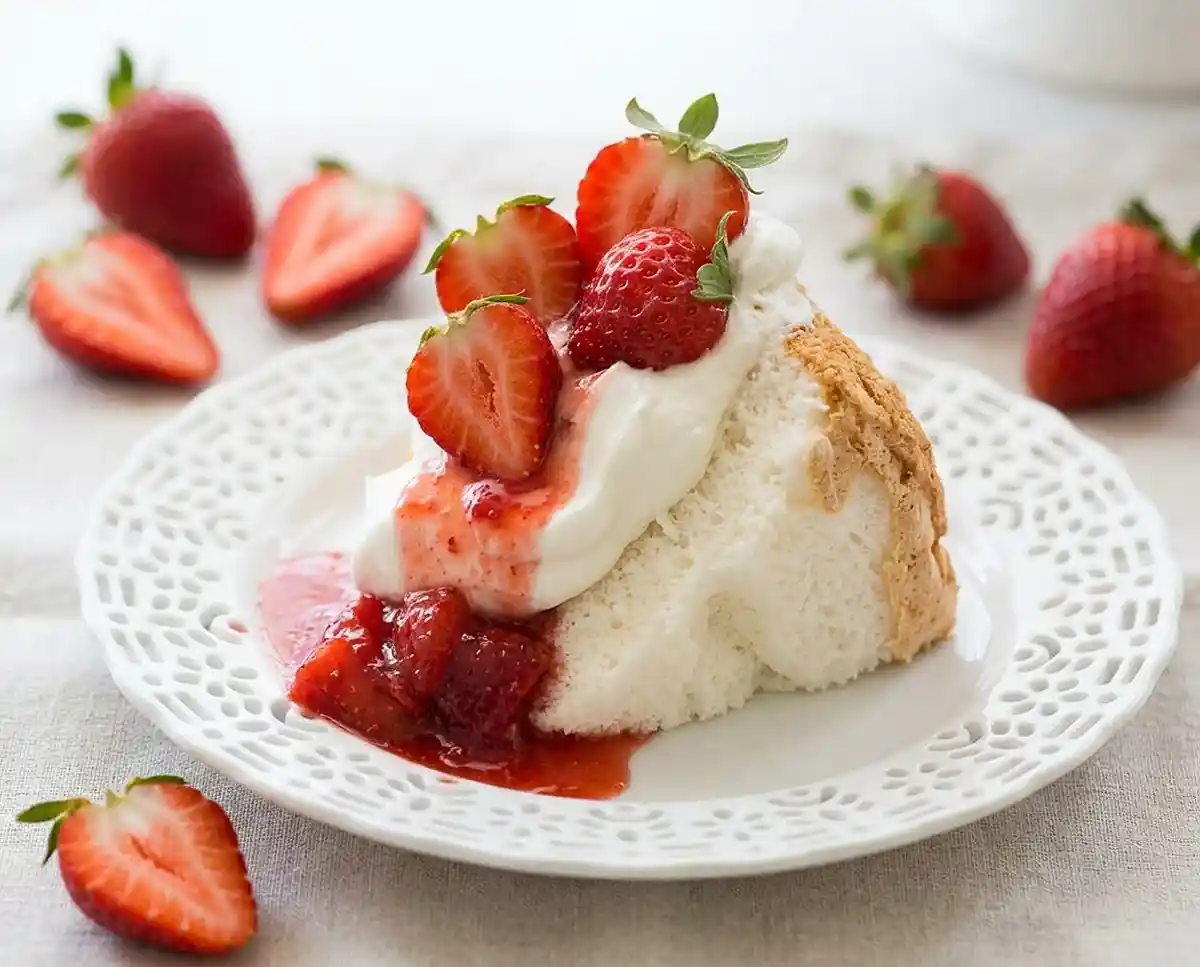
Fresh berries and whipped cream is the classic pairing. Top slices with macerated strawberries, blueberries, or a mixed berry compote. The cake absorbs the juices beautifully.
Coconut angel food adds tropical notes. Fold 1/2 cup finely shredded unsweetened coconut into the finished batter. Toast additional coconut and press onto the sides of the cooled cake.
Make a trifle with leftover cake. Cube any remaining cake and layer with vanilla pudding, fresh fruit, and whipped cream for an impressive no-bake dessert.
Citrus glaze adds sweetness without heaviness. Whisk 1 cup powdered sugar with 2-3 tablespoons fresh lemon or orange juice and drizzle over the cooled cake.
Common Problems & Solutions
Problem: The cake collapsed after removing from the oven.
You didn’t invert it immediately, or the cake wasn’t fully baked. The structure needs to set while hanging upside down—gravity pulling downward while inverted keeps the cake stretched tall. Always invert immediately and leave until completely cool.
Problem: The egg whites wouldn’t whip properly.
There was fat contamination from a trace of yolk or a greasy bowl. Even tiny amounts of fat prevent whites from foaming. Ensure all equipment is completely clean and dry, and separate eggs carefully.
Problem: The cake is dense and gummy.
The flour was overfolded, deflating the egg white foam, or the batter wasn’t light enough before folding began. Fold gently in thirds, stopping as soon as flour streaks disappear. Ensure your whites reached proper soft peak stage before adding flour.
Problem: The cake stuck to the pan.
The pan was greased, or you tried to release it while still warm. Never grease an angel food pan—the batter must cling to the sides to rise properly. Cool completely (at least 1-2 hours) before attempting to release.
Problem: Large holes or tunnels in the cake.
Air pockets weren’t released before baking. Run a knife through the batter in zigzags after filling the pan. Also ensure the batter was folded completely—undermixing can leave flour pockets that create holes.
Storage & Meal Prep
| Method | Duration | Notes |
|---|---|---|
| Counter | 2-3 days | Cover with cake dome or loosely wrap |
| Refrigerator | 5-7 days | Wrap tightly; may dry out faster |
| Freezer | 2-3 months | Wrap in plastic then foil; thaw at room temp |
Angel food cake is best enjoyed fresh, when the texture is at its lightest and most tender. However, it freezes remarkably well—wrap tightly in plastic wrap, then aluminum foil, and freeze for up to 3 months.
Thaw frozen cake at room temperature for 2-3 hours before serving. The texture remains surprisingly good after freezing.
For meal prep, make the cake 1-2 days ahead and store covered at room temperature. Add toppings just before serving to maintain the cake’s delicate texture.
Your Questions Answered
Why do you flip angel food cake upside down to cool?
The delicate foam structure can’t support its own weight while still warm. Cooling inverted allows the proteins to fully set in their expanded state. Without inversion, the cake compresses under gravity, losing up to half its height and becoming dense instead of fluffy.
Can I make angel food cake without a tube pan?
Unfortunately, no. The center tube is essential—it conducts heat to the middle of the cake, ensuring even baking, and provides structure for the inverted cooling. Bundt pans don’t work because their decorative ridges prevent proper release and the batter can’t cling properly.
What can I do with leftover egg yolks?
Save them for lemon curd, custard, hollandaise sauce, homemade ice cream, pasta carbonara, or enriched bread dough. Yolks keep refrigerated for 2-3 days, or freeze individually in ice cube trays for up to 3 months.
Why does my angel food cake taste eggy?
The eggs weren’t fresh, or the vanilla and almond extracts weren’t added. Fresh eggs have less pronounced flavor than older ones. Ensure you use quality extracts in the full amounts specified—they mask any eggy notes.
Can I make this cake in a 9-inch pan instead of 10-inch?
A 9-inch pan will work but the cake will rise higher and may take 5-10 minutes longer to bake. Watch carefully for the golden top and springy texture. The taller cake is more dramatic but also more fragile.
Serving Suggestions
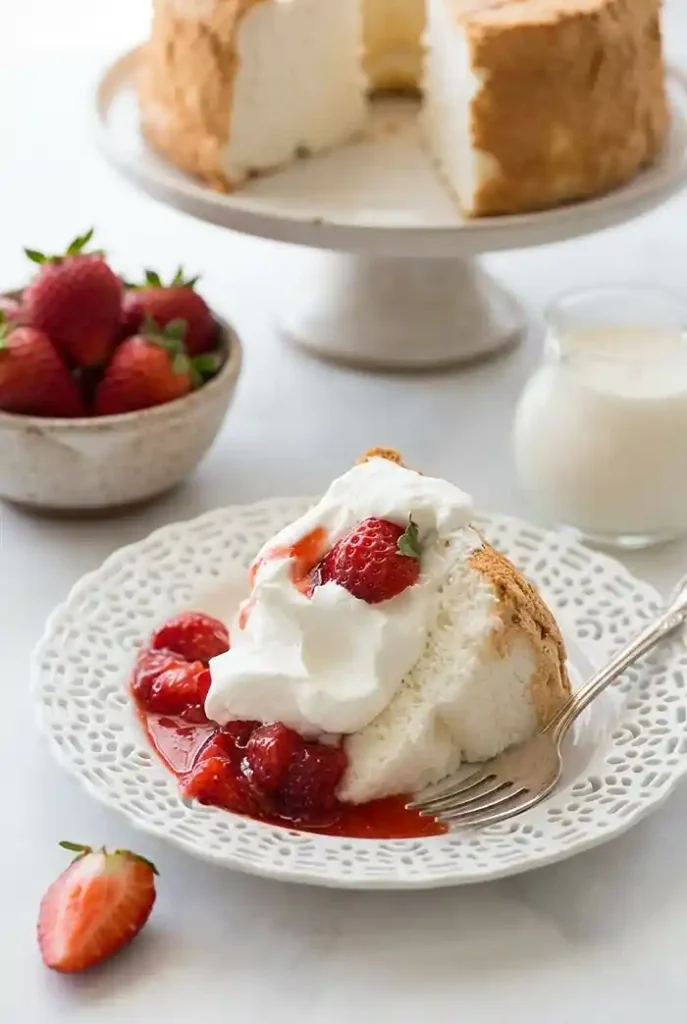
This gluten-free angel food cake creates an ethereal centerpiece for spring celebrations—Easter brunch, Mother’s Day, bridal showers, or any gathering where you want impressive without heavy. The pristine white color and towering height need no additional decoration to impress.
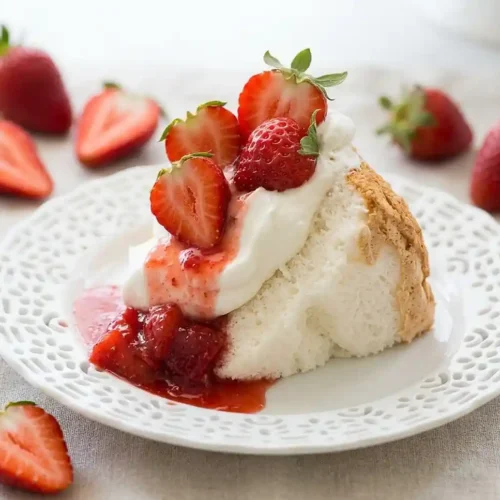
For the classic presentation, serve slices with fresh strawberries and a cloud of whipped cream. The cake’s light texture absorbs berry juices beautifully, creating a simple but perfect combination.
Build a complete gluten-free dessert spread by pairing this spring cake with other options like gluten-free cinnamon sugar donuts for those wanting something smaller, gluten-free red velvet cheesecake brownies for chocolate lovers, or gluten-free dairy-free matcha latte cookies for something trendy and unique.
Let’s Get Baking!
There’s something almost miraculous about angel food cake—watching egg whites transform into that towering, cloud-like creation feels like kitchen magic. The fact that gluten-free flour achieves the same ethereal results makes it even more special.
I’d love to see your angel food cake triumphs! Share your photos on Pinterest and tell me in the comments what topping you chose. Did you try the lemon variation? Make a chocolate swirl? Your successes inspire other home bakers to tackle this beautiful, light cake with confidence.
Gluten-Free Angel Food Cake
Equipment
- 10-inch tube pan (ungreased)
- Stand mixer with whisk attachment (or hand mixer)
- Food processor or blender
- Large rubber spatula
- Wire cooling rack
- Thin knife
- Serrated knife for slicing
Ingredients
Dry Ingredients
- ¾ cup gluten-free all-purpose flour
- ¼ cup cornstarch
- ¾ cup powdered sugar
Egg White Foam
- 1 ½ cups egg whites from 10-11 large eggs, room temperature
- ¾ cup + 2 tablespoons granulated sugar
- ¼ teaspoon salt
- 1 ½ teaspoons cream of tartar
- 1 tablespoon vanilla extract
- ¼ teaspoon almond extract
Instructions
- Separate the egg whites and allow them to sit at room temperature for at least 30 minutes.
- Preheat the oven to 350°F. In a food processor or blender, process the gluten-free flour, cornstarch, and powdered sugar together until smooth, about 30 seconds. Pour into a bowl and set aside.
- Add the granulated sugar to the food processor or blender and pulse 5-7 times to create a slightly finer texture. Set aside separately.
- In a stand mixer fitted with the whisk attachment, beat the egg whites on high speed until starting to foam. Add the salt and cream of tartar.
- Add the vanilla extract and almond extract and continue whipping on high speed.
- With the mixer running on high, slowly add the granulated sugar 1 tablespoon at a time until all sugar is added and the mixture is glossy with soft peaks.
- Using a rubber spatula, slowly fold in the flour mixture in three additions. Fold carefully and gently to avoid deflating the egg whites—this is the key to a good angel food cake.
- Scoop the batter into an ungreased 10-inch tube pan. Run a knife through the batter in zigzags to release air pockets.
- Bake for 35-40 minutes until lightly golden and the top springs back when gently pressed.
- Remove from the oven and immediately flip the cake upside down onto a wire rack. Cool the cake completely, at least 1-2 hours.
- Once cooled, run a thin knife around the edge of the cake and the center tube. Gently tap the pan on the counter until the cake releases. Slice with a serrated knife and serve.