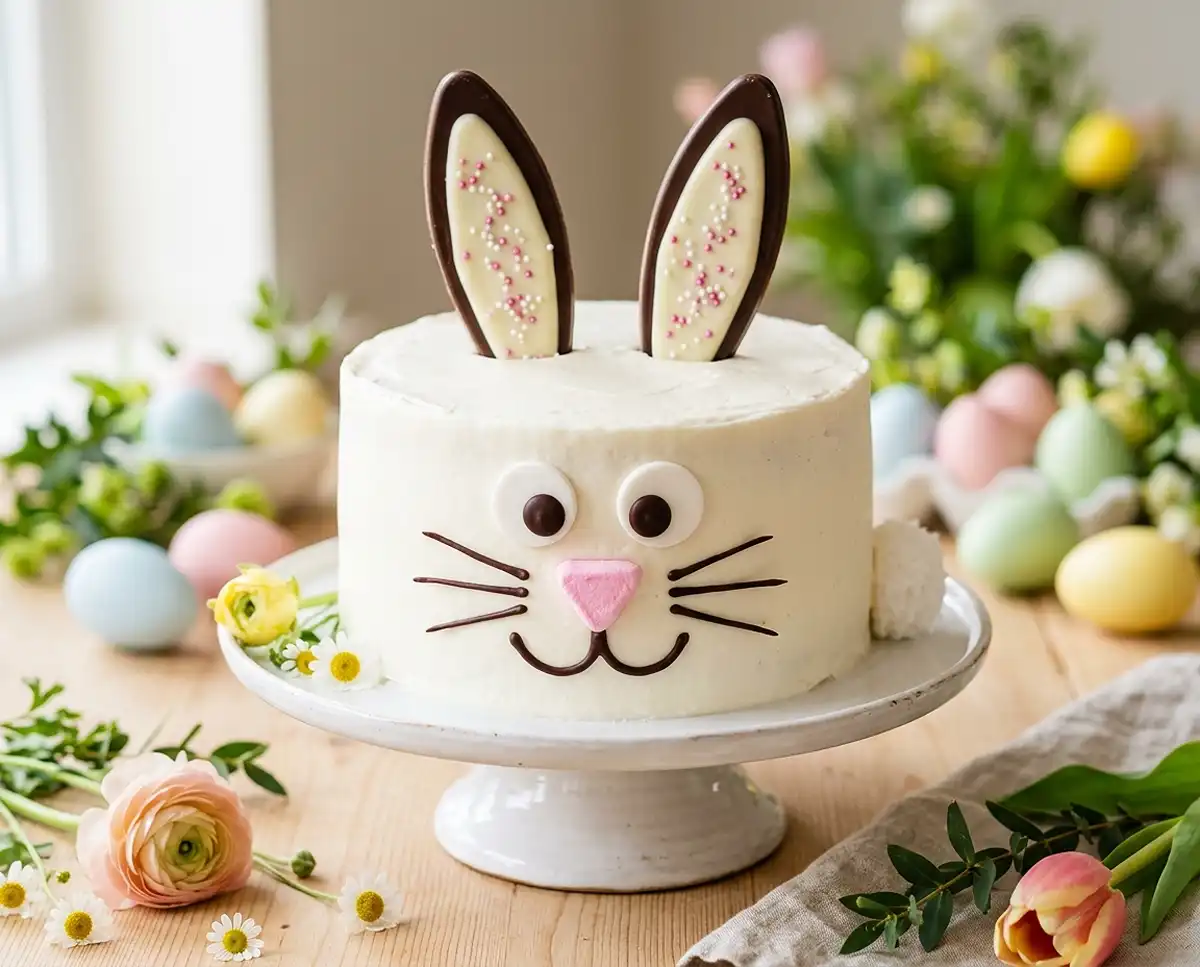
Gluten-Free Easter Bunny Cake
Gluten-Free Easter Bunny Cake with fluffy vanilla layers, creamy frosting, and chocolate ears. Kid-friendly and stunning for Easter celebrations!
Last Easter, I volunteered to bring dessert to our family gathering and promised my niece I’d make “the cutest bunny cake ever.” What followed was a three-hour frosting disaster where the ears kept sliding off, the chocolate seized into a grainy mess, and I nearly gave up and bought a grocery store cake instead.
That near-failure taught me that making a gluten-free Easter bunny cake isn’t about perfection—it’s about stabilizing those ears properly, using the right chocolate consistency, and embracing the wobbly charm of homemade decoration.
Why You’ll Love This Gluten-Free Easter Bunny Cake
- Fluffy, tender vanilla cake that tastes like it came from a bakery—no gritty texture or weird aftertaste thanks to grated white chocolate in the batter
- Kid-friendly decorating project that looks impressive but uses simple techniques anyone can master, even if you’ve never worked with chocolate molds
- Naturally gluten-free with easy swaps for dairy-free diets using plant-based butter and chocolate alternatives
- Perfect Easter centerpiece that serves 12-16 people and doubles as both dessert and entertainment when you assemble it at the table
The Secret to Perfect Gluten-Free Easter Bunny Cake
Grated white chocolate in the batter adds moisture and prevents that dry, crumbly texture. Gluten-free cakes can turn out dense or stale-tasting because gluten-free flour blends lack the protein structure of wheat. According to King Arthur Baking’s gluten-free cake science, adding melted or grated chocolate introduces fat that coats the flour particles, creating a tender crumb that stays soft for days.
Cooling the chocolate ears in the fridge sets them quickly and prevents melting during assembly. Dark chocolate has a higher cocoa butter content than milk chocolate, so it sets firm at room temperature—but refrigerating it for 10-15 minutes creates a stable structure that won’t bend or break when you insert it into the cake. This technique is especially important in warm kitchens where chocolate can soften too quickly.
Cutting slits in the cake top before inserting the ears gives them structural support. If you just push chocolate ears into soft frosting, they’ll topple over within minutes. Creating small slits with a sharp knife anchors the ears directly into the cake layers, and a dab of frosting behind each ear acts like edible glue to hold them in place.
Using Stork (or plant-based butter) instead of regular butter makes the cake dairy-free friendly. Stork is a British margarine brand that’s naturally dairy-free and creates exceptionally light cakes because it whips more air than butter. If you can’t find Stork, use room-temperature dairy-free butter like Miyoko’s or Earth Balance—just make sure it’s softened to the same consistency as the recipe requires.
Table of Contents
Ingredients
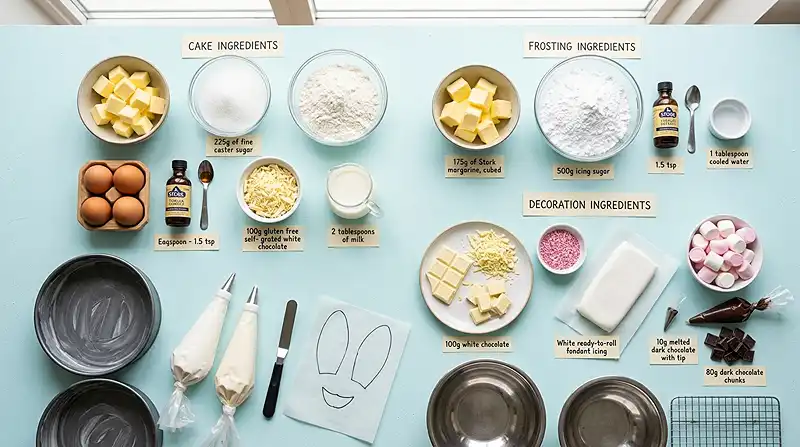
| For the Cake | Amount | Notes |
|---|---|---|
| Stork (or dairy-free butter) | 225 grams | Room temperature; equals about 1 cup |
| Caster sugar | 225 grams | Superfine sugar; can substitute granulated |
| Medium eggs | 4 | Room temperature |
| Vanilla extract | 1½ teaspoons | Pure vanilla, not imitation |
| Gluten-free self-raising flour | 225 grams | Or use GF all-purpose + 2 tsp baking powder |
| White chocolate | 100 grams | Grated; use dairy-free if needed |
| Milk | 2 tablespoons | Dairy or non-dairy |
| For the Vanilla Frosting | Amount | Notes |
|---|---|---|
| Stork (or dairy-free butter) | 175 grams | Softened; equals about ¾ cup |
| Icing sugar | 500 grams | Powdered sugar; sifted if lumpy |
| Vanilla extract | 1 teaspoon | |
| Cooled boiled water | 1 tablespoon | For spreadable consistency |
| For Decoration | Amount | Notes |
|---|---|---|
| White chocolate | 100 grams | Melted; for ear centers |
| Pink sprinkles | To taste | For inner ears |
| White ready-to-roll icing | Small amount | For eyes |
| Pink and white marshmallows | 2 | Pink for nose, white for tail |
| Dark chocolate (for features) | 10 grams | Melted; for pupils, mouth, nose outline |
| Dark chocolate (for ears) | 80 grams | Melted; for ear structure |
Pro Tip: If you don’t have caster sugar, pulse granulated sugar in a food processor for 10 seconds to create a finer texture. This helps the sugar dissolve more easily during creaming, creating a lighter cake.
Step-by-Step Instructions
Make the Cake
1. Prep the pans and preheat the oven.
Grease the base and sides of 2 x 7-inch deep-sided round cake tins with Stork (or dairy-free butter), then dust with gluten-free flour, tapping out any excess. Line the bottoms with parchment paper circles. Preheat your oven to 160°C fan/180°C conventional/Gas Mark 4 (about 350°F).
2. Cream the Stork and sugar.
In a large bowl using an electric mixer, cream together the Stork and caster sugar on medium-high speed for 4-5 minutes, until the mixture is pale, fluffy, and almost mousse-like. This extended creaming incorporates air that will help the cake rise and stay tender—don’t rush this step.
3. Add the eggs and vanilla.
Beat in the vanilla extract, then add the eggs one at a time, beating well for 30-60 seconds after each addition before adding the next. If the mixture looks slightly curdled after adding eggs, that’s normal—it will come together when you add the flour.
4. Fold in the flour and white chocolate.
Sift the gluten-free self-raising flour over the batter, then gently fold it in with a spatula using a figure-eight motion until no dry streaks remain. Fold in the grated white chocolate until evenly distributed. The batter should look thick and ribbony, falling off the spatula in slow ribbons.
5. Bake the cakes.
Divide the mixture equally between the two prepared tins (a kitchen scale helps with accuracy). Bake for 35 minutes, or until the cakes are golden brown on top, springy to the touch, and a toothpick inserted in the center comes out clean or with just a few moist crumbs. Transfer the tins to a wire rack and let the cakes cool for 10 minutes, then turn them out onto the rack to cool completely—at least 1 hour.
Make the Decorations
6. Create the chocolate eyes.
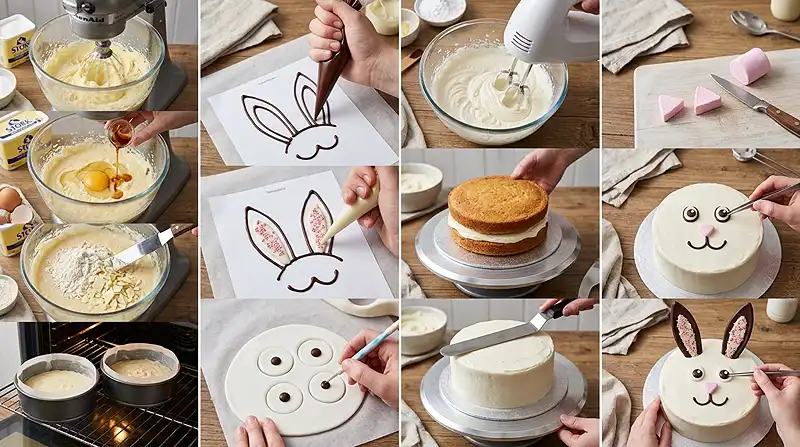
Roll out a small piece of white ready-to-roll icing on a surface dusted with powdered sugar until it’s about ⅛-inch thick. Use a small round cutter or the back of a piping tip to cut out 2 circles for the eyes. Place them on a parchment-lined plate. Melt 10 grams of dark chocolate in the microwave in 15-second bursts, stirring between each, until smooth. Use a toothpick or small brush to add a dot of dark chocolate to each white circle for pupils. Let them set at room temperature for 10 minutes.
7. Pipe the chocolate ears and mouth.
Print or draw a bunny ear template on paper (two elongated ovals about 4 inches tall). Lay a sheet of parchment paper over the template. Melt 80 grams of dark chocolate in the microwave, stirring every 20 seconds until completely smooth. Transfer to a disposable piping bag, snip a small hole in the tip, and pipe the outline of each ear following the template. Fill in the outlines with more chocolate, spreading it smooth with a small offset spatula or the back of a spoon. Pipe a small curved mouth shape (like an upside-down Y) on a separate piece of parchment. Place everything in the fridge to set for 15 minutes.
8. Add white chocolate centers to the ears.
Once the dark chocolate ears are firm, melt 100 grams of white chocolate and transfer it to a piping bag. Pipe a thin layer of white chocolate in the center of each ear (leaving a dark chocolate border), then immediately sprinkle pink sprinkles onto the wet white chocolate for the inner ear detail. Return to the fridge for another 10 minutes to set completely.
Make the Frosting and Assemble
9. Beat the vanilla frosting.
In a large bowl, beat together the softened Stork, sifted icing sugar, and vanilla extract on low speed until combined, then increase to medium-high and beat for 2-3 minutes until light and fluffy. Add the cooled boiled water and beat for another minute—the frosting should be smooth, spreadable, and hold soft peaks when you lift the beaters.
10. Assemble and frost the cake.
Place one cooled cake layer on a serving plate or cake stand. Spread about ⅓ of the frosting on top in an even layer, then place the second cake layer on top, pressing gently. Use the remaining frosting to coat the top and sides of the cake with a thin layer (this is your crumb coat). Use an offset spatula or butter knife to smooth the frosting as evenly as possible—it doesn’t have to be perfect since this is a rustic, homemade look.
11. Add the facial features.
Gently press the white icing eyes onto the front of the cake, positioning them about ⅓ of the way down from the top. Place the piped chocolate mouth below the eyes. Cut a pink marshmallow diagonally to create a triangular nose shape, and press it onto the cake just above the mouth. Cut a white marshmallow in half and press one half onto the back of the cake for the bunny tail.
12. Insert the chocolate ears.
Use a sharp paring knife to cut two small slits (about 1 inch deep) in the top of the cake, angled slightly outward where you want the ears to stand. Remove the chocolate ears from the fridge and carefully peel them off the parchment. Place a small dab of frosting on the back of each ear, then gently insert the base of each ear into the slits, pressing lightly to secure. Man, oh man… that moment when the ears stand up straight and your bunny comes to life is pure magic. The frosting dab acts like glue, and the slit in the cake keeps them from toppling over.
Make It Your Own (Substitutions & Variations)
Make it fully dairy-free with simple swaps. Use dairy-free butter (Miyoko’s or Earth Balance) instead of Stork, dairy-free white and dark chocolate chips, and plant-based milk. The texture and flavor stay remarkably similar—most people won’t even notice the difference in this Easter bunny cake gluten free version.
Try different cake flavors. Swap the vanilla for lemon extract and add 1 tablespoon of lemon zest for a bright citrus rabbit cake, or use almond extract for a subtle nutty flavor. You can even divide the batter and add cocoa powder to half for a marble effect.
Simplify the decorations for younger kids. Well… if piping chocolate ears feels too intimidating, use store-bought chocolate cookies (like gluten-free Oreos) for ears instead—just press them into the frosting at an angle. You can also use candy eyes instead of making them from icing, and draw the mouth with a food-safe marker or piped frosting.
Make it a layer cake instead of a round cake. Bake the batter in rectangular pans, then cut out a bunny face shape using a template. This creates a flat, 2D bunny face that’s easier to frost and decorate—perfect for beginners or kids’ parties.
Add fruit filling between the layers. Spread a thin layer of strawberry or raspberry jam on top of the first frosting layer before adding the second cake—the fruity tartness balances the sweetness and adds a pop of color when you slice it.
Common Problems & Solutions
Problem: My cake is dense and gummy in the center.
Solution: You either overmixed the batter after adding the flour or didn’t bake it long enough. Fold the flour in gently with a spatula using as few strokes as possible—overmixing activates the xanthan gum in gluten-free flour and creates a gummy texture. Also, bake until a toothpick comes out completely clean; gluten-free cakes need the full baking time to set properly.
Problem: The chocolate ears broke when I tried to peel them off the parchment.
Solution: Your chocolate was too thin or you tried to remove them before they were fully set. Pipe a thicker layer of chocolate (at least ⅛-inch thick) to create sturdier ears, and make sure they’ve been in the fridge for at least 15 minutes until completely hard and matte (not shiny). If they still feel fragile, chill them for another 5 minutes.
Problem: The ears keep falling over or sliding out.
Solution: You didn’t cut deep enough slits in the cake, or you skipped the frosting dab behind the ears. Cut slits that are at least 1 inch deep so the ears have something to anchor into, and always add a pea-sized dab of frosting on the back of each ear before inserting—this acts like glue and holds them in place.
Problem: My frosting is too stiff or too runny.
Solution: If it’s too stiff, add more cooled boiled water 1 teaspoon at a time until it reaches a spreadable consistency. If it’s too runny, add more sifted icing sugar ¼ cup at a time and beat well after each addition. Room temperature matters too—butter that’s too cold makes stiff frosting, while butter that’s too warm makes runny frosting.
Problem: The white chocolate seized and turned grainy when I melted it.
Solution: White chocolate is more delicate than dark chocolate and seizes easily if it gets too hot or if any water gets in. Melt it in 15-second bursts in the microwave, stirring between each, and make sure your bowl and spatula are completely dry. If it does seize, stir in 1 teaspoon of coconut oil or vegetable oil to bring it back to a smooth consistency.
Storage & Meal Prep
| Method | Duration | Notes |
|---|---|---|
| Counter | 2-3 days | Cover loosely with a cake dome; frosting stays soft |
| Refrigerator | 5-7 days | Store in airtight container; bring to room temp 1 hour before serving |
| Freezer | 2-3 months | Freeze unfrosted cake layers wrapped tightly; frost after thawing |
This cute cake actually tastes better on day two after the flavors meld together and the cake absorbs some moisture from the frosting. Store it at room temperature if you’ll eat it within 2-3 days, or refrigerate it for longer storage.
Make-ahead tip: Bake the cake layers up to 2 days ahead and store them wrapped tightly at room temperature. Make the chocolate decorations up to 1 week ahead and store them in an airtight container in the fridge. Frost and assemble the cake the day you plan to serve it for the freshest look and best texture.
Gluten-Free Easter Bunny Cake FAQs
Can I use regular all-purpose flour instead of gluten-free?
Yes, substitute 225 grams (about 1¾ cups) of regular self-raising flour or all-purpose flour plus 2 teaspoons of baking powder. The texture will be slightly more tender and less dense than the gluten-free version, but the flavor and assembly stay the same.
What’s the best gluten-free flour for this bunny cake?
Use a gluten-free self-raising flour blend like Dove’s Farm or Bob’s Red Mill, or make your own by combining gluten-free all-purpose flour with 2 teaspoons of baking powder and ½ teaspoon of xanthan gum. According to the Celiac UK baking guide, blends with xanthan gum create the best structure and prevent crumbling.
Can I make this without eggs?
You can try using 4 flax eggs (4 tablespoons ground flaxseed mixed with 12 tablespoons water, let sit 5 minutes) or a commercial egg replacer, but the cake will be denser and less fluffy. Eggs provide structure and lift in gluten-free baking, so vegan versions are always a bit heavier—still tasty, just different.
How do I prevent the marshmallow tail from sliding off?
Use a dab of frosting on the back of the marshmallow before pressing it onto the cake—this acts like glue and holds it in place. You can also push a toothpick through the marshmallow into the cake for extra security, just remember to warn guests before serving.
Can I make this cake in advance?
Yes, bake the cake layers and make the chocolate decorations up to 2 days ahead, then frost and assemble on the day you plan to serve it. Fully assembled cakes can sit at room temperature for up to 8 hours before serving, making them perfect for Easter brunch or afternoon parties.
Serving Suggestions
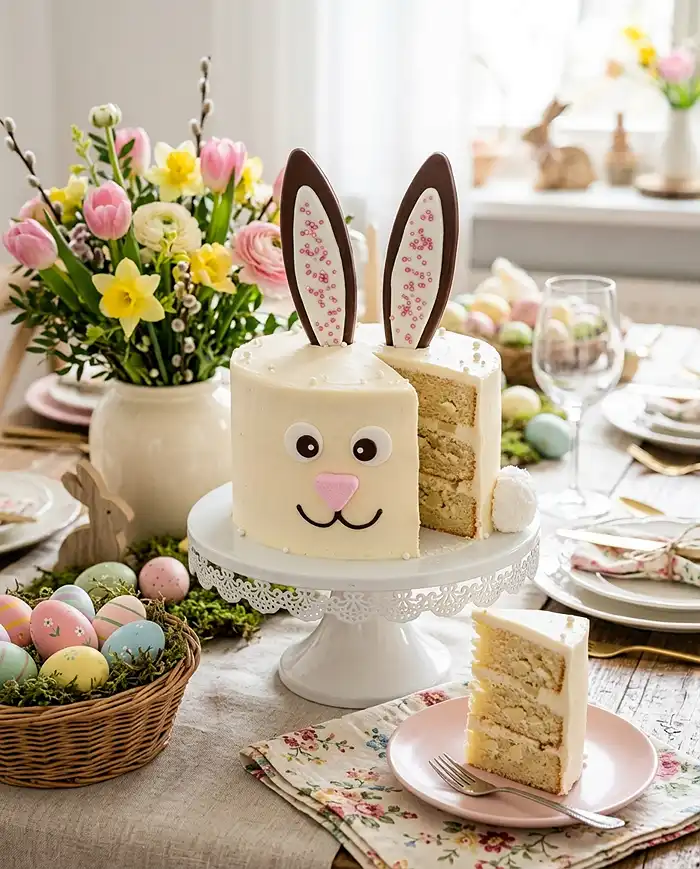
Serve this gluten-free Easter bunny cake as the centerpiece of your Easter brunch table alongside scrambled eggs, fresh fruit, and gluten-free chia pudding parfaits for a lighter dessert option. It’s also perfect for spring birthday parties, baby showers with a woodland theme, or any gathering where you want to wow kids and adults alike with a homemade cute cake that looks way more complicated than it actually is.
For a complete gluten-free Easter menu, start with gluten-free Tuscan butter salmon for an elegant main course, then end with this bunny cake and gluten-free Dubai chocolate bars for guests who want something rich and indulgent. The combination of savory, sweet, and show-stopping presentation makes for a meal no one will forget.
Ready to Make Your Easter Bunny Cake?
This Easter bunny cake gluten free has become our family’s non-negotiable Easter tradition—my niece requests it every year, and now her little brother has joined the decorating crew. The fluffy vanilla layers, creamy frosting, and those adorable chocolate ears create a dessert that’s as fun to make as it is to eat.
Try this rabbit cake recipe this weekend and let me know in the comments if you customized the decorations—did you use pink frosting, add edible flowers, or create your own chocolate ear design? Pin this to your gluten-free desserts board on Pinterest so you can find it again next Easter, and don’t forget to rate it below if it becomes your new springtime showstopper!
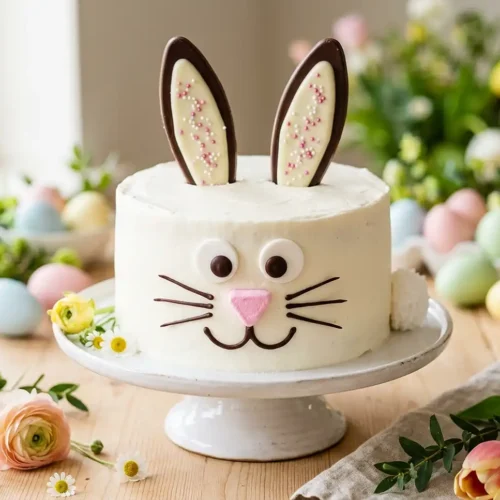
Gluten-Free Easter Bunny Cake
Equipment
- 2 x 7-inch round cake tins
- Parchment paper
- Electric mixer
- Large mixing bowl
- Spatula
- Wire cooling rack
- Toothpick
- Kitchen scale
- Grater
- Disposable piping bags
- Offset spatula or butter knife
- Small round cutter
- Paring knife
- Rolling Pin
Ingredients
For the Cake
- 225 grams Stork or dairy-free butter room temperature; about 1 cup
- 225 grams caster sugar superfine sugar; can substitute granulated
- 4 medium eggs room temperature
- 1 ½ teaspoons vanilla extract pure vanilla
- 225 grams gluten-free self-raising flour or GF all-purpose + 2 tsp baking powder
- 100 grams white chocolate grated; use dairy-free if needed
- 2 tablespoons milk dairy or non-dairy
For the Vanilla Frosting
- 175 grams Stork or dairy-free butter softened; about 3/4 cup
- 500 grams icing sugar powdered sugar; sifted if lumpy
- 1 teaspoon vanilla extract
- 1 tablespoon cooled boiled water
For Decoration
- 100 grams white chocolate melted; for ear centers
- pink sprinkles for inner ears
- white ready-to-roll icing small amount for eyes
- 1 pink marshmallow for nose
- 1 white marshmallow for tail
- 10 grams dark chocolate melted; for pupils, mouth, nose outline
- 80 grams dark chocolate melted; for ear structure
Instructions
- Grease the base and sides of 2 x 7-inch deep-sided round cake tins with Stork or dairy-free butter, then dust with gluten-free flour, tapping out any excess. Line the bottoms with parchment paper circles. Preheat your oven to 160°C fan/180°C conventional/Gas Mark 4 (about 350°F).
- In a large bowl using an electric mixer, cream together the Stork and caster sugar on medium-high speed for 4-5 minutes, until the mixture is pale, fluffy, and almost mousse-like.
- Beat in the vanilla extract, then add the eggs one at a time, beating well for 30-60 seconds after each addition before adding the next.
- Sift the gluten-free self-raising flour over the batter, then gently fold it in with a spatula using a figure-eight motion until no dry streaks remain. Fold in the grated white chocolate until evenly distributed.
- Divide the mixture equally between the two prepared tins. Bake for 35 minutes, or until the cakes are golden brown on top, springy to the touch, and a toothpick inserted in the center comes out clean or with just a few moist crumbs. Transfer the tins to a wire rack and let cool for 10 minutes, then turn out onto the rack to cool completely (at least 1 hour).
- Roll out a small piece of white ready-to-roll icing on a surface dusted with powdered sugar until about ⅛-inch thick. Use a small round cutter to cut out 2 circles for the eyes. Place them on a parchment-lined plate. Melt 10 grams of dark chocolate in the microwave in 15-second bursts, stirring between each. Use a toothpick to add a dot of dark chocolate to each white circle for pupils. Let set at room temperature for 10 minutes.
- Print or draw a bunny ear template (two elongated ovals about 4 inches tall). Lay parchment paper over the template. Melt 80 grams of dark chocolate, transfer to a piping bag, snip a small hole, and pipe the outline of each ear following the template. Fill in the outlines with more chocolate, spreading smooth with an offset spatula. Pipe a small curved mouth shape (like an upside-down Y) on separate parchment. Place everything in the fridge to set for 15 minutes.
- Once the dark chocolate ears are firm, melt 100 grams of white chocolate and transfer to a piping bag. Pipe a thin layer of white chocolate in the center of each ear (leaving a dark chocolate border), then immediately sprinkle pink sprinkles onto the wet white chocolate. Return to the fridge for 10 minutes to set completely.
- In a large bowl, beat together the softened Stork, sifted icing sugar, and vanilla extract on low speed until combined, then increase to medium-high and beat for 2-3 minutes until light and fluffy. Add the cooled boiled water and beat for another minute until smooth and spreadable.
- Place one cooled cake layer on a serving plate. Spread about ⅓ of the frosting on top in an even layer, then place the second cake layer on top, pressing gently. Use the remaining frosting to coat the top and sides of the cake with a smooth layer using an offset spatula or butter knife.
- Gently press the white icing eyes onto the front of the cake, positioning them about ⅓ of the way down from the top. Place the piped chocolate mouth below the eyes. Cut a pink marshmallow diagonally to create a triangular nose shape, and press it onto the cake just above the mouth. Cut a white marshmallow in half and press one half onto the back of the cake for the bunny tail.
- Use a sharp paring knife to cut two small slits (about 1 inch deep) in the top of the cake, angled slightly outward where you want the ears to stand. Remove the chocolate ears from the fridge and carefully peel them off the parchment. Place a small dab of frosting on the back of each ear, then gently insert the base of each ear into the slits, pressing lightly to secure.