Gluten-Free French Macarons
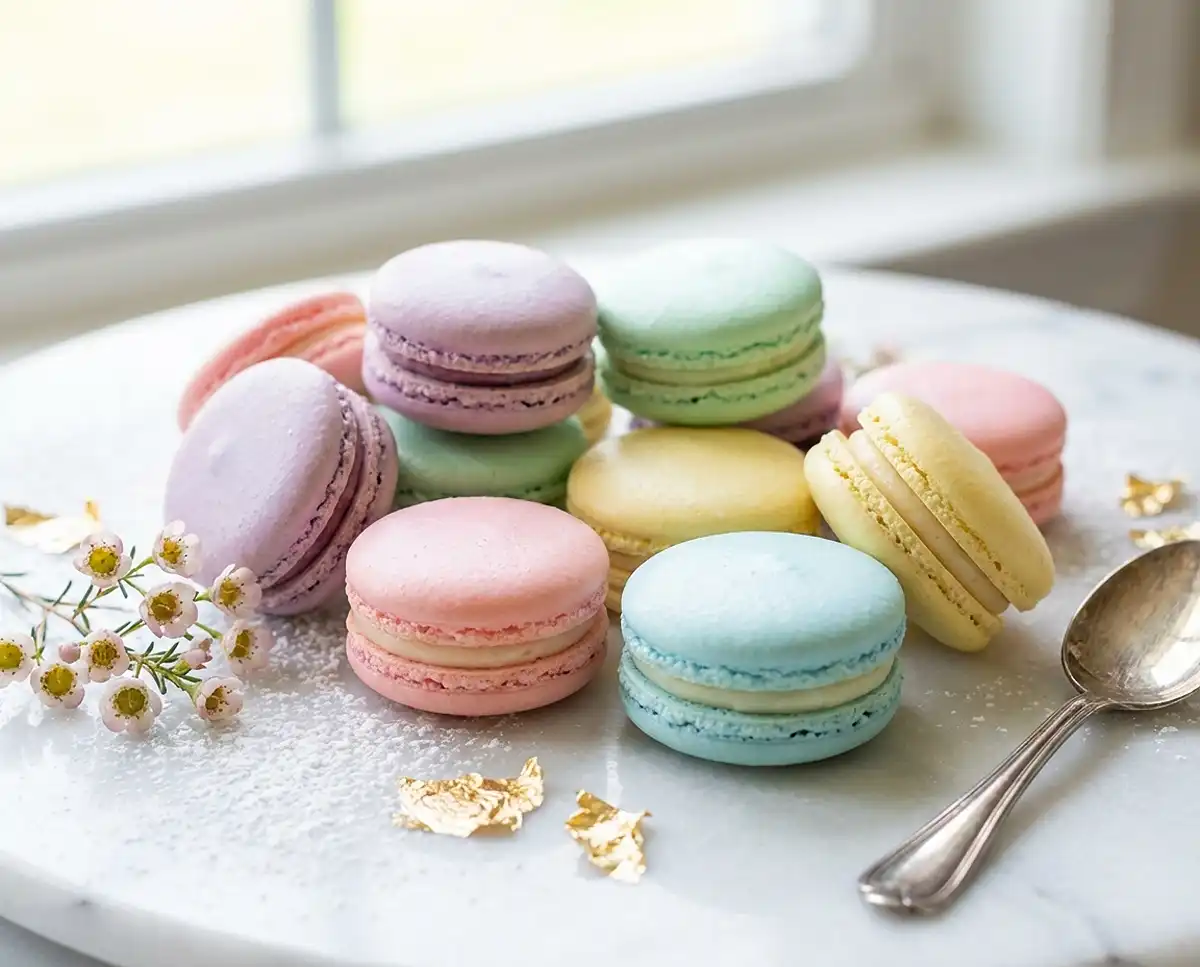
Gluten-Free French Macarons with smooth tops, ruffled feet, and chewy centers. Naturally gluten-free with almond flour—master the technique in one batch!
The first time I attempted gluten-free french macarons, I cracked every single shell trying to lift them off the parchment paper, and the “feet” (those adorable ruffled edges) looked more like flat pancakes. Well… I learned that macarons are naturally gluten-free—they’ve always been made with almond flour—but that doesn’t make them any less finicky.
After dozens of batches and countless hours watching the meringue deflate, I finally cracked the code: stiff peaks, gentle folding, and patience during the drying stage are non-negotiable. Now these pastel cookies are my secret weapon for impressing guests, and honestly? They’re easier than you think once you understand the science.
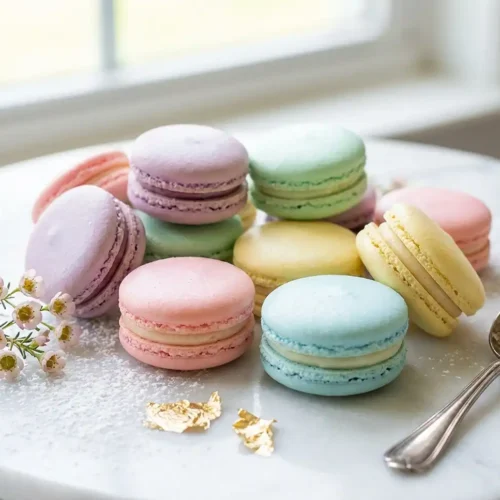
What makes a macaron truly bakery-worthy? For me, it’s that delicate shell that cracks gently to reveal a soft, chewy interior—like biting into a sweet cloud with a slight crunch. The iconic “feet” (the ruffled base) prove you’ve mastered the technique, and the smooth, glossy tops catch the light like silk. These gluten free macarons use traditional French meringue method, pure almond flour, and a technique called macaronage (the art of folding) that transforms stiff meringue into a ribbony batter that flows like lava.
Why You’ll Love These Gluten-Free French Macarons
- Texture perfection: Crisp, delicate shells with that signature “crack” when you bite down, followed by a soft, chewy center that melts on your tongue—exactly like the ones from Parisian patisseries
- Naturally gluten-free: French macarons have always been made with blanched almond flour (no wheat ever!), making them safe for celiacs when made with certified gluten-free ingredients
- Impressive but achievable: Yes, they’re finicky, but once you understand the three critical steps (stiff meringue, proper folding, drying time), you’ll nail them every single batch
- Perfect for: Wedding showers, Mother’s Day brunches, Valentine’s Day gifts, or any time you want a dessert that looks like you hired a pastry chef
The Secret to Perfect Gluten Free Macarons
Why this recipe works when others crack, hollow, or fail to develop feet:
- Stiff meringue is the foundation: Whisking egg whites with cream of tartar until they form really stiff, glossy peaks creates a stable structure that won’t deflate during folding—the science of macaronage explains how proper meringue strength prevents hollow shells and uneven rising.
- Macaronage (folding technique) controls texture: Gently folding the almond flour mixture into the meringue deflates it just enough to create a smooth, ribbony batter that flows off the spatula—under-mixed batter produces lumpy, cracked tops, while over-mixed batter spreads too thin and creates flat, foot-less cookies.
- Drying creates the signature feet: Letting the piped macarons sit at room temperature for about an hour forms a thin skin on top, which forces the batter to rise from the bottom during baking—this creates those adorable ruffled “feet” and prevents cracking.
- Blanched almond flour is naturally gluten-free: Pure almond flour (made from blanched, skinless almonds) contains zero gluten and provides the nutty flavor and fine texture that makes french macarons so distinctive—it’s been the traditional ingredient for centuries, long before gluten-free baking became mainstream.
Table of Contents
Ingredients
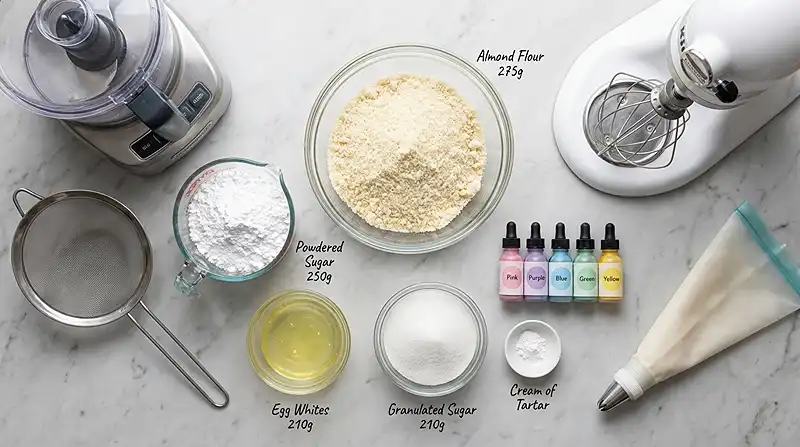
| Ingredient | Amount | Notes |
|---|---|---|
| Blanched almond flour | 275 grams (about 2¾ cups) | Must be finely ground and blanched (no skins); Bob’s Red Mill or Honeyville work well |
| Powdered sugar | 250 grams (about 2 cups) | Regular or monkfruit 1:1 powdered sugar for low-carb version |
| Egg whites | 210 grams (from 6-8 large eggs) | Aged egg whites (separated 24 hours ahead) work best |
| Granulated or superfine sugar | 210 grams (about 1 cup) | Superfine dissolves faster but granulated works |
| Cream of tartar | Pinch | Stabilizes the meringue and helps achieve stiff peaks |
| Food coloring | Optional | Gel food coloring works best; liquid can add too much moisture |
Step-by-Step Instructions
Prep Work
1. Prepare your baking sheets.
Line two large baking sheets with silicone baking mats (preferred for even heat distribution) or parchment paper. If using parchment, secure the corners with a tiny dab of batter or tape so it doesn’t shift when you pipe.
Pro Tip: Draw 2-inch circles on the parchment paper with a pencil, then flip it over so the graphite doesn’t transfer to your macarons—the circles will show through as piping guides.
Make the Dry Mixture
2. Process the almond flour and powdered sugar.
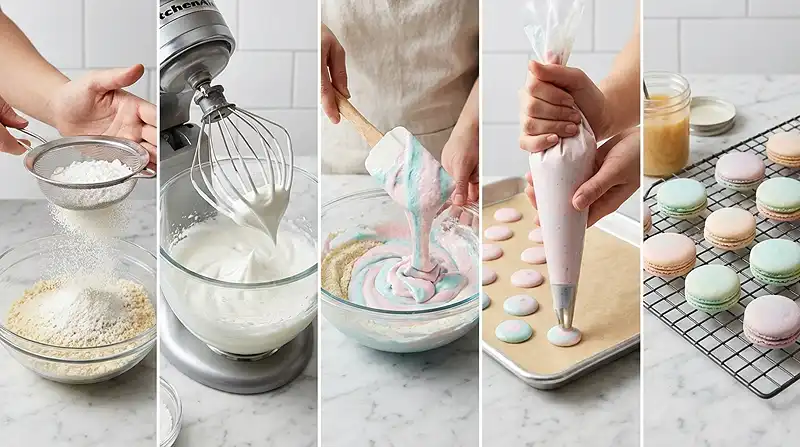
Put the almond flour and powdered sugar into a food processor and pulse 8-10 times until combined and very finely ground. This breaks up any clumps and creates an ultra-smooth texture.
3. Sift the mixture twice.
Sift the almond flour mixture through a fine-mesh sieve two times, discarding any large almond pieces that won’t pass through. This step is tedious but crucial—it’s what gives you those smooth, glossy macaron tops without lumps.
Sensory cue: The sifted mixture should feel like baby powder—impossibly fine and soft, with no gritty bits when you rub it between your fingers.
Make the Meringue
4. Whisk the egg whites until foamy.
Pour the egg whites into the bowl of a stand mixer fitted with the whisk attachment. Whisk on medium-low speed for about 1-2 minutes until the whites are foamy and full of tiny bubbles—they should look like a bubble bath.
Pro Tip: Make sure your mixing bowl and whisk are completely clean and grease-free. Even a tiny bit of fat will prevent the whites from whipping properly.
5. Add cream of tartar and whisk to soft peaks.
Add a pinch of cream of tartar to the foamy egg whites and increase the speed to medium. Whisk for 2-3 minutes until soft peaks form—when you lift the whisk, the peak should curl over gently at the tip.
6. Add the sugar gradually.
Reduce the speed to medium-low and slowly add the granulated sugar in a steady stream over about 15 seconds. Once all the sugar is added, increase the speed to high and whisk for 3-5 minutes until really stiff, glossy peaks form.
Sensory cue: The meringue should look like thick, shiny marshmallow fluff and hold a stiff peak that stands straight up when you lift the whisk—no drooping or curling. If you turn the bowl upside down, the meringue shouldn’t move at all.
Pro Tip: This is the time to add gel food coloring if you want colored macarons. Add 2-3 drops and whisk until evenly distributed.
The Macaronage (Folding)
7. Fold in the dry mixture in three additions.
Once stiff peaks have formed, turn off the mixer and sift ⅓ of the almond flour mixture over the meringue. Using a large silicone spatula, fold gently using a “J” motion—cut down through the center, scrape along the bottom, and lift up the side. Repeat this motion 10-15 times, rotating the bowl as you go.
8. Continue folding until the batter ribbons.
Add the second third of the dry mixture and fold another 10-15 times, then add the final third and fold until the batter is smooth, glossy, and flows off the spatula in thick ribbons that slowly dissolve back into the batter within 10-15 seconds. The batter should move like slowly flowing lava—not too stiff, not too runny.
Sensory cue: When you lift the spatula and let the batter fall, it should create a ribbon that sits on the surface for a moment before sinking in. If it holds its shape completely, keep folding. If it disappears instantly, you’ve over-mixed.
Pro Tip: The macaronage stage is the make-or-break moment. Most beginners under-mix (resulting in lumpy, cracked tops) or over-mix (resulting in flat, spread-out macarons with no feet). Aim for 50-60 total folds across all additions.
Pipe and Dry
9. Fill a pastry bag and pipe circles.
Transfer the batter to a pastry bag fitted with a ½-inch plain round tip. Hold the bag perpendicular to the baking sheet and pipe 2-inch circles, spacing them about 1 inch apart. The batter will spread slightly, so don’t make them too large.
Pro Tip: Apply even pressure and lift the tip straight up after each circle to avoid peaks—if you get peaks, tap them down gently with a wet fingertip.
10. Tap the sheets to release air bubbles.
Once you’ve piped all the macarons, firmly tap each baking sheet on the counter twice. This releases any trapped air bubbles that could cause cracks or hollow shells during baking.
11. Let them dry at room temperature.
Preheat your oven to 300°F while the macarons dry. Let the piped macarons sit at room temperature for about 1 hour (longer in humid weather) until they’re completely dry to the touch. When you gently press the top with your finger, it shouldn’t stick or indent—it should feel like a smooth, matte surface.
Sensory cue: The tops will lose their shine and look almost powdery when they’re ready. This skin formation is what creates the feet during baking.
Pro Tip: If your kitchen is very humid (above 60%), use a fan to speed up drying, or consider making macarons on a less humid day—moisture is the enemy of macaron success.
Bake
12. Bake one sheet at a time.
Bake 1 sheet at a time on the middle rack for 18 minutes, rotating the pan halfway through (at the 9-minute mark). The macarons should have developed feet and the tops should be set—they shouldn’t wobble when you gently touch them.
Pro Tip: Don’t open the oven door during the first 10 minutes or the macarons may collapse. After that, you can check and rotate if needed.
13. Cool completely before removing.
Let the macarons cool on the baking sheet for 10-15 minutes before carefully peeling them off. If they stick, they need to cool longer—be patient. Once cool, they should lift off cleanly.
Sensory cue: The shells will smell nutty and sweet, with a faint toasted aroma. They should feel firm but delicate when you pick them up.
14. Fill and sandwich.
Once all the macarons are baked and cooled, match them up by size. Pipe or spread your filling of choice (buttercream, ganache, jam) onto one shell, then gently sandwich with its partner. Store filled macarons in the fridge overnight before serving—they taste best after 24 hours when the filling has softened the shells slightly.
Make It Your Own: Substitutions & Variations
Try different flavors by adding 1-2 teaspoons of extract (vanilla, almond, lemon, peppermint) to the meringue along with the food coloring. You can also fold in 2 tablespoons of cocoa powder or matcha powder with the almond flour for chocolate or green tea pastel cookies.
Use monkfruit powdered sugar instead of regular powdered sugar to make these keto-friendly and lower in carbs. The texture and technique stay exactly the same—just make sure it’s a 1:1 substitute with no added fillers.
Fill with different fillings to create endless flavor combinations: dark chocolate ganache, lemon curd, raspberry jam, salted caramel buttercream, or even dairy-free strawberry mousse for an allergen-friendly option. The filling is where you can get really creative.
Man, oh man… you can also make giant 4-inch macaron shells and fill them with ice cream to create macaron ice cream sandwiches. They’re a showstopper for summer parties and Fourth of July cookouts.
Common Problems & Solutions
Problem: My macarons cracked on top during baking.
Solution: Make sure you let them dry completely before baking (they should be matte and dry to the touch), and don’t open the oven door during the first 10 minutes.
Explanation: Cracks happen when the shell hasn’t formed properly before baking, or when the oven temperature is too high. The skin needs to be set so the batter rises from the bottom instead of bursting through the top.
Problem: My macarons are hollow inside.
Solution: Make sure your meringue is whisked to really stiff peaks, and don’t over-mix during the macaronage stage.
Explanation: Hollow shells result from weak meringue or over-folding, which knocks out too much air. The meringue needs enough structure to support the shell as it bakes.
Problem: My macarons didn’t develop feet.
Solution: Let them dry longer before baking (up to 90 minutes in humid weather), and make sure your oven isn’t too hot.
Explanation: Feet form when the skin on top is dry enough that the batter is forced to rise from the bottom. If the top is still wet, the whole thing spreads outward instead of upward.
Problem: The shells stuck to the parchment paper.
Solution: Let them cool completely before trying to remove them, and use silicone baking mats instead of parchment paper if this keeps happening.
Explanation: Macarons release from the paper as they cool and firm up. Trying to peel them off while still warm will tear the bottoms. Silicone mats create more even heat distribution and less sticking.
Storage & Meal Prep
| Method | Duration | Notes |
|---|---|---|
| Counter | 2-3 days | Unfilled shells in airtight container; filled macarons not recommended at room temp |
| Fridge | 5-7 days | Filled macarons in airtight container; bring to room temp 30 min before serving |
| Freezer | 3 months | Unfilled shells freeze beautifully; separate layers with parchment |
Gluten-free french macarons actually taste better after resting in the fridge for 24 hours—the filling softens the shells slightly and the flavors meld together. Store filled macarons in a single layer in an airtight container, and let them come to room temperature for 30 minutes before serving for the best texture. Unfilled shells can be frozen for up to 3 months and filled whenever you’re ready—just thaw them at room temperature for 30 minutes, then fill and serve. This makes them perfect for make-ahead entertaining.
Gluten-Free French Macarons FAQs
Can macarons be made gluten-free?
Yes, traditional French macarons are naturally gluten-free because they’re made with almond flour, egg whites, and sugar—no wheat flour is ever used.
Can celiacs eat macarons?
Yes, celiacs can safely eat macarons made with certified gluten-free almond flour and ingredients, as the traditional recipe contains no gluten.
Is Ladurée gluten-free?
Ladurée macarons are made with traditional almond flour and should be naturally gluten-free, but Ladurée does not certify their products as gluten-free due to potential cross-contamination in their kitchens.
Can you use gluten-free almond flour for macarons?
Yes, but make sure it’s blanched almond flour (without skins) that’s finely ground—coarse almond meal won’t work.
What is surprisingly not gluten-free?
Many foods that seem naturally gluten-free—like oats, soy sauce, beer, imitation crab, and some candies—actually contain gluten or are processed on shared equipment.
Serving Suggestions
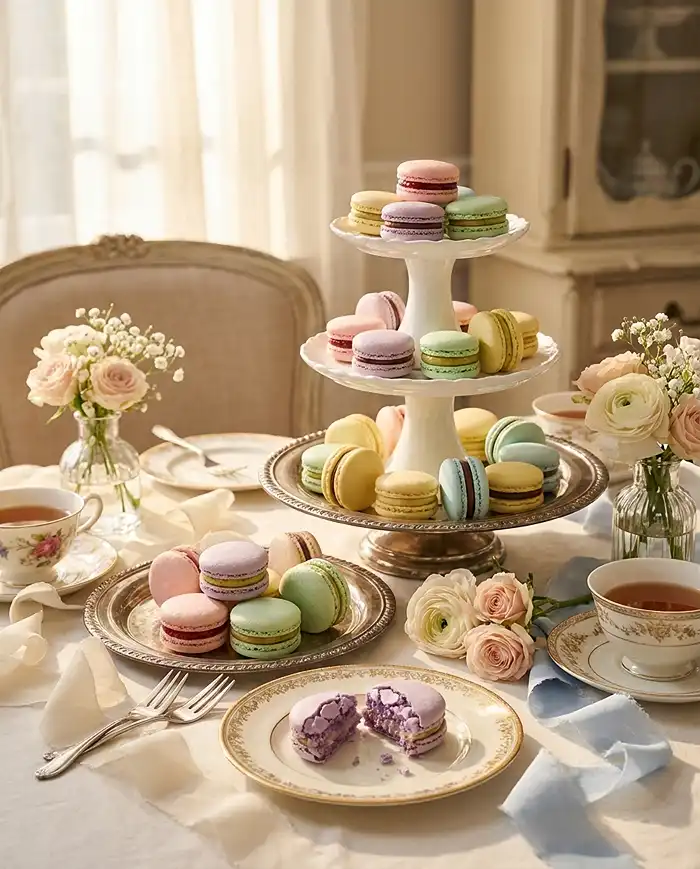
These gluten-free french macarons are stunning on a Mother’s Day brunch table, arranged in a pyramid on a tiered cake stand alongside gluten-free herb roasted chicken and a fresh spring salad. They’re also perfect for bridal showers and baby showers—package them in clear boxes tied with ribbon for elegant party favors that guests will actually eat (and remember!). For Valentine’s Day, make them in shades of pink and red, fill them with raspberry buttercream, and serve them with champagne or sparkling cider.
If you’re hosting a French-themed dinner party, serve these pastel cookies as the grand finale alongside espresso or tea, with gluten-free prosciutto and melon as an elegant appetizer. The combination of savory and sweet creates a sophisticated menu that feels restaurant-quality without the stress.
Let’s Hear From You!
Give these gluten-free french macarons a try and let me know how your first batch turns out! Did you master the macaronage on your first attempt, or did it take a few tries to get the texture right? I’d love to hear about your successes (and failures—we all have them!) in the comments below. And if you nail these bakery-perfect macarons, please pin this recipe on Pinterest so you can find it again for every special occasion. Trust me, once you master the technique, you’ll be making these for every holiday, birthday, and celebration. Happy baking!
Gluten-Free French Macarons
Equipment
- 2 large baking sheets
- Silicone baking mats or parchment paper
- Food processor
- Fine-mesh sieve
- Stand mixer with whisk attachment
- Large silicone spatula
- Pastry bag with ½-inch plain round tip
- Oven thermometer (recommended)
Ingredients
Dry Mixture
- 275 grams blanched almond flour finely ground, about 2¾ cups; Bob’s Red Mill or Honeyville recommended
- 250 grams powdered sugar about 2 cups; or monkfruit 1:1 powdered sugar for low-carb
Meringue
- 210 grams egg whites from about 6-8 large eggs; aged 24 hours preferred
- 210 grams granulated or superfine sugar about 1 cup
- 1 pinch cream of tartar stabilizes meringue
- gel food coloring optional; 2-3 drops
Instructions
- Line two large baking sheets with silicone baking mats (preferred for even heat distribution) or parchment paper. If using parchment, secure the corners with a tiny dab of batter or tape so it doesn’t shift when you pipe. Draw 2-inch circles on the parchment paper with a pencil, then flip it over so the graphite doesn’t transfer to your macarons—the circles will show through as piping guides.
- Put the almond flour and powdered sugar into a food processor and pulse 8-10 times until combined and very finely ground. This breaks up any clumps and creates an ultra-smooth texture.
- Sift the almond flour mixture through a fine-mesh sieve two times, discarding any large almond pieces that won’t pass through. This step is tedious but crucial—it’s what gives you those smooth, glossy macaron tops without lumps. The sifted mixture should feel like baby powder—impossibly fine and soft, with no gritty bits when you rub it between your fingers.
- Pour the egg whites into the bowl of a stand mixer fitted with the whisk attachment. Whisk on medium-low speed for about 1-2 minutes until the whites are foamy and full of tiny bubbles—they should look like a bubble bath. Make sure your mixing bowl and whisk are completely clean and grease-free. Even a tiny bit of fat will prevent the whites from whipping properly.
- Add a pinch of cream of tartar to the foamy egg whites and increase the speed to medium. Whisk for 2-3 minutes until soft peaks form—when you lift the whisk, the peak should curl over gently at the tip.
- Reduce the speed to medium-low and slowly add the granulated sugar in a steady stream over about 15 seconds. Once all the sugar is added, increase the speed to high and whisk for 3-5 minutes until really stiff, glossy peaks form. The meringue should look like thick, shiny marshmallow fluff and hold a stiff peak that stands straight up when you lift the whisk—no drooping or curling. If you turn the bowl upside down, the meringue shouldn’t move at all. This is the time to add gel food coloring if you want colored macarons. Add 2-3 drops and whisk until evenly distributed.
- Once stiff peaks have formed, turn off the mixer and sift ⅓ of the almond flour mixture over the meringue. Using a large silicone spatula, fold gently using a “J” motion—cut down through the center, scrape along the bottom, and lift up the side. Repeat this motion 10-15 times, rotating the bowl as you go.
- Add the second third of the dry mixture and fold another 10-15 times, then add the final third and fold until the batter is smooth, glossy, and flows off the spatula in thick ribbons that slowly dissolve back into the batter within 10-15 seconds. The batter should move like slowly flowing lava—not too stiff, not too runny. When you lift the spatula and let the batter fall, it should create a ribbon that sits on the surface for a moment before sinking in. If it holds its shape completely, keep folding. If it disappears instantly, you’ve over-mixed. The macaronage stage is the make-or-break moment. Aim for 50-60 total folds across all additions.
- Transfer the batter to a pastry bag fitted with a ½-inch plain round tip. Hold the bag perpendicular to the baking sheet and pipe 2-inch circles, spacing them about 1 inch apart. The batter will spread slightly, so don’t make them too large. Apply even pressure and lift the tip straight up after each circle to avoid peaks—if you get peaks, tap them down gently with a wet fingertip.
- Once you’ve piped all the macarons, firmly tap each baking sheet on the counter twice. This releases any trapped air bubbles that could cause cracks or hollow shells during baking.
- Preheat your oven to 300°F while the macarons dry. Let the piped macarons sit at room temperature for about 1 hour (longer in humid weather) until they’re completely dry to the touch. When you gently press the top with your finger, it shouldn’t stick or indent—it should feel like a smooth, matte surface. The tops will lose their shine and look almost powdery when they’re ready. This skin formation is what creates the feet during baking. If your kitchen is very humid (above 60%), use a fan to speed up drying, or consider making macarons on a less humid day—moisture is the enemy of macaron success.
- Bake 1 sheet at a time on the middle rack for 18 minutes, rotating the pan halfway through (at the 9-minute mark). The macarons should have developed feet and the tops should be set—they shouldn’t wobble when you gently touch them. Don’t open the oven door during the first 10 minutes or the macarons may collapse. After that, you can check and rotate if needed.
- Let the macarons cool on the baking sheet for 10-15 minutes before carefully peeling them off. If they stick, they need to cool longer—be patient. Once cool, they should lift off cleanly. The shells will smell nutty and sweet, with a faint toasted aroma. They should feel firm but delicate when you pick them up.
- Once all the macarons are baked and cooled, match them up by size. Pipe or spread your filling of choice (buttercream, ganache, jam) onto one shell, then gently sandwich with its partner. Store filled macarons in the fridge overnight before serving—they taste best after 24 hours when the filling has softened the shells slightly.