Gluten-Free Lavender Honey Cake
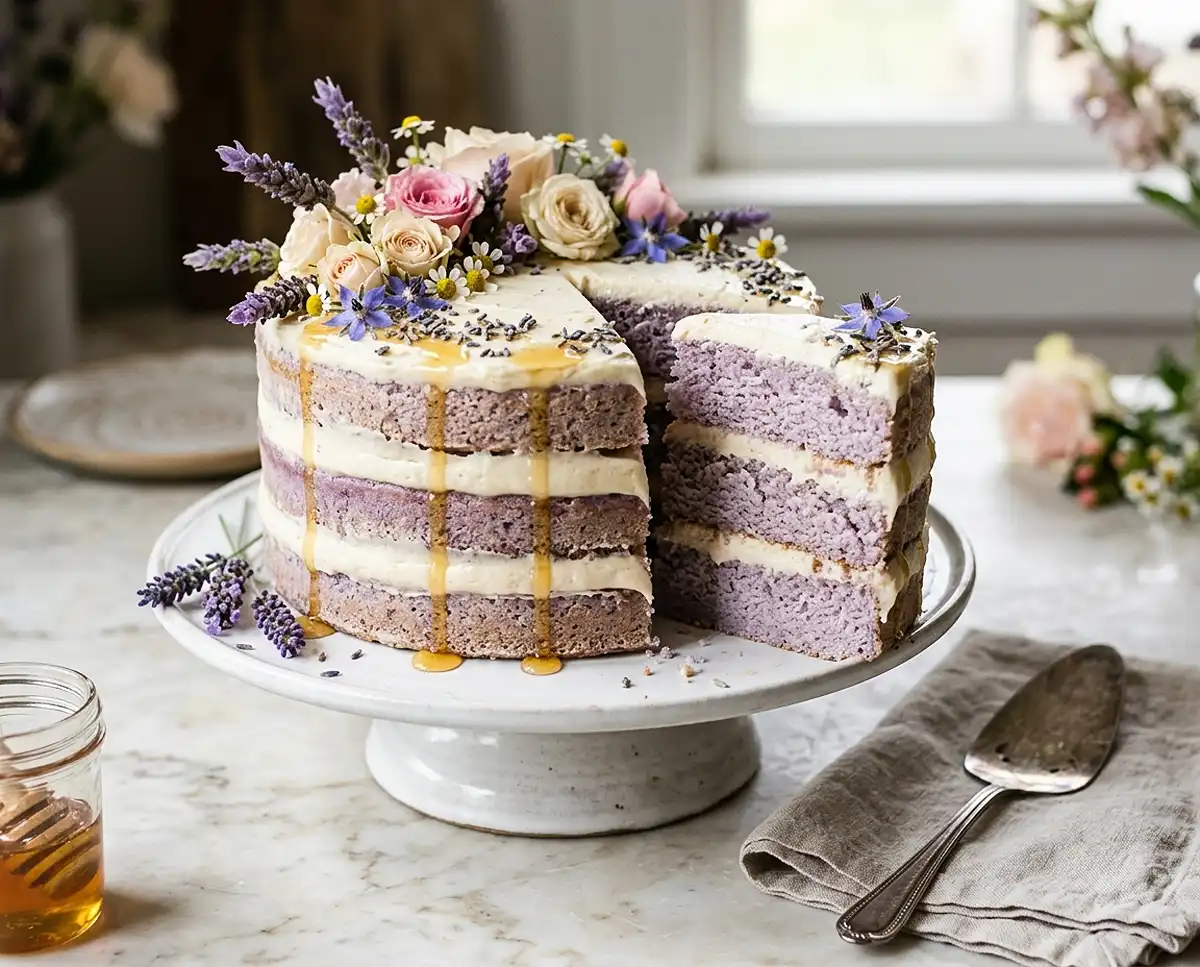
Gluten-Free Lavender Honey Cake with cashew honey frosting—ready in 30 minutes for a stunning spring celebration dessert.
Two springs ago, I made a lavender cake for my daughter’s bridal shower using regular flour and didn’t realize until halfway through baking that three of the guests had celiac disease. The panic of watching that beautiful purple cake rise while knowing half the table couldn’t eat it taught me to always have a gluten-free backup plan—and this gluten-free lavender honey cake has since become my go-to for any special occasion where I want to impress without stressing.
The magic of this floral cake is that Simple Mills cake mix provides a foolproof gluten-free base while dried culinary lavender infuses the batter with that signature perfume-like aroma that transports you straight to a Provence garden. The cashew honey frosting (naturally dairy-free!) melts on your tongue like silk, and honestly, can you think of a more elegant dessert for Mother’s Day brunch or spring weddings?
Why You’ll Love This Gluten-Free Lavender Honey Cake
- Beginner-friendly mix shortcut: Simple Mills Vanilla Cake Mix is certified gluten-free and creates a tender, moist crumb without measuring multiple flours—just blend with lavender and you’re done with the dry ingredients.
- Natural purple color option: Blending frozen blackberries into a homemade dye gives you that gorgeous lavender-purple hue without artificial food coloring or synthetic dyes.
- Dairy-free cashew frosting: Soaked cashews blended with honey, coconut oil, and lemon juice create a creamy, spreadable frosting that’s naturally dairy-free and has that signature honey-sweetness that complements lavender perfectly.
- Fast baking time: Six-inch layer cakes bake in just 15 minutes, making this a quick but impressive dessert for last-minute celebrations or when you need something special without hours of work.
The Secret to Perfect Gluten-Free Lavender Honey Cake
Blending lavender with dry mix distributes flavor evenly: Pulsing dried culinary lavender in a food processor or blender with the Simple Mills cake mix breaks up the buds and distributes the floral oils throughout the batter, preventing clumps of concentrated lavender flavor. According to trusted culinary lavender guides, grinding or blending lavender releases its essential oils gradually rather than all at once, creating a subtle perfume instead of a soapy, overpowering taste.
Blackberry juice creates natural purple dye: Heating frozen blackberries with water breaks down their cell walls and releases anthocyanins (natural purple pigments), then straining removes seeds and pulp to leave pure colored juice. This technique gives you a soft lavender-purple color that’s food-safe and natural—no Blue #1 or Red #40 needed.
Soaking cashews makes them creamy: Soaking raw cashews in water for at least 1 hour (or up to overnight) softens them so they blend into a smooth, velvety frosting instead of staying grainy or gritty. You know, the soaked cashews release starches that help emulsify with the coconut oil and honey, creating that classic buttercream texture without any dairy.
Freezing cakes prevents crumb chaos: Transferring the baked cakes to the freezer while you make the frosting (about 15-20 minutes) firms up the crumb structure so it doesn’t tear or shed crumbs when you spread on the frosting. This professional baker’s trick is the difference between messy, crumb-covered layers and clean, Instagram-worthy results.
Table of Contents
Gluten-Free Lavender Honey Cake Ingredients
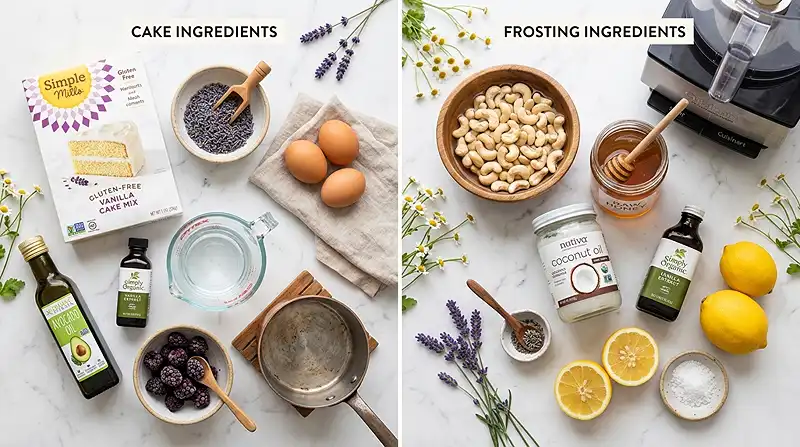
For the Lavender Cake:
- 1 box Simple Mills Vanilla Cake Mix (certified gluten-free)
- 1 tablespoon dried culinary lavender (from spice section)
- 3 large eggs
- ⅓ cup oil (avocado, melted coconut, or vegetable oil)
- ⅓ cup water (or ⅓ cup blackberry juice if dying the cake)
- 1 tablespoon vanilla extract
- 1 cup frozen blackberries (optional, for natural purple dye)
For the Cashew Honey Frosting:
- 1¾ cups raw cashews, soaked for at least 1 hour and drained
- 1 tablespoon coconut oil
- ⅓ cup honey (preferably raw or local)
- 1 teaspoon vanilla extract
- Juice of 1 lemon (preferably Meyer lemon, but regular works)
- Pinch of sea salt
For Garnish:
- Fresh or dried lavender buds, edible roses, or other edible flowers
Note: Make sure you use culinary lavender (sold as food-grade), not decorative lavender from craft stores which may be treated with pesticides. Brands like Frontier Co-op and Simply Organic offer certified organic culinary lavender.
Step-by-Step Instructions
Make the Lavender Cake
1. Preheat and prep pans
Preheat your oven to 350°F and grease two 6-inch round cake pans (or one 9-inch round pan) with butter, oil, or non-stick spray. Line the bottoms with parchment paper circles for easy removal.
2. Make optional blackberry dye
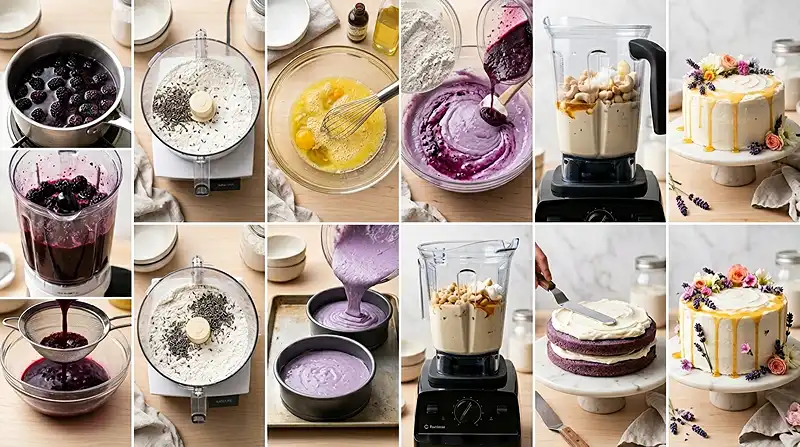
If you’re dying the cake purple, place 1 cup frozen blackberries and 2-3 tablespoons water in a small saucepan. Heat over medium until the berries are warm and beginning to break apart, about 5 minutes. Transfer to a blender and blend until smooth, then pour through a fine-mesh strainer or nut milk bag to remove seeds and pulp—you should have about ⅓ cup of purple juice. Set aside.
3. Blend dry ingredients with lavender
Add the entire box of Simple Mills Vanilla Cake Mix and 1 tablespoon dried culinary lavender to a blender or food processor. Pulse on high for 30-45 seconds until the lavender is finely ground and well distributed throughout the mix—you should see small purple flecks but no large buds.
4. Mix wet ingredients
In a separate large bowl, beat together 3 eggs, ⅓ cup oil, and 1 tablespoon vanilla extract until well combined and slightly frothy. Add either ⅓ cup water (for a natural cake color) or ⅓ cup of your strained blackberry juice (for purple cake), then whisk until smooth.
5. Combine and bake
Pour the lavender-infused dry mix into the wet ingredients and stir gently just until no dry streaks remain—don’t overmix or the cake will be dense. Divide the batter evenly between your prepared pans and bake for 12-15 minutes (for 6-inch pans) or 25-30 minutes (for a 9-inch pan), until a toothpick inserted in the center comes out clean and the edges begin to pull away from the pan.
6. Cool in freezer
Remove the cakes from the oven and immediately turn them out onto a wire cooling rack. Transfer the rack to the freezer and let the cakes chill for 15-20 minutes while you make the frosting—this firms them up for easier frosting application.
Make the Cashew Honey Frosting
7. Drain and blend cashews
Drain your soaked cashews and add them to a food processor along with 1 tablespoon coconut oil, ⅓ cup honey, 1 teaspoon vanilla extract, the juice of 1 lemon, and a pinch of sea salt. Process on high for 2-3 minutes, stopping to scrape down the sides every 30 seconds, until the frosting is completely smooth and creamy—like the texture of thick cream cheese frosting.
8. Adjust consistency and sweetness
Taste the frosting and add more honey if you prefer it sweeter (up to 2 additional tablespoons). If the frosting is too thick to spread easily, add water 1 tablespoon at a time while processing until you reach your desired texture—it should be thick enough to hold its shape but spreadable like buttercream.
Assemble the Cake
9. Frost and layer
Remove the cakes from the freezer—they should be cool to the touch but not frozen solid. Place the first layer on your serving plate and spread about ⅓ of the frosting evenly across the top. Add the second layer and use the remaining frosting to cover the top and sides, using an offset spatula or butter knife to create smooth or textured designs.
10. Garnish and serve
Decorate the top with fresh or dried lavender buds, edible roses, pansies, or any other edible flowers you love. Let the cake sit at room temperature for 15-20 minutes before slicing so the frosting softens slightly—this makes cutting and serving much easier.
Pro Tip: For the cleanest slices, wipe your knife clean with a damp cloth between each cut, and use a sharp serrated knife in a gentle sawing motion rather than pressing straight down.
Make It Your Own
Try different floral flavors: Replace the lavender with 1 tablespoon dried culinary rose petals, chamomile flowers, or hibiscus petals for different floral notes. Well, you can also combine ½ tablespoon lavender with ½ tablespoon rose for a more complex, garden-inspired flavor.
Make it a full-size cake: Use a 9-inch round pan instead of two 6-inch pans—the baking time will increase to 25-30 minutes, and you’ll have a single-layer cake that you can split horizontally if you want two layers. This works great for birthday cakes or when you need to feed more people.
Add citrus brightness: Fold 1 tablespoon lemon zest or orange zest into the batter before baking for a citrus-floral combination that tastes like spring in a cake. The zest adds bright notes that cut through the richness of the honey frosting.
Create a different frosting: Skip the cashew frosting and use traditional cream cheese frosting (8 oz cream cheese, ½ cup butter, 2 cups powdered sugar, 1 teaspoon vanilla) if you’re not dairy-free. You can also make a simple honey buttercream with butter, powdered sugar, and honey for a more traditional texture.
Skip the purple dye: Leave out the blackberry juice and just use ⅓ cup water for a natural golden cake color—the flavor will be exactly the same, just without the lavender-purple aesthetic. This is perfect if you’re short on time or don’t have blackberries on hand.
Common Problems & Solutions
Cake tastes too soapy or perfume-like
You used too much lavender or didn’t blend it finely enough, leaving large buds that release concentrated flavor. Stick to exactly 1 tablespoon for the entire cake, and make sure you pulse it in the food processor until the buds are broken into tiny pieces—you should barely be able to see individual buds in the dry mix.
Frosting is grainy instead of smooth
Your cashews weren’t soaked long enough, or your food processor isn’t powerful enough to break them down completely. Man, oh man, soak the cashews for at least 1 hour (preferably 2-3 hours or overnight), and process for a full 3-4 minutes, stopping to scrape down the sides frequently—if your machine is heating up, let it rest for 30 seconds between processing sessions.
Cake is dry and crumbly
You overbaked it or used too little liquid in the batter. Check the cakes at 12 minutes for 6-inch pans and 25 minutes for 9-inch pans—they should be just set in the center with a toothpick showing moist crumbs (not wet batter, but not bone-dry). If you accidentally added less than ⅓ cup liquid, the cake will be dense and dry.
Purple color is too dark or too light
The intensity of blackberry juice varies depending on the berries—very ripe berries produce darker juice, while less ripe ones give lighter color. If you want a deeper purple, use the full ⅓ cup of unstrained blackberry juice (with pulp), or add 1-2 drops of natural red food coloring to intensify the color.
Frosting won’t spread and keeps tearing the cake
The cakes weren’t fully cooled or chilled before frosting, or your frosting is too thick. Make sure you freeze the cakes for at least 15 minutes before frosting, and thin your frosting with 1-2 tablespoons of water if it’s too stiff to spread smoothly—it should glide onto the cake like softened butter, not pull and tear.
Storage & Meal Prep
| Method | Duration | Notes |
|---|---|---|
| Counter | 1-2 days | Cover loosely; best at room temperature |
| Refrigerator | 4-5 days | Store in airtight container; bring to room temp 30 min before serving |
| Freezer | Up to 2 months | Wrap unfrosted cakes individually; frost after thawing |
Storage tips: This gluten-free lavender honey cake stays moist at room temperature for 1-2 days thanks to the oil in the cake and the honey in the frosting. Store any leftovers in an airtight container in the refrigerator, but let the cake sit at room temperature for 30 minutes before serving so the frosting softens and the flavors bloom.
Make-ahead strategy: Bake the cake layers up to 2 days ahead and store them wrapped tightly in plastic wrap in the refrigerator, or freeze them for up to 2 months. Make the cashew frosting up to 3 days ahead and store it in the fridge—just let it come to room temperature and give it a quick stir before spreading. Assemble and frost the cake up to 1 day before your event for maximum freshness.
Gluten-Free Lavender Honey Cake FAQs
Can I use a different gluten-free cake mix?
Yes, any gluten-free vanilla or white cake mix will work—brands like King Arthur, Bob’s Red Mill, or Pamela’s are all good substitutes. Just follow the liquid ratios on that specific mix’s box, then add the 1 tablespoon lavender and blend as directed. The Simple Mills mix is my favorite because it’s grain-free and tastes incredibly moist, but others work too.
What if I can’t find culinary lavender?
Order it online from Amazon, Frontier Co-op, or Mountain Rose Herbs, or check your local health food store’s bulk herb section. Do not use lavender from craft stores, florists, or garden centers—it’s often treated with pesticides and isn’t food-safe. If you absolutely can’t find it, skip the lavender and make a simple vanilla honey cake, or substitute 1 tablespoon dried rose petals.
Can I make this cake without the blackberry dye?
Absolutely—the blackberry juice is purely for aesthetics and doesn’t affect the flavor at all. Just use ⅓ cup water instead of ⅓ cup blackberry juice, and you’ll have a golden-colored lavender cake that tastes exactly the same. The purple color is beautiful for spring celebrations, but the natural cake color is equally lovely.
How do I know if my cashew frosting is the right consistency?
The frosting should be thick enough to hold its shape when spread but soft enough to glide onto the cake without tearing it—think of the texture of cream cheese frosting or softened buttercream. If you lift your spatula and the frosting holds stiff peaks, it’s too thick (add water). If it drips off the spatula, it’s too thin (add more cashews or refrigerate for 10 minutes).
Why does my lavender cake taste like soap?
You used too much lavender, didn’t blend it finely enough, or bought low-quality lavender with a chemical-like flavor. High-quality culinary lavender from reputable sources should taste floral and slightly sweet, not soapy—if your lavender tastes soapy on its own, it’s not suitable for baking. Stick to exactly 1 tablespoon and blend it until finely ground to avoid concentrated pockets of flavor.
Serving Suggestions
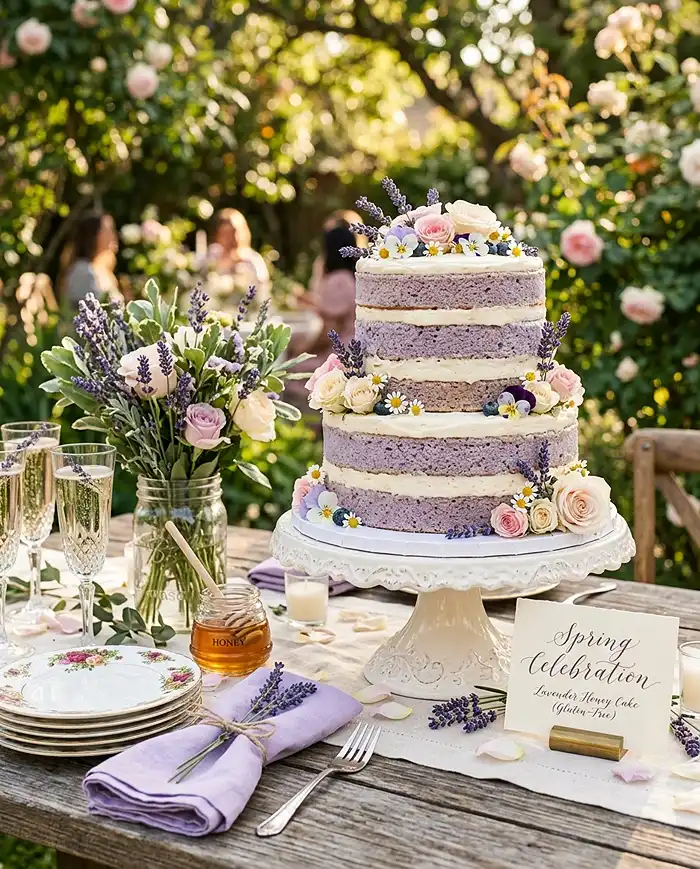
Serve this gluten-free lavender honey cake at spring and summer celebrations like Mother’s Day brunch, bridal showers, baby showers, Easter dessert tables, or garden parties where you want an elegant, floral dessert that photographs beautifully. The delicate lavender flavor pairs wonderfully with fresh berries, lemon curd, or a simple cup of chamomile tea for an afternoon tea experience.
For a complete gluten-free celebration menu, pair the lavender cake with gluten-free herb butter lobster tails for an impressive dinner, or serve it alongside gluten-free rose water pistachio cake and gluten-free brownie cookies for a stunning dessert buffet that showcases the versatility of gluten-free baking.
Bake This Floral Masterpiece Today
Give this gluten-free lavender honey cake a try for your next special occasion and let me know if it becomes your new signature dessert! Pin this recipe for spring entertaining, and drop a comment below about your favorite edible flower garnishes.
Rate the recipe after you make it, and share photos of your beautiful layered cake with the community—I love seeing everyone’s creative decorating styles. This cake proves that gluten-free baking can be just as elegant, flavorful, and celebration-worthy as any traditional dessert.
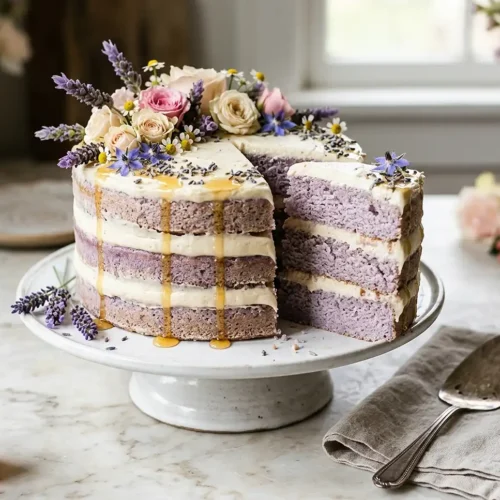
Gluten-Free Lavender Honey Cake
Equipment
- Two 6-inch round cake pans or one 9-inch round pan
- Blender or food processor
- Small saucepan (for blackberry dye, optional)
- Fine-mesh strainer or nut milk bag
- Large mixing bowl
- Whisk
- Wire cooling rack
- Offset spatula or butter knife
- Parchment paper
- Toothpick
Ingredients
For the Lavender Cake
- 1 box Simple Mills Vanilla Cake Mix certified gluten-free
- 1 tablespoon Dried culinary lavender food-grade, from spice section
- 3 Large eggs
- ⅓ cup Oil avocado, melted coconut, or vegetable oil
- ⅓ cup Water or ⅓ cup blackberry juice if dying the cake
- 1 tablespoon Vanilla extract
- 1 cup Frozen blackberries optional, for natural purple dye
For the Cashew Honey Frosting
- 1¾ cups Raw cashews soaked for at least 1 hour and drained
- 1 tablespoon Coconut oil
- ⅓ cup Honey preferably raw or local
- 1 teaspoon Vanilla extract
- 1 Lemon juice only, preferably Meyer lemon
- 1 pinch Sea salt
For Garnish
- Fresh or dried lavender buds or edible roses, pansies, or other edible flowers
Instructions
- Preheat your oven to 350°F and grease two 6-inch round cake pans (or one 9-inch round pan) with butter, oil, or non-stick spray. Line the bottoms with parchment paper circles for easy removal.
- If you’re dying the cake purple, place 1 cup frozen blackberries and 2-3 tablespoons water in a small saucepan. Heat over medium until the berries are warm and beginning to break apart, about 5 minutes. Transfer to a blender and blend until smooth, then pour through a fine-mesh strainer or nut milk bag to remove seeds and pulp—you should have about ⅓ cup of purple juice. Set aside.
- Add the entire box of Simple Mills Vanilla Cake Mix and 1 tablespoon dried culinary lavender to a blender or food processor. Pulse on high for 30-45 seconds until the lavender is finely ground and well distributed throughout the mix—you should see small purple flecks but no large buds.
- In a separate large bowl, beat together 3 eggs, ⅓ cup oil, and 1 tablespoon vanilla extract until well combined and slightly frothy. Add either ⅓ cup water (for a natural cake color) or ⅓ cup of your strained blackberry juice (for purple cake), then whisk until smooth.
- Pour the lavender-infused dry mix into the wet ingredients and stir gently just until no dry streaks remain—don’t overmix or the cake will be dense. Divide the batter evenly between your prepared pans and bake for 12-15 minutes (for 6-inch pans) or 25-30 minutes (for a 9-inch pan), until a toothpick inserted in the center comes out clean and the edges begin to pull away from the pan.
- Remove the cakes from the oven and immediately turn them out onto a wire cooling rack. Transfer the rack to the freezer and let the cakes chill for 15-20 minutes while you make the frosting—this firms them up for easier frosting application.
- Drain your soaked cashews and add them to a food processor along with 1 tablespoon coconut oil, ⅓ cup honey, 1 teaspoon vanilla extract, the juice of 1 lemon, and a pinch of sea salt. Process on high for 2-3 minutes, stopping to scrape down the sides every 30 seconds, until the frosting is completely smooth and creamy—like the texture of thick cream cheese frosting.
- Taste the frosting and add more honey if you prefer it sweeter (up to 2 additional tablespoons). If the frosting is too thick to spread easily, add water 1 tablespoon at a time while processing until you reach your desired texture—it should be thick enough to hold its shape but spreadable like buttercream.
- Remove the cakes from the freezer—they should be cool to the touch but not frozen solid. Place the first layer on your serving plate and spread about ⅓ of the frosting evenly across the top. Add the second layer and use the remaining frosting to cover the top and sides, using an offset spatula or butter knife to create smooth or textured designs.
- Decorate the top with fresh or dried lavender buds, edible roses, pansies, or any other edible flowers you love. Let the cake sit at room temperature for 15-20 minutes before slicing so the frosting softens slightly—this makes cutting and serving much easier.