Gluten-Free Quiche Lorraine
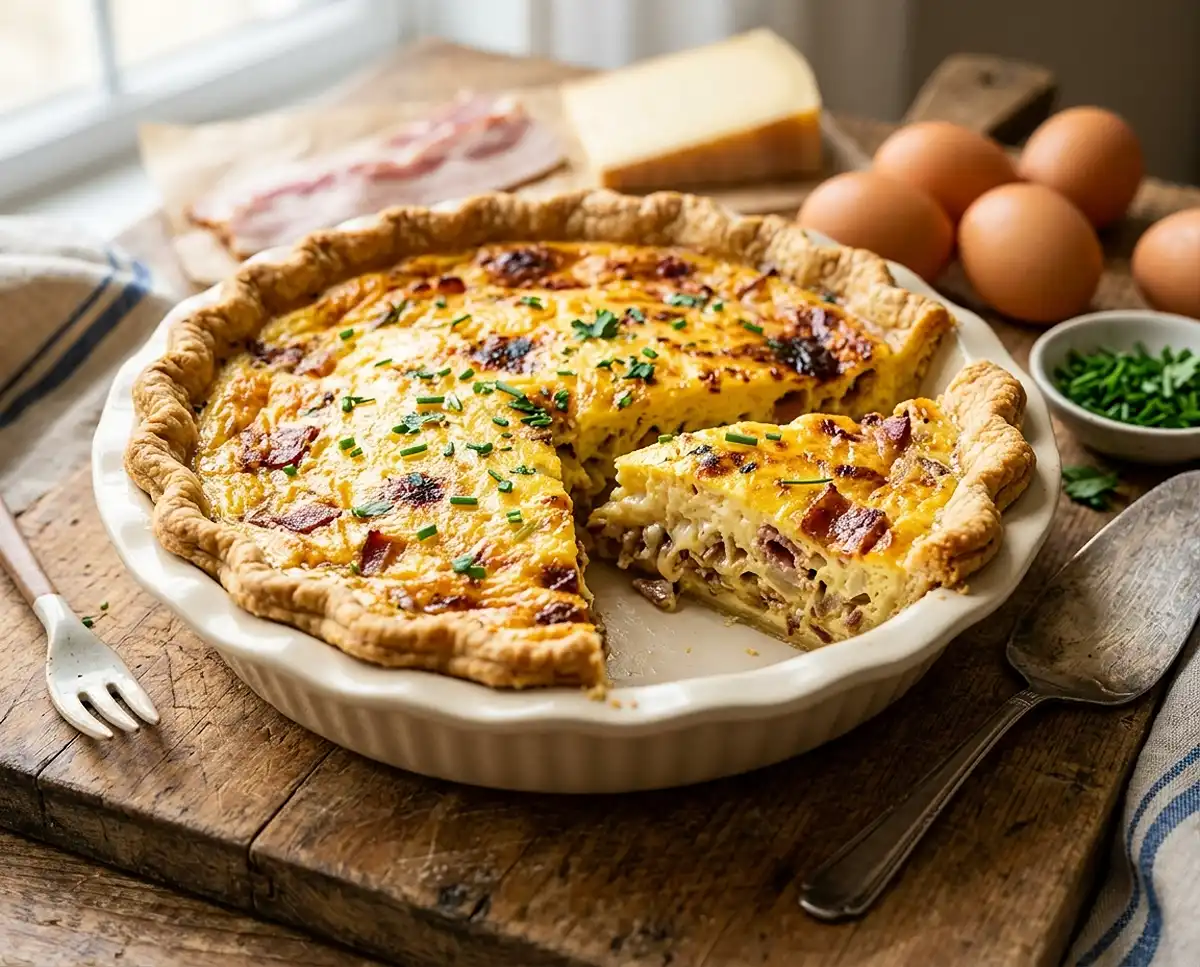
Gluten-Free Quiche Lorraine with flaky homemade crust, crispy bacon, Swiss cheese, and creamy custard. Perfect for Easter brunch—ready in 90 minutes!
Three years ago, I attempted my first gluten-free quiche for Easter brunch and ended up with a soggy-bottomed disaster that stuck to the pan like cement.
My mother-in-law politely pushed hers around her plate while I mentally catalogued every mistake—too much liquid, skipped the pre-bake, used the wrong flour blend. That failure taught me more than any cookbook ever could, and now I make this Gluten-Free Quiche Lorraine at least twice a month because it actually works.
Why You’ll Love This Gluten-Free Quiche Lorraine
- Restaurant-quality flaky crust that holds its shape and doesn’t crumble when you slice it—no gummy texture or weird aftertaste
- Beginner-friendly technique using a food processor and plastic wrap rolling method that eliminates the mess and frustration of traditional pie dough
- Make-ahead friendly so you can prep the crust up to 2 days in advance and assemble the morning of your brunch
- Naturally impressive for holiday gatherings (especially Easter, Mother’s Day, or Christmas morning) when you need something elegant that also happens to be gluten-free
The Secret to Perfect Gluten-Free Quiche Lorraine
The sour cream and vinegar trick creates gluten-like elasticity. Traditional pie crust relies on gluten strands for structure, but this combination adds tangy flavor and tenderizes the gluten-free flour blend, creating a dough that rolls out smoothly without cracking. According to the Celiac Disease Foundation’s gluten-free baking guidelines, adding acidic ingredients like vinegar or sour cream helps mimic the extensibility that gluten normally provides in pastry dough.
Pre-baking (blind baking) the crust for 10-12 minutes prevents the dreaded soggy bottom. This step creates a moisture barrier between the custard filling and the crust, ensuring every bite has that satisfying flaky crunch instead of a wet, gummy layer. The King Arthur Baking Company’s blind baking tutorial explains how this technique seals the surface of the dough before adding wet fillings—a critical step for any custard-based pie.
The flour in the custard stabilizes the eggs. Just 1 tablespoon of gluten-free flour thickens the custard slightly and prevents it from separating or weeping as it cools—a common problem in gluten-free quiches that use only eggs and cream.
Freezing the butter and dough creates steam pockets for flakiness. Cold butter doesn’t fully incorporate into the flour; instead, it creates tiny layers that puff and separate in the oven, mimicking the flaky texture of traditional pastry without needing gluten.
Table of Contents
Ingredients
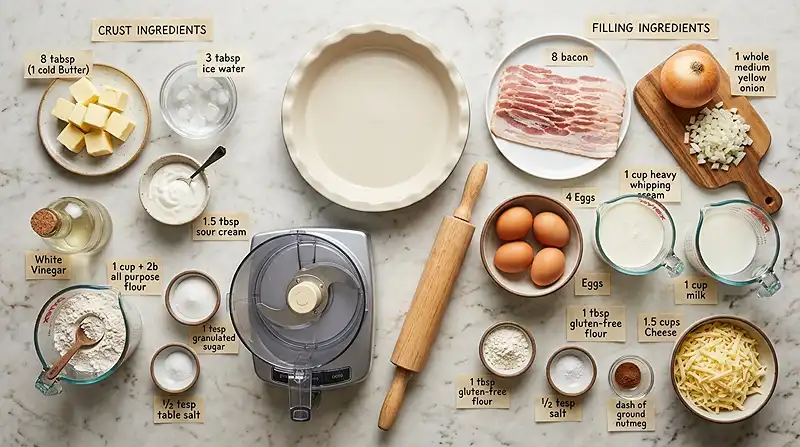
| For the Crust | Amount |
|---|---|
| Butter (1 stick) | 8 tablespoons |
| Ice water | 3 tablespoons |
| Sour cream | 1½ tablespoons |
| White vinegar or rice vinegar | 1½ teaspoons |
| Gluten-free 1:1 baking flour | 1 cup + 2 tablespoons (185g) |
| Sugar | 1 teaspoon |
| Salt | ½ teaspoon |
| For the Filling | Amount |
|---|---|
| Bacon | 8 slices |
| Medium onion, finely diced | 1 |
| Eggs | 4 |
| Heavy whipping cream | 1 cup |
| Milk | 1 cup |
| Gluten-free 1:1 baking flour | 1 tablespoon |
| Salt | ½ teaspoon |
| Nutmeg | Dash |
| Freshly shredded Swiss cheese | 1½ cups (6 oz) |
Pro Tip: Use Bob’s Red Mill 1:1 Baking Flour or King Arthur Measure for Measure for the best texture—both contain xanthan gum, which is essential for binding. Avoid blends labeled “all-purpose” without xanthan gum, or your crust will crumble.
Step-by-Step Instructions
Make the Crust
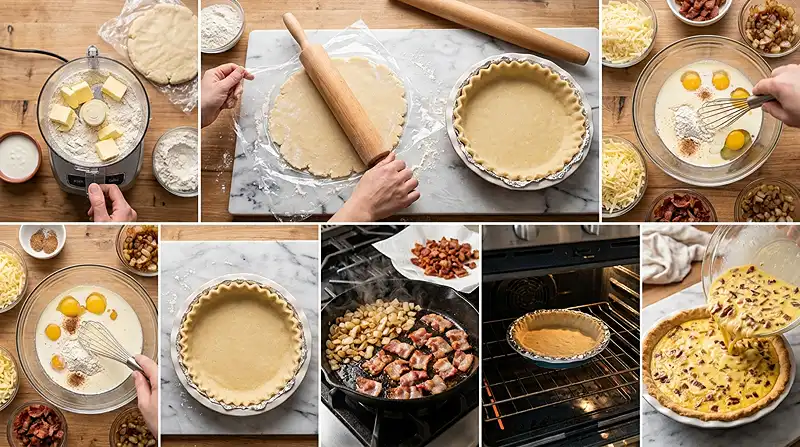
1. Freeze the butter and prep the wet ingredients.
Cut the butter into small ¼-inch pieces and freeze for 10-15 minutes until rock-solid. Meanwhile, whisk together the ice water, sour cream, and vinegar in a small bowl until smooth and set aside. This tangy mixture is what gives your crust elasticity without gluten.
2. Process the dry ingredients and butter.
Add the flour, sugar, and salt to a food processor and pulse 2-3 times to combine. Scatter the frozen butter pieces over the flour and pulse about 10 times, until the butter is the size of large peas—you should still see visible butter chunks, not a uniform powder. These butter pieces create the flaky layers.
3. Add the sour cream mixture and form the dough.
Pour in the sour cream mixture and pulse about 10 times, just until the dough begins to clump around the blade. It should look shaggy and slightly sticky, not smooth. Turn the dough out onto a piece of plastic wrap, gather it into a flat disc, and wrap tightly. Refrigerate for 1 hour or up to 2 days.
4. Roll the dough between plastic wrap.
Let the chilled dough sit at room temperature for 15 minutes to soften slightly—this prevents cracking when you roll it. Place the disc between 2 large pieces of plastic wrap and roll into a 12-inch circle about ⅛-inch thick. The plastic wrap method eliminates sticky flour messes and makes transferring the dough foolproof.
5. Transfer to the pie plate and freeze.
Remove the top piece of plastic wrap and flip the dough into a 9-inch pie plate. Gently ease the dough into the edges without stretching it, then remove the second piece of plastic. Trim any excess edges with scissors and crimp the edges as desired. Wrap the shaped crust loosely in plastic and freeze for 15 minutes until firm—this helps it hold its shape during baking.
Make the Filling
6. Cook the bacon and sauté the onion.
Cook the bacon over medium-low heat until crisp, about 8-10 minutes, then transfer to a paper-towel-lined plate to cool. Crumble once cooled. Pour off all but 2 tablespoons of bacon grease from the pan, add the diced onion, and cook over medium-high heat until softened and lightly golden, about 6-8 minutes. Let the onion cool slightly before adding to the custard.
7. Whisk the custard and combine the fillings.
In a medium bowl, whisk together the eggs, heavy cream, milk, 1 tablespoon gluten-free flour, salt, and a dash of nutmeg until completely smooth with no lumps. Stir in the shredded Swiss cheese, crumbled bacon, and cooled onion. The custard should smell rich and slightly nutty from the cheese and nutmeg.
8. Blind bake the crust.
Preheat your oven to 450°F. Press 2 layers of aluminum foil into the chilled pie crust to line it completely, gently pressing it into the edges. This weight prevents the crust from puffing up. Bake for 10-12 minutes, until the edges are just beginning to turn golden and the crust looks nearly done. This step is non-negotiable—it creates a moisture barrier that keeps your crust crispy.
9. Add the filling and bake.
Reduce the oven temperature to 325°F. Carefully pour the custard filling into the hot crust—it should come almost to the top. Bake for 45-50 minutes, until the center is set but still has a slight jiggle when you gently shake the pan. Test the middle with a knife or toothpick; it should come out clean with just a few moist crumbs.
10. Cool and serve.
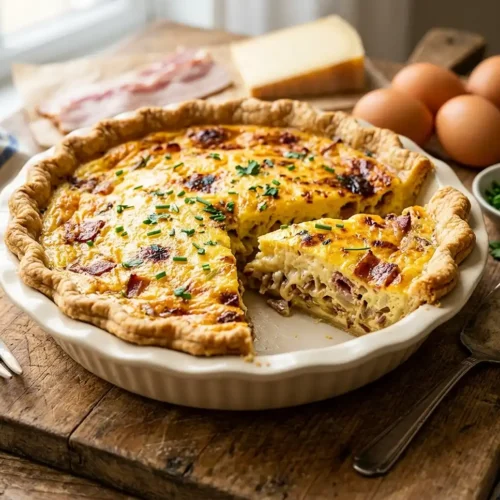
Let the quiche cool for at least 20 minutes before slicing—this allows the custard to fully set so you get clean slices instead of a runny mess. Man, oh man… that first slice, with its golden crust and creamy, bacon-studded interior, is worth every minute of wait time. This quiche is also delicious at room temperature, making it perfect for buffet-style brunches.
Make It Your Own (Substitutions & Variations)
Swap the bacon for ham, sausage, or smoked salmon. If you’re using cooked sausage, crumble about 8 ounces and skip the bacon grease step—just sauté the onion in 1 tablespoon of butter instead. Smoked salmon creates an elegant brunch quiche that pairs beautifully with capers and fresh dill.
Make it dairy-free (mostly). Replace the butter in the crust with cold vegan butter (I like Miyoko’s), swap the sour cream for dairy-free sour cream, and use full-fat coconut milk in place of the heavy cream and milk. You know… the Swiss cheese is harder to replace without losing that classic quiche Lorraine gluten free flavor, but Violife or Follow Your Heart shredded mozzarella work in a pinch.
Try different cheese combinations. Gruyère is the traditional choice and adds a slightly sweeter, nuttier flavor than Swiss. Cheddar creates a sharper, more robust quiche that pairs well with broccoli or mushrooms. For a lighter option, use half Swiss and half Parmesan—the Parmesan adds umami depth without extra richness.
Load it with vegetables. Sautéed mushrooms, baby spinach, roasted bell peppers, or blanched asparagus all work beautifully in this bacon quiche base. Add up to 1 cup of cooked, well-drained vegetables to the custard mixture—just make sure they’re completely dry or they’ll make your filling watery.
Make mini quiches for parties. Press the dough into a muffin tin instead of a pie plate, blind bake for 8 minutes at 450°F, then fill and bake for 20-25 minutes at 325°F. These individual portions are perfect for Mother’s Day brunch or holiday gatherings.
Common Problems & Solutions
Problem: My crust crumbled when I tried to roll it.
Solution: Your dough was too cold or you didn’t let it rest long enough at room temperature. Let it sit for 15-20 minutes until it’s pliable but still cool to the touch—it should feel like Play-Doh, not a brick. If it cracks while rolling, press the edges back together and keep rolling; gluten-free dough is more forgiving than you think.
Problem: The bottom crust is soggy.
Solution: You either skipped the blind bake step or didn’t bake it long enough. The crust should look dry and slightly golden before you add the filling—if it’s still pale and soft, give it another 2-3 minutes. Also, make sure your filling isn’t too liquid-heavy; if you added extra vegetables, squeeze out all moisture first.
Problem: The custard is watery or separated.
Solution: You either overbaked it or didn’t whisk the flour into the custard thoroughly. The quiche is done when the center still has a slight jiggle—it will continue to set as it cools. Well… if you accidentally overbaked it and the custard looks curdled, there’s no saving the texture, but it will still taste delicious served warm with a dollop of sour cream.
Problem: My crust shrank during baking.
Solution: You stretched the dough when transferring it to the pie plate, or you didn’t freeze it long enough before baking. Always ease the dough gently into the pan without pulling it, and give it a full 15 minutes in the freezer to relax. The gluten-free flour needs time to firm up and hold its shape.
Problem: The edges are browning too fast.
Solution: Cover the edges loosely with a pie crust shield or strips of aluminum foil after the first 25 minutes of baking at 325°F. The center needs more time to set, but the exposed edges can burn quickly in a hot oven.
Storage & Meal Prep
| Method | Duration | Notes |
|---|---|---|
| Counter | Up to 2 hours | Cover loosely; custard is at peak texture when slightly warm |
| Refrigerator | 3-4 days | Store in airtight container; crust softens slightly but filling stays creamy |
| Freezer | Up to 2 months | Wrap individual slices in plastic wrap, then foil; thaw overnight in fridge |
To reheat, place a slice on a microwave-safe plate and heat for 45-60 seconds at 50% power, or reheat in a 300°F oven for 10-12 minutes until warmed through. The oven method crisps up the crust better, but the microwave is faster for weekday breakfasts.
No-waste tip: Leftover quiche makes an excellent lunch filling for gluten-free wraps or can be crumbled over a green salad with a tangy vinaigrette. You can also freeze the unbaked crust (wrapped tightly) for up to 3 months and blind bake it straight from the freezer, adding 2-3 extra minutes to the baking time.
Gluten-Free Quiche Lorraine FAQs
Can I use a store-bought gluten-free pie crust instead?
Yes, but the texture won’t be as flaky. Most store-bought gluten-free crusts are denser and more crumbly than this homemade version, which uses sour cream and vinegar to create elasticity. If you’re short on time, look for Wholly Gluten Free or Wholly Wholesome pie shells—they’re the best I’ve found, and they’re usually in the freezer section.
What’s the best gluten-free flour for this crust?
Use a 1:1 baking flour blend that contains xanthan gum, like Bob’s Red Mill, King Arthur Measure for Measure, or Cup4Cup. Avoid single-grain flours (like rice flour alone) or blends without xanthan gum—they won’t hold together. If your blend doesn’t have xanthan gum, add ½ teaspoon to the dry ingredients.
Can I make this quiche ahead of time?
Absolutely. Assemble the entire quiche (baked crust + filling) up to 1 day ahead, cover tightly with plastic wrap, and refrigerate. Bake it the next morning, adding an extra 5-10 minutes to the bake time since it’s starting cold. You can also bake it fully, refrigerate it, and reheat slices as needed—this is my go-to for meal prep.
Why did my quiche puff up and then deflate?
That’s completely normal. The eggs in the custard create steam during baking, which causes the quiche to puff like a soufflé. As it cools, the steam escapes and the quiche settles into its final height. As long as the center is set and the top is golden, you’ve nailed it.
Can I skip the nutmeg?
You can, but nutmeg adds a subtle warmth that balances the richness of the cream and cheese—it’s one of those secret ingredients that makes people ask, “What’s in this?” If you don’t have nutmeg, a tiny pinch of white pepper or cayenne adds complexity without making it spicy.
Serving Suggestions

Serve this Gluten-Free Quiche Lorraine warm or at room temperature with a crisp green salad dressed in Dijon vinaigrette—the tangy dressing cuts through the richness of the custard beautifully. For Easter brunch or Mother’s Day, pair it with fresh berries, gluten-free strawberry cream puffs for dessert, and a DIY gluten-free avocado toast bar so guests can customize their plates. If you’re serving a crowd, round out the menu with a light, elegant gluten-free lemon raspberry tart that you can prep the day before.
Ready to Make the Best Gluten-Free Quiche?
This bacon quiche has saved me more times than I can count—it’s my go-to for last-minute brunch invitations, holiday mornings, and weekday meal prep. The flaky crust, creamy custard, and smoky bacon create a dish that tastes like it came from a French bakery, not a gluten-free kitchen.
Try it this weekend and let me know how it turns out in the comments below! Did you add vegetables? Swap the cheese? I’d love to hear your variations. And if this recipe becomes your new brunch staple, pin it to your gluten-free breakfast board on Pinterest so you can find it again when Easter or Mother’s Day rolls around.
Gluten-Free Quiche Lorraine
Equipment
- Food processor
- 9-inch pie plate
- Plastic wrap
- Rolling Pin
- Medium bowl
- Whisk
- Skillet or frying pan
- Paper towels
- Aluminum foil
- Measuring cups and spoons
- Knife or toothpick
- Scissors
Ingredients
For the Crust
- 8 tablespoons butter 1 stick
- 3 tablespoons ice water
- 1 ½ tablespoons sour cream
- 1 ½ teaspoons white vinegar or rice vinegar
- 1 cup + 2 tablespoons gluten-free 1:1 baking flour 185 grams
- 1 teaspoon sugar
- ½ teaspoon salt
For the Filling
- 8 slices bacon
- 1 medium onion finely diced
- 4 eggs
- 1 cup heavy whipping cream
- 1 cup milk
- 1 tablespoon gluten-free 1:1 baking flour
- ½ teaspoon salt
- 1 dash nutmeg
- 1 ½ cups freshly shredded Swiss cheese 6 oz
Instructions
- Cut the butter into small ¼-inch pieces and freeze for 10-15 minutes until rock-solid. Meanwhile, whisk together the ice water, sour cream, and vinegar in a small bowl until smooth and set aside.
- Add the flour, sugar, and salt to a food processor and pulse 2-3 times to combine. Scatter the frozen butter pieces over the flour and pulse about 10 times, until the butter is the size of large peas—you should still see visible butter chunks, not a uniform powder.
- Pour in the sour cream mixture and pulse about 10 times, just until the dough begins to clump around the blade. It should look shaggy and slightly sticky. Turn the dough out onto a piece of plastic wrap, gather it into a flat disc, and wrap tightly. Refrigerate for 1 hour or up to 2 days.
- Let the chilled dough sit at room temperature for 15 minutes to soften slightly. Place the disc between 2 large pieces of plastic wrap and roll into a 12-inch circle about ⅛-inch thick.
- Remove the top piece of plastic wrap and flip the dough into a 9-inch pie plate. Gently ease the dough into the edges without stretching it, then remove the second piece of plastic. Trim any excess edges with scissors and crimp the edges as desired. Wrap the shaped crust loosely in plastic and freeze for 15 minutes until firm.
- Cook the bacon over medium-low heat until crisp, about 8-10 minutes, then transfer to a paper-towel-lined plate to cool. Crumble once cooled. Pour off all but 2 tablespoons of bacon grease from the pan, add the diced onion, and cook over medium-high heat until softened and lightly golden, about 6-8 minutes. Let the onion cool slightly.
- In a medium bowl, whisk together the eggs, heavy cream, milk, 1 tablespoon gluten-free flour, salt, and a dash of nutmeg until completely smooth with no lumps. Stir in the shredded Swiss cheese, crumbled bacon, and cooled onion.
- Preheat your oven to 450°F. Press 2 layers of aluminum foil into the chilled pie crust to line it completely. Bake for 10-12 minutes, until the edges are just beginning to turn golden and the crust looks nearly done.
- Reduce the oven temperature to 325°F. Carefully pour the custard filling into the hot crust. Bake for 45-50 minutes, until the center is set but still has a slight jiggle. Test the middle with a knife or toothpick; it should come out clean with just a few moist crumbs.
- Let the quiche cool for at least 20 minutes before slicing. This quiche can also be served at room temperature. Store in the refrigerator and reheat slices individually for up to 3 days.