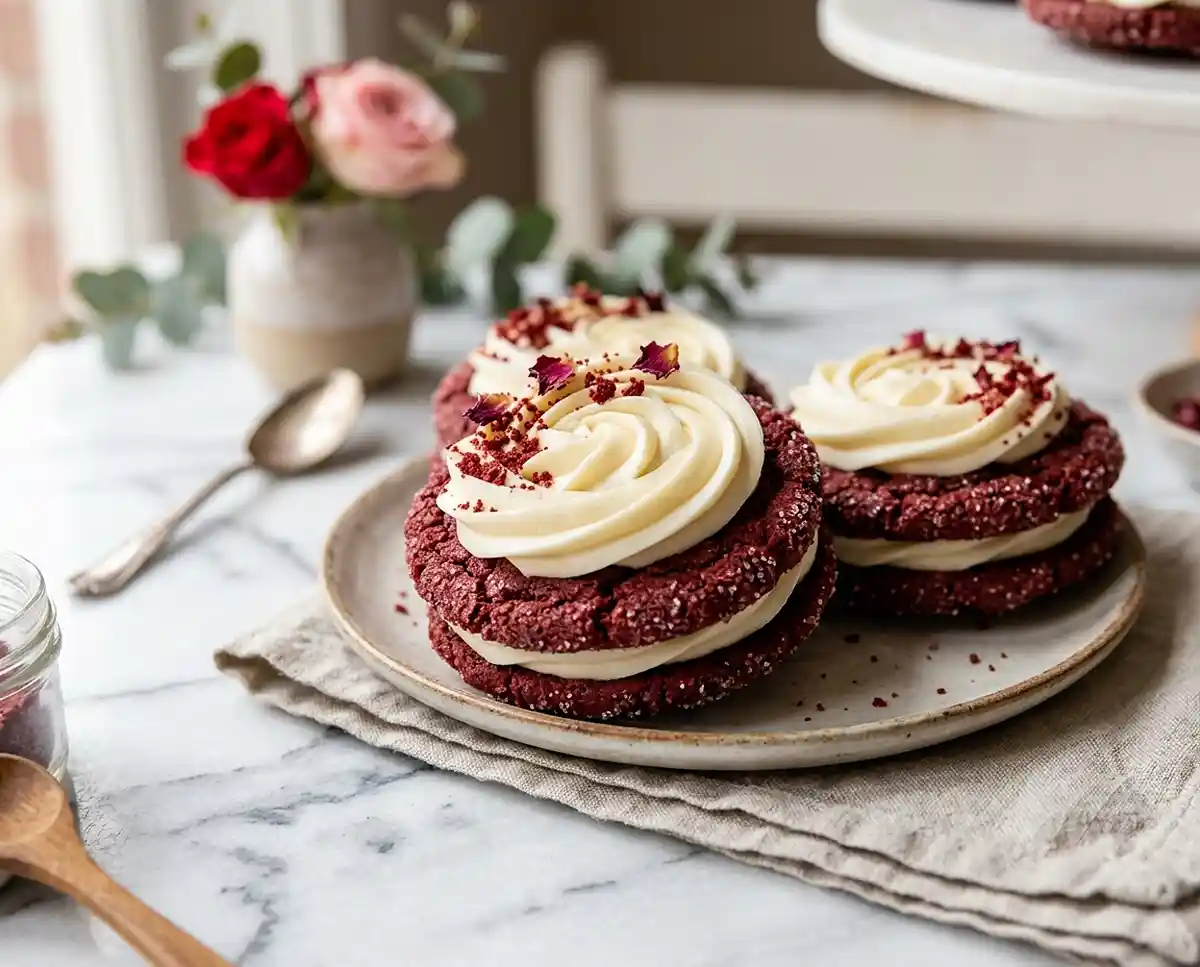
Gluten-Free Red Velvet Cookies
These gluten-free red velvet cookies feature a gooey cream cheese center and fluffy frosting. Soft, stunning, and perfect for holidays—no one will guess they’re GF!
The first time I attempted red velvet anything gluten-free, I ended up with cookies that looked like sad little hockey pucks dyed an unfortunate shade of brown-red. My daughter took one look and asked if we could just order from the bakery instead. Well… that was the push I needed to spend the next year perfecting these gluten-free red velvet cookies until they were actually better than the wheat-based versions I remembered.
What makes these cream cheese cookies so special isn’t just the vibrant color or the sweet tang of that luscious filling—it’s the texture. These come out of the oven as soft as a cloud pillow, with slightly crackled sugary tops and a center that stays impossibly tender for days. You know… the kind of cookie that makes people stop mid-bite and ask for the recipe?
Table of Contents
Why You’ll Love These Gluten-Free Red Velvet Cookies
- Soft, chewy texture that stays tender for days—no cardboard cookies here
- Beginner-friendly difficulty with clear visual cues at every step
- Stunning presentation perfect for Valentine’s Day, Christmas cookie exchanges, or impressing the in-laws
- Make-ahead friendly with dough that can be prepped in advance and frosted cookies that freeze beautifully
The Secret to Perfect Gluten-Free Red Velvet Cookies
Getting red velvet right without gluten requires understanding a few key principles that took me dozens of batches to nail down.
- Xanthan gum creates structure: Since gluten provides elasticity in traditional cookies, xanthan gum steps in to bind the dough and prevent crumbling. The ½ teaspoon here is precise—too much makes cookies gummy, too little and they’ll fall apart.
- Room temperature ingredients matter more in GF baking: Cold eggs or cream cheese won’t emulsify properly with gluten-free flours, leading to a grainy texture. According to King Arthur Baking’s gluten-free guidelines, proper ingredient temperature is even more critical without gluten to mask mixing errors.
- Apple cider vinegar activates the baking soda: This classic red velvet technique creates a tender crumb by producing carbon dioxide for lift. The acid also helps stabilize the red food coloring, keeping your cookies vibrant rather than muddy brown.
- Dutch-processed cocoa delivers the right flavor balance: Regular cocoa is too acidic and can throw off the leavening chemistry, but Dutch-processed cocoa gives that signature subtle chocolate note without competing with the tanginess of the cream cheese.
Ingredients
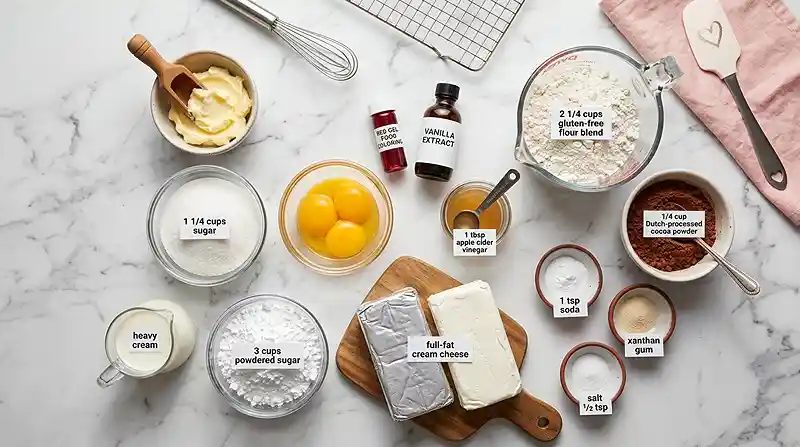
Red Velvet Cookie Dough
| Ingredient | Amount | Notes |
|---|---|---|
| Unsalted butter, softened | 115 g (1 stick) | Room temp is crucial |
| Caster/superfine or granulated sugar | 100 g (½ cup) | |
| Egg yolks, room temperature | 2 US large/UK medium | Save whites for another recipe |
| Vanilla bean paste | 1 tsp | Or 2 tsp vanilla extract |
| Gel or paste red food coloring | ½ tsp | Liquid coloring will make dough too wet |
| Apple cider vinegar | 5 g (1 tsp) | Don’t skip this |
| Plain gluten free flour blend | 220 g (1¾ cups + 1 tbsp) | See notes on flour choice below |
| Dutch processed cocoa powder | 12 g (2 tbsp) | Not regular cocoa |
| Baking soda | ½ tsp | |
| Xanthan gum | ½ tsp | Omit if your flour contains it |
| Salt | ¼ tsp |
Flour Note: I used Doves Farm Freee gluten free plain white flour without added xanthan gum. You can mix your own blend, but note that for homemade blends, 1 cup = 150g—use a digital scale for accuracy. I don’t recommend King Arthur Gluten-Free Measure for Measure Flour here, as it contains ingredients that affect the texture and spread of these cookies.
Cream Cheese Filling
| Ingredient | Amount |
|---|---|
| Full-fat cream cheese, room temperature | 115 g (½ cup) |
| Caster/superfine or granulated sugar | 25 g (2 tbsp) |
| Heavy/double cream, warm | 35 g (2½ tbsp) |
| Vanilla bean paste | ½ tsp (or 1 tsp extract) |
For Rolling
| Ingredient | Amount |
|---|---|
| Granulated sugar | 100 g (½ cup) |
Cream Cheese Frosting
| Ingredient | Amount |
|---|---|
| Heavy/double cream, cold | 120 g (½ cup) |
| Powdered/icing sugar, sifted | 60 g (½ cup) |
| Full-fat cream cheese, cold | 115 g (½ cup) |
| Vanilla bean paste | ½ tsp (or 1 tsp extract) |
Step-by-Step Instructions
Preparing Your Workspace
Adjust your oven rack to the middle position and preheat to 350°F (180°C). Line two large baking sheets with parchment paper—this prevents sticking and makes cleanup effortless.
Making the Red Velvet Cookie Dough
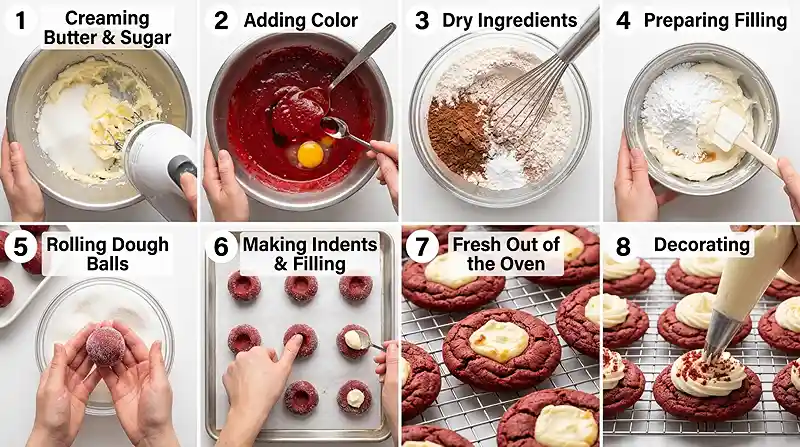
Step 1: In a large bowl, cream together the softened butter and sugar until pale and fluffy—about 3-4 minutes with a hand mixer or stand mixer with paddle attachment. You can also do this by hand with a large balloon whisk, though it takes more elbow grease. The mixture should look noticeably lighter in color.
Step 2: Add the egg yolks and vanilla, and mix well to combine. Scrape down the sides of the bowl to ensure everything incorporates evenly.
Step 3: Add the red food coloring and apple cider vinegar, mixing until the color is uniform throughout. Don’t panic when it fizzes slightly—that’s the vinegar reacting with the baking soda residue, and it’s exactly what you want.
Step 4: In a separate bowl, whisk together the gluten free flour blend, cocoa powder, xanthan gum, baking soda, and salt. Add these dry ingredients to the wet mixture.
Step 5: Mix until you get a smooth cookie dough with no flour clumps. The dough should have a scoopable consistency—firm enough to roll into balls with your hands, but not sticky to the touch. If it feels dry or crumbly, your flour measurement may have been off; if it’s sticky, add flour one tablespoon at a time.
Preparing the Cream Cheese Filling
Step 6: In a bowl, use a wooden spoon or silicone spatula to mix the room temperature cream cheese and sugar together until smooth and well combined. Work out any lumps now—they won’t disappear later.
Step 7: Add the warm heavy cream and vanilla, folding everything together into a fairly loose, smooth mixture. It should have the consistency of cheesecake filling but shouldn’t be runny.
Pro Tip: If your filling is too firm (especially with US-style block cream cheese), add an extra teaspoon or two of cream to loosen it. The filling needs to flow slightly into the cookie indent.
Assembling and Baking
Step 8: Put the granulated sugar for rolling into a small, shallow bowl. Use a 2-tablespoon cookie scoop to portion out the dough, then roll each portion between your palms to form a smooth ball.
Step 9: Roll each dough ball in the granulated sugar until evenly coated—this creates that gorgeous crackled top. Place on your lined baking sheet and use a 1-tablespoon measuring spoon to make an indent in the center of each cookie.
Step 10: Repeat until you have 12 cookies, spacing them at least 2 inches (5cm) apart. With the remaining 2 tablespoons of dough, shape one more ball and place it on the sheet without sugar coating or filling—this becomes your crumb topping later.
Step 11: Fill each indented cookie with about 2-3 teaspoons of cream cheese filling. They’ll look very full, but trust the process—the filling won’t overflow during baking.
Step 12: Bake one sheet at a time at 350°F (180°C) for 10-11 minutes. The cookies are done when they’ve spread and puffed slightly, and the cream cheese filling has set but still has a slight jiggle. The second sheet can wait at room temperature—no refrigeration needed.
Step 13: Allow cookies to cool completely on the baking sheet. They’re extremely fragile when hot, and moving them could cause crumbling. If you want perfectly round cookies, use a circular cookie cutter slightly larger than the cookie to nudge them into shape immediately out of the oven while they’re still malleable.
Making the Cream Cheese Frosting
Step 14: In a large bowl, whisk the cold heavy cream and sifted powdered sugar until soft peaks form—the mixture should hold its shape but still look billowy, not stiff.
Step 15: In a separate bowl, vigorously whisk the cold cream cheese to loosen it up. Add it to the whipped cream along with the vanilla, then fold everything together until you have a soft, fluffy frosting that holds a gentle peak. You can whisk a bit more if it needs additional thickness.
Step 16: Transfer the frosting to a piping bag fitted with your preferred tip (a large round tip works beautifully) and pipe generous swirls onto each cooled cookie.
Step 17: Crumble the unfrosted extra cookie and sprinkle those gorgeous red velvet crumbs over your frosted masterpieces. Serve immediately or store as directed below.
Make It Your Own
Dairy-Free Adaptation: Swap the butter for a quality vegan butter stick (I like Miyoko’s) and use dairy-free cream cheese for both the filling and frosting. You’ll need coconut cream instead of heavy cream—refrigerate the can overnight and use only the solid portion. The texture will be slightly different but still absolutely delicious.
Chocolate Lover’s Version: Increase the Dutch-processed cocoa powder to 20g (about 3 tablespoons) for a more intense chocolate flavor. This takes these gluten free red velvet cookies into double-chocolate territory while keeping that signature tang. Man, oh man… this variation disappears fastest at my house.
Mini Cookie Version: Use a 1-tablespoon scoop instead of 2-tablespoon, reduce filling to 1 teaspoon per cookie, and bake for 7-8 minutes. You’ll get about 24 bite-sized treats perfect for parties.
Skip the Frosting: If you’re short on time or prefer a simpler presentation, these cream cheese cookies are wonderful with just the filling—no frosting required. They’re still stunning with their sugary, crackled tops and that gooey center peeking through.
Common Problems & Solutions
Problem: My cookies spread too flat and thin.
Check that your butter wasn’t too soft or melted—it should hold a fingerprint but not be greasy. Also verify your oven temperature with a thermometer; many ovens run hot, which causes excessive spreading before the structure sets.
Problem: The filling overflowed or sank completely.
Your indent probably wasn’t deep or wide enough. Use the back of a measuring spoon to create a substantial well—don’t be shy. The filling also needs to be at the right consistency; if it’s too thin, it will run.
Problem: Cookies turned out gummy or dense.
This is almost always an overmixing issue or too much xanthan gum. Mix the dough only until the flour disappears, and measure your xanthan gum precisely. Well… if you’re using a flour blend that already contains xanthan gum and you added more, that’s your culprit.
Problem: The red color looks more brown than red.
Gel or paste food coloring is essential—liquid coloring dilutes the dough and produces a muddy hue. Also ensure you’re using Dutch-processed (not natural) cocoa, and don’t overbake. Color fades with excessive heat.
Problem: Cookies crumbled when I tried to move them.
Patience is key with gluten-free baked goods. They absolutely must cool completely on the baking sheet before handling. If they’re still crumbling after cooling, your flour ratio may have been off, or the dough was too dry from the start.
Storage & Meal Prep
| Method | Duration | Notes |
|---|---|---|
| Counter | 2-3 days | Store in airtight container, single layer with parchment between layers |
| Fridge | 5-7 days | Bring to room temperature 30 minutes before serving for best texture |
| Freezer | 2-3 months | Freeze unfrosted cookies; add frosting after thawing |
Reheating tip: For that fresh-from-the-oven softness, microwave individual cookies for 8-10 seconds. Don’t overdo it—they should feel barely warm.
Make-ahead strategy: The cookie dough can be prepared, scooped, and frozen unbaked for up to 2 months. Bake directly from frozen, adding 2-3 minutes to the bake time. The cream cheese filling can be made a day ahead and refrigerated; bring to room temperature before using.
Your Questions Answered
Can I use a different gluten-free flour blend?
Yes, but results will vary. Bob’s Red Mill 1-to-1 works reasonably well, though cookies may spread slightly more. Avoid blends heavy in coconut flour or almond flour, as they absorb moisture differently and produce a denser texture. Always weigh your flour rather than using cup measurements for consistency.
How do I know when the cookies are done?
Look for set edges and a slight puff. The cream cheese filling should no longer be liquid, and the cookie edges will look matte rather than shiny. The centers will seem underdone—that’s perfect. They firm up significantly as they cool, and overbaking is the fastest path to dry, crumbly cookies.
Why did my cream cheese frosting turn runny?
Your cream cheese or cream wasn’t cold enough. Both must come straight from the refrigerator. If it’s already runny, pop the entire bowl in the freezer for 10 minutes, then re-whip. According to Celiac Disease Foundation’s baking resources, temperature control is one of the most overlooked factors in successful gluten-free baking.
Can I make these without the cream cheese filling?
Absolutely. Skip the indent and filling, reduce bake time by 1-2 minutes, and you’ll have delicious red velvet sugar cookies. They won’t be quite as show-stopping, but they’re still wonderful dipped in white chocolate or sandwiched with the cream cheese frosting.
What’s the best red food coloring to use?
Gel or paste food coloring is essential. Americolor Super Red and Wilton Red Red are both excellent choices. Liquid food coloring adds too much moisture and produces a weaker color. If you’re avoiding artificial dyes, beet powder can work but will give a more burgundy shade.
Serving Suggestions

These gluten-free red velvet cookies are absolute showstoppers on a Valentine’s Day dessert platter or Christmas cookie exchange—the red color and white frosting swirl make them impossibly festive without any extra decoration. Pair them with a simple dairy-free matcha ice cream for a sophisticated flavor contrast, or serve alongside savory bites like gluten-free bacon wrapped dates for a party spread that covers all the cravings.
For a complete celebration dinner, these make the perfect sweet ending after a main course of gluten-free honey garlic salmon—the tangy cream cheese complements the savory-sweet salmon beautifully.
Let’s Bake Together!
I’d absolutely love to see your gluten-free red velvet cookies come to life—tag me on social media or drop a comment below with your results! If you’ve made any tweaks or discovered a brilliant variation, please share so other readers can benefit from your experience. And if these become your new holiday go-to (I have a feeling they might), save this recipe to Pinterest so you can find it whenever the craving strikes. Happy baking!
Gluten-Free Red Velvet Cookies with Cream Cheese Filling
Equipment
- Large baking sheets
- Parchment paper
- Hand mixer or stand mixer
- Large mixing bowls
- Balloon whisk
- 2-tablespoon cookie scoop
- 1-tablespoon measuring spoon
- Piping bag
- Large round piping tip
- Digital food scale
Ingredients
Red Velvet Cookie Dough
- 115 g unsalted butter softened, 1 stick
- 100 g caster/superfine or granulated sugar ½ cup
- 2 egg yolks US large/UK medium, room temperature
- 1 tsp vanilla bean paste or 2 tsp vanilla extract
- ½ tsp gel or paste red food colouring
- 5 g apple cider vinegar 1 tsp
- 220 g plain gluten free flour blend 1¾ cups + 1 tbsp, I used Doves Farm Freee gluten free plain white flour without xanthan gum
- 12 g Dutch processed cocoa powder 2 tbsp
- ½ tsp baking soda
- ½ tsp xanthan gum omit if your gluten free flour blend already contains xanthan gum
- ¼ tsp salt
Cream Cheese Filling
- 115 g full-fat cream cheese ½ cup, room temperature
- 25 g caster/superfine or granulated sugar 2 tbsp
- 35 g heavy/double cream 2½ tbsp, warm
- ½ tsp vanilla bean paste or 1 tsp vanilla extract
For Rolling
- 100 g granulated sugar ½ cup
Cream Cheese Frosting
- 120 g heavy/double cream ½ cup, cold from the fridge
- 60 g powdered/icing sugar ½ cup, sifted
- 115 g full-fat cream cheese ½ cup, cold from the fridge
- ½ tsp vanilla bean paste or 1 tsp vanilla extract
Instructions
- Adjust the oven rack to the middle position, preheat the oven to 350°F (180°C) and line two large baking sheets with parchment paper.
- In a large bowl, cream together the softened butter and sugar until pale and fluffy. You can do this by hand using a large balloon whisk, with a hand mixer fitted with the double beaters, or with a stand mixer fitted with the paddle attachment.
- Add the egg yolks and vanilla, and mix well to combine.
- Add the red food colouring and vinegar, and mix well to combine.
- In a separate bowl, whisk together the gluten free flour blend, cocoa powder, xanthan gum, baking soda and salt, and add them to the wet ingredients.
- Mix well until you get a smooth cookie dough with no flour clumps. It should have a scoopable consistency and shouldn’t be sticky to the touch. It’ll be firm enough so you can scoop it and shape it into balls with your hands, but it shouldn’t be dry or crumbly.
- For the cream cheese filling: In a bowl, using a wooden spoon or silicone spatula, mix the room temperature cream cheese and sugar together until well combined and smooth.
- Add the warm heavy/double cream and the vanilla, and fold everything together into a fairly loose, smooth mixture. It should have the consistency of cheesecake filling, but it shouldn’t be too runny. If your filling is too firm, you can add a teaspoon or two of extra cream to loosen it up.
- Put the granulated sugar into a small bowl. Use a 2-tablespoon cookie or ice cream scoop to scoop out a portion of the cookie dough. Roll it between your palms to shape it into a ball, then roll it in the granulated sugar so it’s evenly coated.
- Place the sugar-coated cookie dough ball onto the lined baking sheet, and use a 1-tablespoon measuring spoon to make an indent in the centre.
- Repeat with the rest of the cookie dough until you get 12 cookies in total. Space them at least 2 inches (5cm) apart, as they will expand and spread out slightly during baking.
- You should have 2 tablespoons of cookie dough left over – shape it into a ball and place it onto the baking sheet without rolling in sugar or filling with cream cheese. This extra cookie will be crumbled for decoration later.
- Fill the cookies with about 2-3 teaspoons of the cream cheese filling. They’ll be full to the brim but the filling won’t overflow.
- Bake the cookies, one baking sheet at a time, at 350°F (180°C) for about 10-11 minutes or until they’ve spread and puffed up slightly, and the cream cheese filling has set. Keep the other baking sheet at room temperature while baking the first batch.
- The cookies will be very soft and fragile immediately out of the oven. Allow them to cool completely to room temperature on the baking sheet. If you wish, you can correct the shape of the cookies while they’re still hot using a round cookie cutter slightly larger than the cookie diameter.
- For the cream cheese frosting: In a large bowl, whisk the heavy/double cream and powdered/icing sugar until soft peaks form.
- In a separate bowl, give the cream cheese a thorough whisk to loosen it up. Add it to the whipped cream along with the vanilla and fold everything together until you get a soft, fluffy frosting that holds a soft peak. If necessary, whisk until it thickens further.
- Transfer the cream cheese frosting to a piping bag fitted with a piping tip of your choice and pipe it onto the cooled cookies.
- Crumble up the extra cookie (baked without sugar coating and cream cheese filling) and sprinkle the cookie crumbs over the decorated cookies. Serve and enjoy!