Gluten-Free Simnel Cake
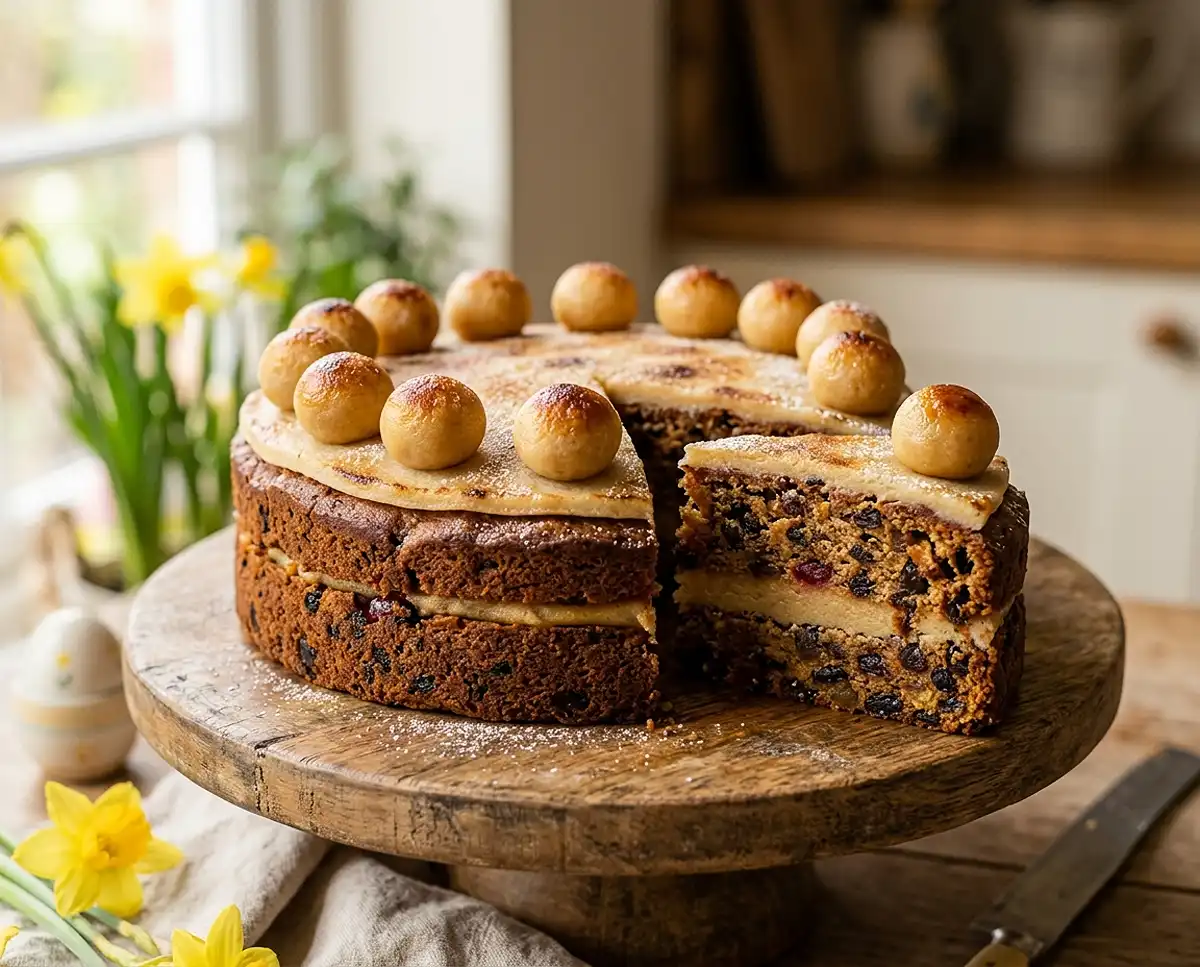
Gluten-Free Simnel Cake with marzipan layers, mixed spice, and 11 apostle balls. Traditional British Easter fruit cake ready in 2.5 hours—soft, moist, never crumbly!
The first time I tried to make a simnel cake gluten-free, I ended up with a dense, gummy brick that even my most polite dinner guests struggled to chew. I’d assumed I could just swap the flour and call it done—big mistake. After three failed attempts and a lot of research into how xanthan gum mimics gluten’s structure, I finally nailed the texture: tender, moist, and sturdy enough to support two full layers of marzipan without collapsing. Now this gluten-free simnel cake is my go-to for Easter Sunday, and nobody can tell it’s not the traditional version.
You know… there’s something deeply satisfying about slicing into this cake and revealing that perfect ribbon of marzipan running through the middle. It’s as impressive as it is delicious, and it keeps beautifully for a full week—if it lasts that long.
Why You’ll Love This Gluten-Free Simnel Cake
- Texture triumph: Tender, moist crumb with a soft bite—never gummy, never crumbly—thanks to the precise balance of xanthan gum, ground almonds, and gluten-free flour
- Beginner-friendly: No tricky techniques or specialty pans required; just mix, layer, bake, and decorate with simple marzipan shapes
- Allergen-adaptable: Easily made dairy-free by swapping butter for Stork hard margarine and using dairy-free milk—no flavor sacrifice
- Perfect for: Easter gatherings, British-themed tea parties, or any time you want a show-stopping fruit cake that feeds a crowd and stores beautifully
The Secret to Perfect Gluten-Free Simnel Cake
Why this recipe works when others crumble or turn gummy:
- Xanthan gum precision: Just ½ teaspoon provides the elasticity and structure that gluten normally gives, helping the cake hold together without feeling rubbery—King Arthur Baking explains how xanthan gum mimics gluten’s binding properties in baked goods.
- Ground almond boost: Adding 50g of ground almonds not only enhances the nutty, marzipan-like flavor but also contributes healthy fats and protein that keep the crumb tender and prevent dryness.
- Low and slow baking: Baking at 130°C fan (150°C conventional) for nearly 2 hours ensures the fruit doesn’t burn and the cake bakes evenly all the way through, avoiding the raw center that plagues gluten-free cakes.
- Marzipan moisture lock: The layer of marzipan baked into the center acts as a moisture barrier, keeping the bottom half of the cake extra soft while the top layer stays light and fluffy.
Table of Contents
Ingredients
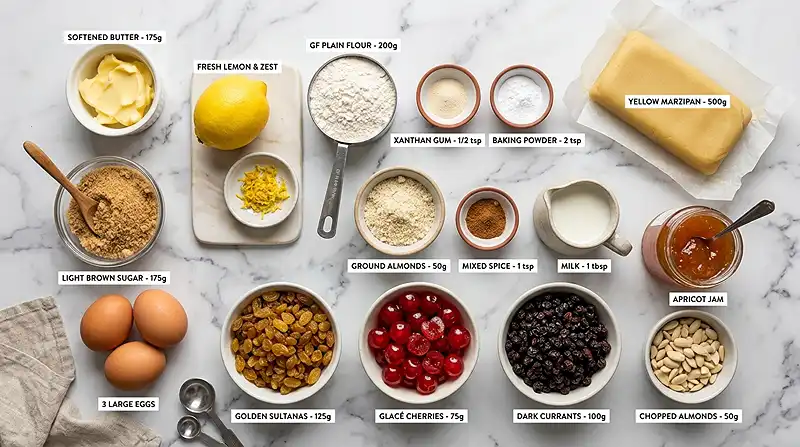
| Ingredient | Amount | Notes |
|---|---|---|
| Butter | 175 g, softened | Use Stork hard margarine if dairy-free |
| Light brown sugar | 175 g | Adds moisture and a subtle caramel note |
| Large eggs | 3 | Room temperature for easier mixing |
| Lemon zest | 1 lemon | Brightens the fruit and spice flavors |
| Gluten-free plain flour | 200 g | Use a high-quality blend like Bob’s Red Mill 1-to-1 |
| Xanthan gum | ½ tsp | Essential for structure; don’t skip this |
| Gluten-free baking powder | 1 tsp | Ensures proper rise |
| Ground almonds | 50 g | Keeps the cake moist and adds richness |
| Mixed spice | 1 tsp | Traditional British blend of cinnamon, nutmeg, cloves, ginger |
| Milk | 2 tbsp | Dairy-free if necessary |
| Sultanas | 125 g | Golden raisins work too |
| Glace cherries | 75 g | Mix of whole, halved, and chopped for even distribution |
| Currants | 100 g | Small dried grapes with concentrated sweetness |
| Blanched almonds | 50 g, chopped | Adds crunch and texture |
| Marzipan block | 500 g | Yellow or white; make sure it’s gluten-free |
| Apricot jam | 2 tbsp, warmed | Acts as edible glue for the marzipan topping |
Step-by-Step Instructions
1. Preheat and prepare your tin.
Preheat the oven to 130°C fan (150°C conventional) and prepare your 20cm loose-bottom round cake tin with non-stick baking paper on the base and the sides. This low temperature is key to preventing the fruit from burning and ensuring the cake bakes evenly all the way through without drying out.
Pro Tip: Grease the tin lightly before pressing in the parchment paper—it helps the paper stick and stay in place while you pour in the batter.
2. Cream the butter and sugar.
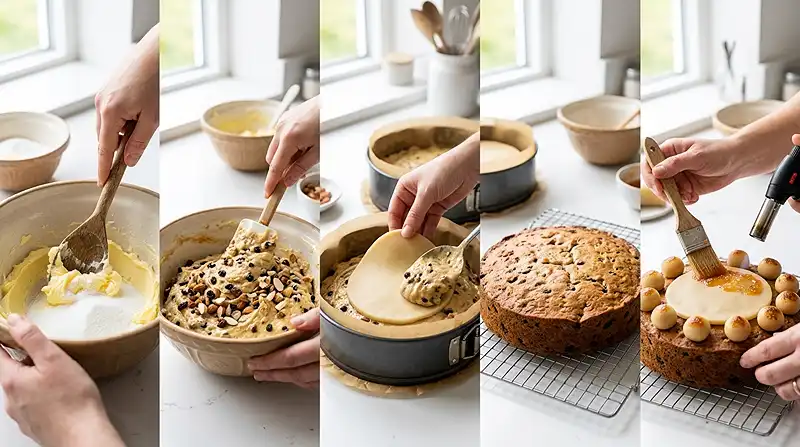
In a large bowl, cream together the softened butter and light brown sugar until combined and slightly lighter in color and texture—this takes about 2-3 minutes with an electric mixer. The mixture should look fluffy and pale, almost like soft-serve ice cream.
Sensory cue: The buttery, caramel aroma will fill your kitchen, and the texture will feel smooth and airy when you lift the beaters.
3. Add the eggs and lemon zest.
Add the eggs one at a time, briefly mixing between each addition to prevent curdling, and add in the lemon zest. If the mixture looks slightly separated, don’t worry—it will come together once you add the flour.
Pro Tip: Room temperature eggs mix more easily and create a smoother batter—leave them on the counter for 30 minutes before you start.
4. Mix in the dry ingredients.
Add the gluten-free plain flour, xanthan gum, gluten-free baking powder, mixed spice, and ground almonds, and mix once more to combine. The batter will be thick and slightly sticky—this is exactly what you want for a tender crumb.
5. Stir in the milk and fruit.
Stir in the milk to loosen the batter slightly, then carefully fold in the sultanas, currants, glace cherries (a mixture of whole, halves, and chopped more finely), and chopped blanched almonds. Ensure everything is evenly dispersed so every slice gets a generous amount of fruit and nuts.
Sensory cue: The batter will smell warm and spicy, with hints of cinnamon and citrus—like a cozy winter morning in cake form.
6. Prepare the marzipan.
Grab the marzipan block and firstly roll out 11 equal balls—mine weighed around 12g each. These represent the eleven faithful apostles (Judas is traditionally left out). With the rest of the marzipan, cut it in half and roll one half between two sheets of non-stick baking paper into a 20cm circle shape. Put the other half of the marzipan to one side for now.
Pro Tip: Dust your hands lightly with icing sugar to prevent the marzipan from sticking while you roll the balls—it makes the process much smoother.
7. Assemble the cake.
Spoon half of your cake mixture into the prepared tin and spread it out evenly, then place your circle of marzipan on top like a hidden treasure layer. Add the remaining cake mixture on top and spread it out so it’s even, covering the marzipan completely.
8. Bake low and slow.
Bake in the preheated oven for 1 hour 45 minutes to 2 hours, until a skewer inserted into the center comes out clean, the cake is well-risen, and the top is a lovely golden brown color. If the top starts to brown too quickly after 90 minutes, tent it loosely with foil.
Sensory cue: Your kitchen will smell like a British bakery at Christmas—warm spices, toasted almonds, and sweet fruit filling every corner of your home.
9. Cool completely.
Once baked, leave the cake to cool in the tin for around 30 minutes before removing it and placing it on a cooling rack to fully cool—this takes at least 1-2 hours. Resist the urge to decorate it while warm, or the apricot jam will soak in and the marzipan will slide off.
10. Level and invert (optional).
Once cooled, if the cake has a slight dome, carefully level it off with a serrated knife, then invert it onto a cake stand so the top is really flat. This gives you a perfect canvas for the marzipan topping.
11. Add the marzipan topping.
Roll out the other half of the marzipan between two sheets of baking paper so it’s a very slightly larger circle than the cake—about 21-22cm. Brush the warmed apricot jam generously over the top of the cake, then lay your marzipan circle on top and gently press down. Crimp the edges with your fingers or a fork to create a decorative border.
Pro Tip: If the marzipan tears, just press it back together with damp fingers—it’s very forgiving and no one will notice once it’s caramelized.
12. Attach the marzipan balls.
Brush a tiny amount of apricot jam on the bottom of each ball of marzipan and stick them evenly around the edge of the cake, spacing them like numbers on a clock. Traditionally, there are 11 balls to represent the apostles minus Judas.
13. Caramelize the topping (optional but stunning).
If you have a kitchen blowtorch, use it to gently caramelize the top of each ball of marzipan and the center of the cake until golden and slightly blistered. If you don’t have a torch, you can carefully place the cake under a hot grill for 1-2 minutes—watch it like a hawk so it doesn’t burn. This step is optional but adds a gorgeous toasted-almond flavor and professional bakery finish.
14. Slice and serve.
Let the caramelized topping cool for 5 minutes, then slice and enjoy. This gluten-free simnel cake will keep for a good week in an airtight container, and it can also be frozen for up to 3 months.
Make It Your Own: Substitutions & Variations
Swap the butter for Stork hard margarine (the block version, not the tub) to make this completely dairy-free. Stork bakes just like butter and won’t affect the texture or flavor—it’s a staple in British baking for a reason.
Use different dried fruits if you don’t love the traditional mix—try chopped dried apricots, cranberries, or even chopped dates for a richer, caramel-like sweetness. Just keep the total fruit weight around 300g so the batter ratio stays balanced.
Make a smaller cake by halving the recipe and using a 15cm tin—perfect for smaller households or if you just want to try it out before committing to a full-size British easter cake. Bake for about 1 hour 15 minutes and check with a skewer.
Well… you can also add a splash of brandy or rum (2-3 tablespoons) to the batter for a more traditional boozy fruit cake flavor. It enhances the spices and helps preserve the cake, and the alcohol bakes off so it’s family-friendly.
Common Problems & Solutions
Problem: My cake sank in the middle.
Solution: Make sure your oven temperature is accurate (use an oven thermometer) and don’t open the door during the first 90 minutes of baking.
Explanation: Gluten-free cakes are more delicate and need consistent heat to set properly. A sudden drop in temperature or a draft from opening the door can cause the center to collapse before the structure fully sets.
Problem: The fruit all sank to the bottom.
Solution: Toss the dried fruit and nuts in 1-2 tablespoons of gluten-free flour before folding them into the batter.
Explanation: Coating the fruit helps it stay suspended in the batter instead of sinking during baking. Chopping larger fruits like glace cherries also helps distribute them more evenly.
Problem: The cake is too dry and crumbly.
Solution: Check that you measured the flour correctly (use the spoon-and-level method, not scooping) and don’t overbake—pull it out as soon as a skewer comes out clean.
Explanation: Gluten-free flour absorbs liquid differently than wheat flour, and too much flour or overbaking will dry out the cake. The ground almonds and marzipan layer should help keep it moist, but precision matters.
Problem: The marzipan topping cracked or slid off.
Solution: Make sure the cake is completely cool before adding the apricot jam and marzipan, and use enough jam to create a tacky surface.
Explanation: If the cake is even slightly warm, the jam will soak in instead of acting as glue, and the marzipan won’t stick. Let the cake cool for at least 2 hours before decorating.
Man, oh man… if your marzipan balls refuse to brown under the grill, your broiler might not be hot enough. Just skip this step and enjoy them as-is—the cake still tastes incredible without the caramelized finish.
Storage & Meal Prep
| Method | Duration | Notes |
|---|---|---|
| Counter | 5-7 days | Store in an airtight container; flavor improves after 24 hours |
| Fridge | 2 weeks | Bring to room temperature 30 minutes before serving for best texture |
| Freezer | 3 months | Wrap tightly in cling film and foil; thaw overnight at room temperature |
This marzipan cake actually tastes better on day two or three—the flavors meld and deepen, and the texture becomes even more tender as the fruit releases its moisture. Wrap it tightly in parchment paper and store it in a tin or airtight container to keep it fresh. If you’re making it for Easter Sunday, bake it on Thursday or Friday for peak flavor. No reheating needed—just slice and serve at room temperature with a cup of tea or coffee.
Gluten-Free Simnel Cake FAQs
Why is it called a simnel cake?
The name likely comes from the Latin word “simila,” meaning fine wheat flour, though folklore claims it’s named after a couple, Simon and Nell, who argued over how to cook it. According to British Food History, simnel cakes date back to medieval times and were originally associated with Mothering Sunday before becoming an Easter tradition. The eleven marzipan balls represent the faithful apostles, making it both a delicious dessert and a symbolic centerpiece for Easter celebrations.
What is the secret to gluten-free baking?
The secret is using xanthan gum (or another binder like psyllium husk) to mimic gluten’s elasticity, plus adding moisture-rich ingredients like ground almonds or sour cream. Gluten-free flours lack the stretchy protein network that holds wheat-based cakes together, so we need binders to prevent crumbling and extra fat or liquid to prevent dryness. Measuring accurately, not overmixing, and baking at lower temperatures also help gluten-free cakes succeed where traditional methods fail.
What is a simnel cake made of?
A traditional simnel cake is a light fruit cake made with butter, sugar, eggs, dried fruits (sultanas, currants, cherries), warm spices, and two layers of marzipan—one baked inside, one on top. The gluten-free version uses gluten-free flour, xanthan gum, and ground almonds to replicate the tender crumb of the original. It’s less dense than a Christmas fruit cake but richer than a sponge cake, with a beautiful balance of sweetness, spice, and almond flavor.
What is the alternative to simnel cake?
If you don’t like marzipan, try a traditional hot cross bun loaf, a lighter lemon drizzle cake, or a spiced carrot cake for Easter. You could also make this recipe without the marzipan layers and top it with cream cheese frosting or a simple lemon glaze instead. But honestly, the marzipan is what makes a British easter cake special—if you’ve only tried cheap store-bought marzipan, give high-quality homemade or imported versions a chance. The flavor is completely different.
What is Prince William’s favorite cake?
Prince William reportedly loves chocolate biscuit cake, which was served as the groom’s cake at his wedding to Kate Middleton. It’s a no-bake treat made with crushed biscuits and chocolate ganache—completely different from simnel cake but equally delicious. However, simnel cake is a royal Easter tradition, and the British royal family has long enjoyed this classic fruit cake during the spring holiday season.
Serving Suggestions
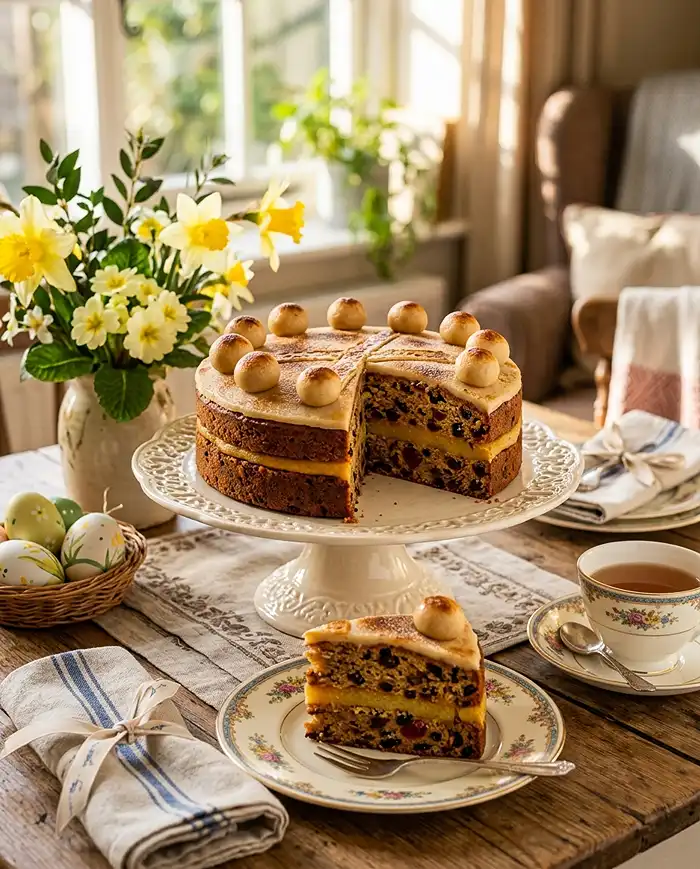
This gluten-free simnel cake is the perfect centerpiece for Easter Sunday brunch, especially when served alongside gluten-free smoked salmon pinwheels and asparagus prosciutto bundles for a savory-sweet spread. Slice it into generous wedges and serve with strong black tea or coffee—the warm spices and rich fruit flavors pair beautifully with bold, slightly bitter drinks. It’s also lovely as an afternoon tea cake, and if you’re lucky enough to have leftovers, it makes an indulgent breakfast toasted with butter.
For a complete Easter dessert table, pair this marzipan cake with dairy-free chocolate Easter eggs and fresh spring berries for a colorful, allergen-friendly feast. The contrast between the rich fruit cake and the fresh, bright flavors creates a balanced menu that satisfies everyone at the table.
Let’s Hear From You!
Give this gluten-free simnel cake a try this Easter and let me know how it turns out! Did you caramelize the marzipan topping or keep it simple? I’d love to hear your family’s reaction in the comments below—especially if you’ve never made a British easter cake before. And if you love it as much as we do (it’s become our new Easter tradition!), please pin this recipe on Pinterest so you can find it again next spring. Happy baking!
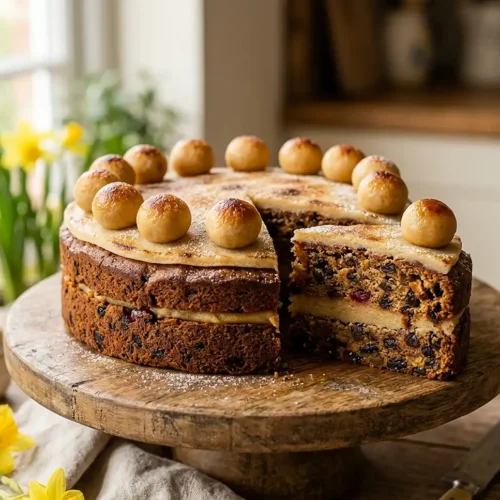
Gluten-Free Simnel Cake
Equipment
- 20cm loose-bottom round cake tin
- non-stick baking paper
- Large mixing bowl
- Electric mixer
- Rolling Pin
- Spatula
- Skewer or cake tester
- Cooling rack
- Kitchen blowtorch (optional)
- Pastry brush
Ingredients
- 175 g butter softened (use Stork hard margarine if dairy-free)
- 175 g light brown sugar
- 3 large eggs room temperature
- 1 lemon zest only
- 200 g gluten-free plain flour
- ½ tsp xanthan gum
- 1 tsp gluten-free baking powder
- 50 g ground almonds
- 1 tsp mixed spice
- 2 tbsp milk dairy-free if necessary
- 125 g sultanas
- 75 g glace cherries mix of whole, halves and chopped
- 100 g currants
- 50 g blanched almonds chopped
- 500 g marzipan yellow or white block
- 2 tbsp apricot jam warmed
Instructions
- Preheat the oven to 130°C fan (150°C conventional) and prepare your 20cm loose-bottom round cake tin with non-stick baking paper on the base and the sides. This low temperature is key to preventing the fruit from burning and ensuring the cake bakes evenly all the way through without drying out. Grease the tin lightly before pressing in the parchment paper—it helps the paper stick and stay in place while you pour in the batter.
- In a large bowl, cream together the softened butter and light brown sugar until combined and slightly lighter in color and texture—this takes about 2-3 minutes with an electric mixer. The mixture should look fluffy and pale, almost like soft-serve ice cream. The buttery, caramel aroma will fill your kitchen, and the texture will feel smooth and airy when you lift the beaters.
- Add the eggs one at a time, briefly mixing between each addition to prevent curdling, and add in the lemon zest. If the mixture looks slightly separated, don’t worry—it will come together once you add the flour. Room temperature eggs mix more easily and create a smoother batter—leave them on the counter for 30 minutes before you start.
- Add the gluten-free plain flour, xanthan gum, gluten-free baking powder, mixed spice, and ground almonds, and mix once more to combine. The batter will be thick and slightly sticky—this is exactly what you want for a tender crumb.
- Stir in the milk to loosen the batter slightly, then carefully fold in the sultanas, currants, glace cherries (a mixture of whole, halves, and chopped more finely), and chopped blanched almonds. Ensure everything is evenly dispersed so every slice gets a generous amount of fruit and nuts. The batter will smell warm and spicy, with hints of cinnamon and citrus—like a cozy winter morning in cake form.
- Grab the marzipan block and firstly roll out 11 equal balls—mine weighed around 12g each. These represent the eleven faithful apostles (Judas is traditionally left out). With the rest of the marzipan, cut it in half and roll one half between two sheets of non-stick baking paper into a 20cm circle shape. Put the other half of the marzipan to one side for now. Dust your hands lightly with icing sugar to prevent the marzipan from sticking while you roll the balls—it makes the process much smoother.
- Spoon half of your cake mixture into the prepared tin and spread it out evenly, then place your circle of marzipan on top like a hidden treasure layer. Add the remaining cake mixture on top and spread it out so it’s even, covering the marzipan completely.
- Bake in the preheated oven for 1 hour 45 minutes to 2 hours, until a skewer inserted into the center comes out clean, the cake is well-risen, and the top is a lovely golden brown color. If the top starts to brown too quickly after 90 minutes, tent it loosely with foil. Your kitchen will smell like a British bakery at Christmas—warm spices, toasted almonds, and sweet fruit filling every corner of your home.
- Once baked, leave the cake to cool in the tin for around 30 minutes before removing it and placing it on a cooling rack to fully cool—this takes at least 1-2 hours. Resist the urge to decorate it while warm, or the apricot jam will soak in and the marzipan will slide off.
- Once cooled, if the cake has a slight dome, carefully level it off with a serrated knife, then invert it onto a cake stand so the top is really flat. This gives you a perfect canvas for the marzipan topping.
- Roll out the other half of the marzipan between two sheets of baking paper so it’s a very slightly larger circle than the cake—about 21-22cm. Brush the warmed apricot jam generously over the top of the cake, then lay your marzipan circle on top and gently press down. Crimp the edges with your fingers or a fork to create a decorative border. If the marzipan tears, just press it back together with damp fingers—it’s very forgiving and no one will notice once it’s caramelized.
- Brush a tiny amount of apricot jam on the bottom of each ball of marzipan and stick them evenly around the edge of the cake, spacing them like numbers on a clock. Traditionally, there are 11 balls to represent the apostles minus Judas.
- If you have a kitchen blowtorch, use it to gently caramelize the top of each ball of marzipan and the center of the cake until golden and slightly blistered. If you don’t have a torch, you can carefully place the cake under a hot grill for 1-2 minutes—watch it like a hawk so it doesn’t burn. This step is optional but adds a gorgeous toasted-almond flavor and professional bakery finish.
- Let the caramelized topping cool for 5 minutes, then slice and enjoy. This gluten-free simnel cake will keep for a good week in an airtight container, and it can also be frozen for up to 3 months.