Gluten-Free Whole Roast Duck
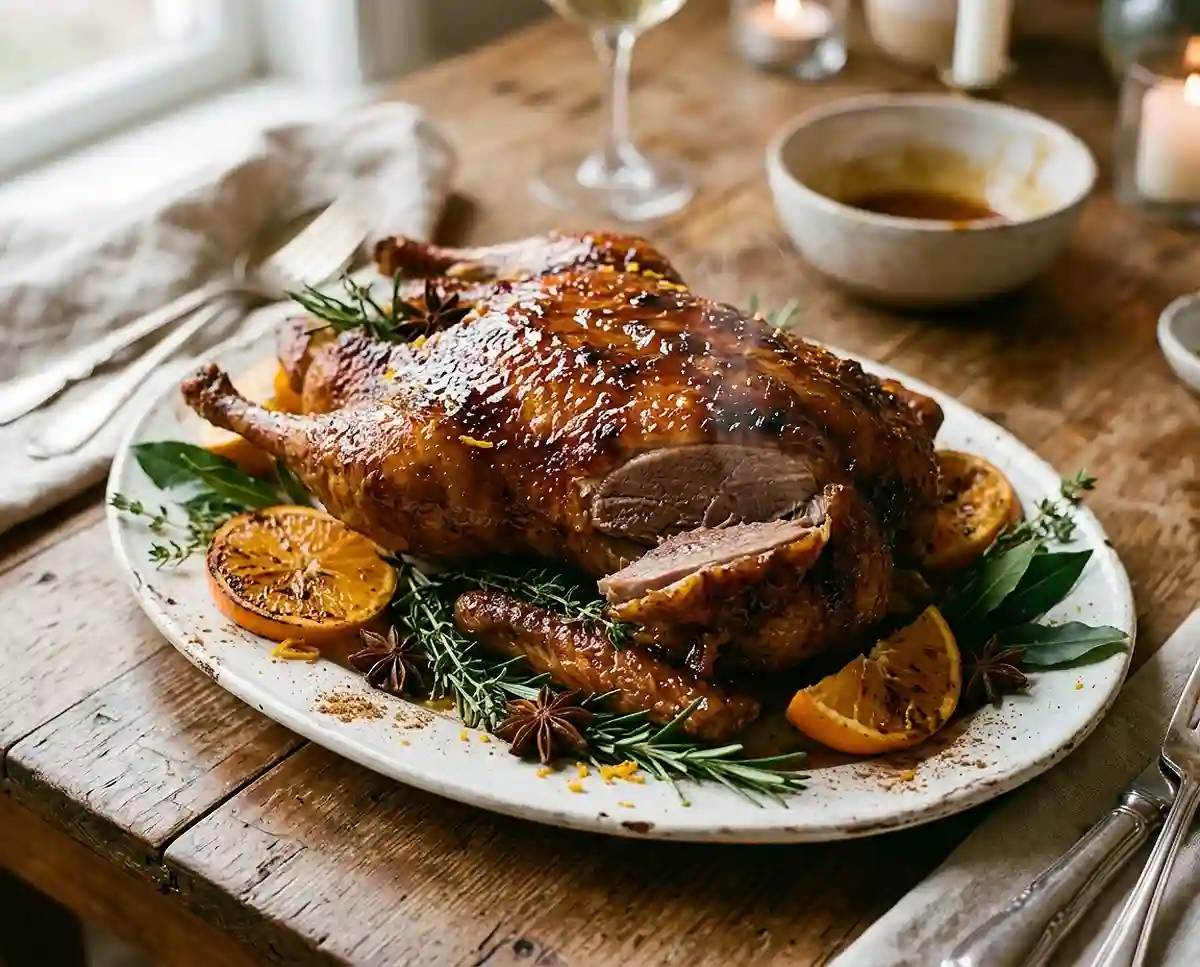
Gluten-Free Whole Roast Duck with Orange Glaze—crispy golden skin, tender meat, five-spice citrus glaze. Easter dinner alternative in 3 hours!
Four years ago, I attempted to roast my first duck for Easter dinner and skipped the crucial step of pricking the skin—I ended up with a greasy, flabby bird that looked more like a deflated balloon than a holiday centerpiece.
That embarrassing failure taught me that gluten-free whole roast duck with orange glaze isn’t about fancy techniques or expensive equipment—it’s about understanding duck’s unique anatomy and rendering out the fat slowly so the skin crisps up like parchment while the meat stays succulent. Have you ever bitten into duck skin so crispy it shatters like glass, then tasted meat so tender it falls off the bone with just a fork?
Why You’ll Love This Gluten-Free Whole Roast Duck
- Glass-crisp skin with zero greasiness—the multi-flip roasting method renders out excess fat while creating a golden, crackling exterior
- Naturally gluten-free with bold Asian flavors—coconut aminos or gluten-free soy sauce, star anise, and five-spice create a glaze that’s both exotic and comforting
- Impressive presentation for special occasions—a whole roasted bird with glistening glaze looks like it came from a Michelin-starred kitchen
- Easier than you think with only 15 minutes of active work—the oven does all the heavy lifting over 2.5-3 hours
The Secret to Perfect Gluten-Free Whole Roast Duck
Drying the skin thoroughly before roasting is the foundation of crispiness. Duck skin is fatty and moisture-laden, so patting it completely dry with paper towels (or even air-drying it uncovered in the fridge overnight) removes surface water that would otherwise steam the skin instead of crisping it. According to Serious Eats’ guide to crispy duck, dry skin browns faster and more evenly because water must evaporate before the Maillard reaction can begin.
Flipping the duck twice during roasting ensures even fat rendering and browning. Duck has a thick layer of fat under the skin, especially on the breast, and cooking it in one position leaves one side soggy while the other crisps. Starting breast-up for the first hour, then flipping breast-down for 45 minutes, then finishing breast-up again allows gravity to help drain the fat while exposing all surfaces to direct heat.
The orange-five-spice glaze adds complexity without overpowering the duck. Star anise and five-spice powder (a blend of star anise, cloves, cinnamon, Sichuan pepper, and fennel) create warm, aromatic notes that complement duck’s richness, while orange juice and zest add brightness. The gluten-free soy sauce or coconut aminos provides umami depth and helps the glaze caramelize into a sticky, lacquered coating.
Resting the duck after roasting redistributes juices and firms up the skin. Cutting into duck immediately causes all the flavorful juices to run out onto the cutting board, leaving you with dry meat. A 10-15 minute rest allows the muscle fibers to relax and reabsorb moisture, while the skin continues to crisp slightly as it cools.
Table of Contents
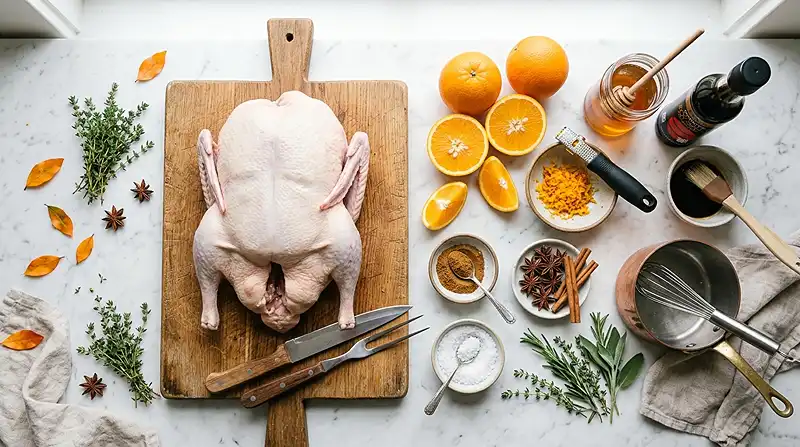
Ingredients
| For the Duck | Amount | Notes |
|---|---|---|
| Whole duck | 1 (about 6 lbs / 2.7 kg) | Cleaned and patted dry; Pekin duck typical |
| Salt | To taste | Kosher or sea salt for seasoning |
| For the Orange Glaze | Amount | Notes |
|---|---|---|
| Orange zest | 1 orange | Use microplane for fine zest |
| Fresh orange juice | ⅓ cup | From 1-2 oranges; freshly squeezed |
| Honey or maple syrup | 1-2 tablespoons | Adjust to taste |
| Star anise | 1 whole | Whole pod for infusing |
| Five-spice powder | ¼ teaspoon | Chinese five-spice blend |
| Gluten-free soy sauce or coconut aminos | ¼ cup | Tamari or coconut aminos work |
Pro Tip: If you can’t find a 6-pound duck, a 4-5 pound bird works too—just reduce the total roasting time by 15-20 minutes and check for doneness with a thermometer (165°F in the thigh).
Step-by-Step Instructions
Prepare and Season the Duck
1. Dry the duck thoroughly.
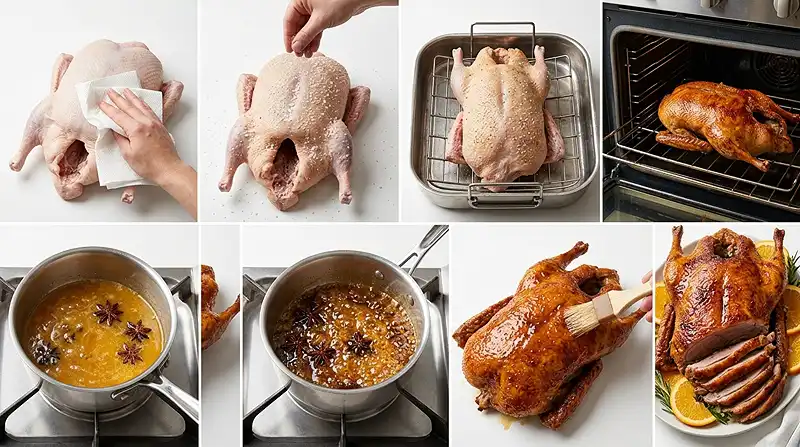
Remove the duck from its packaging and drain any liquid. Use paper towels to pat the entire surface dry—inside the cavity, all over the skin, under the wings, and around the legs. The skin should feel tacky and slightly leathery, not wet or slippery. If you have time, place the duck uncovered on a rack in the fridge overnight to air-dry for maximum crispiness.
2. Season generously.
Preheat your oven to 375°F (190°C). Season the duck inside and out with a generous amount of salt—use about 1-2 tablespoons total, rubbing it into the skin and cavity. Don’t be shy with the salt; duck is a rich, fatty bird that can handle bold seasoning.
3. Set up the roasting rack.
Place a wire rack inside a large roasting pan to elevate the duck above the drippings (this prevents the bottom from steaming). Position the duck breast-side up on the rack, tucking the wing tips under the body so they don’t burn.
Roast the Duck
4. First roast phase (1 hour, breast-up).
Slide the roasting pan into the preheated oven and roast for 1 hour. During this phase, the fat will begin rendering and the skin will start to tighten and brown. After 1 hour, carefully remove the pan and use a turkey baster or ladle to drain the rendered fat from the bottom of the pan into a heatproof container—save this liquid gold for roasting potatoes later!
5. Flip and roast breast-down (45 minutes).
Using tongs and a large spatula (or two spatulas), carefully flip the duck so it’s breast-side down. Return it to the oven and roast for 45 minutes. This position allows the breast fat to continue rendering while the back crisps up. The duck will release more fat during this phase, so don’t be alarmed if the pan fills up again.
6. Final flip and roast breast-up (30-45 minutes).
Drain the fat again, then flip the duck back to breast-side up for the final roasting phase. Roast for another 30-45 minutes, until the skin is deeply golden and crispy all over. The duck is done when an instant-read thermometer inserted into the thickest part of the thigh reads 165°F and the juices run clear.
Make the Orange Glaze and Finish
7. Simmer the glaze.
While the duck finishes roasting, combine the orange zest, orange juice, honey (or maple syrup), star anise, five-spice powder, and gluten-free soy sauce (or coconut aminos) in a small saucepan. Bring to a simmer over medium heat, then reduce to low and cook for 8-10 minutes, stirring occasionally, until the glaze has thickened slightly and coats the back of a spoon. Remove the star anise before using.
8. Glaze the duck.
During the last 15 minutes of roasting, brush the duck generously all over with the orange glaze using a pastry brush. Return it to the oven and let the glaze caramelize into a shiny, sticky coating. Man, oh man… the smell of orange, star anise, and caramelizing duck fat is intoxicating—your kitchen will smell like a Chinese restaurant in the best way.
9. Rest and carve.
Remove the duck from the oven and transfer it to a cutting board. Tent it loosely with aluminum foil and let it rest for 10-15 minutes before carving. This resting period allows the juices to redistribute so every slice is moist and flavorful. Carve the duck by removing the legs and thighs first, then slicing the breast meat against the grain into thin slices. Serve with the remaining warm glaze drizzled over top.
Make It Your Own (Substitutions & Variations)
Try different citrus for the glaze. Well… if you want to mix things up, swap the orange for blood orange (deeper, slightly berry-like flavor), mandarin (sweeter and more delicate), or even grapefruit (tangy and slightly bitter). The five-spice and star anise work beautifully with any citrus.
Make it sweeter or more savory. If you prefer a sweeter glaze, increase the honey or maple syrup to 3 tablespoons. For a more savory, umami-forward version, add 1 tablespoon of rice vinegar and reduce the honey to 1 tablespoon—this creates a glaze more similar to traditional Peking duck.
Add heat with chili flakes. Stir ¼-½ teaspoon of red pepper flakes or a thinly sliced fresh chili into the glaze for a spicy kick that cuts through the duck’s richness. The heat pairs especially well with the warm spices in the five-spice powder.
Use the rendered duck fat for other dishes. The fat you drain during roasting is pure culinary gold—strain it through a fine-mesh sieve, store it in a jar in the fridge (it keeps for months), and use it to roast the crispiest potatoes you’ve ever tasted, sauté vegetables, or make confit.
Make it with duck legs or breasts if you can’t find a whole bird. This glaze works beautifully on duck legs (roast at 350°F for 1.5 hours) or duck breasts (sear skin-side down in a cold pan, then finish in a 400°F oven for 8-10 minutes). Adjust the glaze quantity accordingly—this recipe makes enough for 4 duck legs or 2 large breasts.
Common Problems & Solutions
Problem: The skin is rubbery and not crispy.
Solution: You either didn’t dry the duck thoroughly enough or you skipped the flipping steps. Pat the duck completely dry before roasting (or air-dry it uncovered in the fridge overnight), and make sure to flip it twice during cooking so all surfaces get exposed to direct heat. If the skin is still soft at the end, turn on the broiler for 2-3 minutes to crisp it up—but watch carefully to avoid burning.
Problem: The duck is swimming in grease.
Solution: You didn’t drain the fat during roasting. Duck releases a LOT of fat—easily 2-3 cups over the cooking time—and if you don’t drain it, the bird will essentially fry in its own grease instead of roasting. Drain the fat after the first hour and again after flipping to breast-down to prevent this.
Problem: The breast is overcooked and dry.
Solution: You roasted it too long or at too high a temperature. Duck breast is best served medium-rare to medium (140-150°F internal temp), while the legs need to reach 165°F. If you’re worried about overcooking, pull the duck when the thigh hits 160°F—it will carry over to 165°F while resting.
Problem: The glaze is too thin or won’t stick.
Solution: You didn’t simmer it long enough to reduce. The glaze should coat the back of a spoon and be thick enough to cling to the duck—if it’s watery, simmer it for another 5 minutes uncovered to concentrate the flavors and evaporate excess liquid. You can also add ½ teaspoon of cornstarch mixed with 1 teaspoon of water to thicken it quickly.
Problem: The duck is too salty.
Solution: You over-salted before roasting. Duck has a lot of fat, which dilutes seasoning, but it’s better to start with less salt (about 1 tablespoon) and add more at the table. The glaze also contains soy sauce or coconut aminos, which are salty, so taste it before brushing it on and adjust if needed.
Storage & Meal Prep
| Method | Duration | Notes |
|---|---|---|
| Counter | Up to 2 hours | Cover loosely; best served warm |
| Refrigerator | 3-4 days | Store in airtight container; skin softens when cold |
| Freezer | 2-3 months | Wrap carved meat tightly in foil, then freezer bag |
To reheat leftover roasted duck gluten free, place slices in a baking dish, drizzle with a bit of the glaze or chicken stock to prevent drying, cover with foil, and warm in a 325°F oven for 15-20 minutes. For crispier skin, finish under the broiler for 1-2 minutes—though reheated duck will never be quite as crispy as freshly roasted.
Meal prep tip: You can prep the glaze up to 3 days ahead and store it in the fridge—just reheat it gently before brushing on the duck. The duck itself is best roasted the day you plan to serve it, but if you have leftovers, shred the meat and use it in fried rice, noodle soups, or grain bowls for easy weeknight dinners.
Gluten-Free Whole Roast Duck FAQs
Can I use a frozen duck?
Yes, but thaw it completely in the fridge for 2-3 days before roasting. Never try to roast a frozen or partially frozen duck—it will cook unevenly and the skin won’t crisp. Once thawed, pat it dry thoroughly and proceed with the recipe as written.
What’s the best way to carve a roasted duck?
Start by removing the legs and thighs at the joint where they connect to the body. Then slice the breast meat off the bone in thin slices, cutting against the grain for maximum tenderness. Duck breast is best served medium-rare to medium, so don’t worry if it’s slightly pink—that’s ideal.
Can I make this without the orange glaze?
Absolutely—a simple roasted duck seasoned only with salt is classic and lets the rich, gamey flavor shine. If you skip the glaze, serve the duck with a side of hoisin sauce, plum sauce, or a simple pan sauce made from the drippings, red wine, and chicken stock.
How do I know when the duck is done?
Use an instant-read thermometer inserted into the thickest part of the thigh (near the joint but not touching bone)—it should read 165°F. The juices should run clear, not pink, and the leg should wiggle easily in its socket. According to the USDA’s poultry safety guidelines, 165°F is the safe minimum temperature for poultry.
What should I serve with roasted duck?
Roasted duck pairs beautifully with starchy sides that soak up the rich glaze—try roasted potatoes cooked in duck fat, steamed jasmine rice, or sautéed bok choy. For a complete Easter dinner alternative, serve it alongside spring vegetables and a light salad to balance the richness.
Serving Suggestions
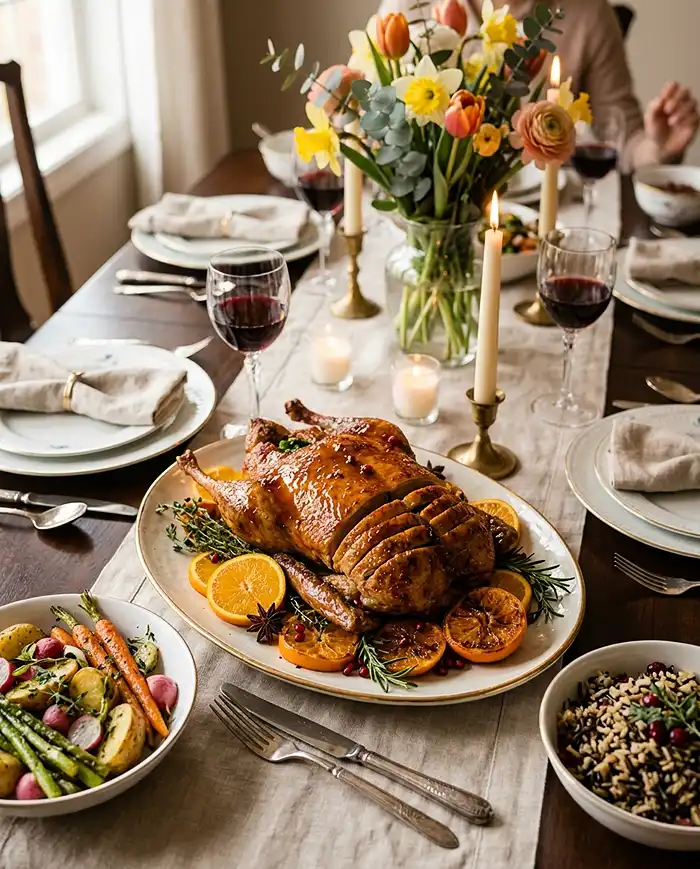
Serve this gluten-free whole roast duck with orange glaze as the star of your Easter dinner table, replacing the traditional ham or lamb with something truly memorable. Pair it with roasted root vegetables, gluten-free spring vegetable frittata for a light side, and finish the meal with gluten-free Cadbury egg brownies for a sweet, festive ending.
For a Chinese New Year or special anniversary dinner, serve the duck with steamed bao buns (gluten-free versions available at Asian markets), pickled vegetables, and hoisin sauce for a DIY Peking duck experience. Round out the dessert table with playful treats like gluten-free Peeps rice krispie treats if you’re celebrating spring holidays.
Ready to Roast Your Best Duck Ever?
This orange duck recipe has turned me into the go-to person for special occasion dinners in our family—it’s dramatic, flavorful, and easier than anyone expects once you understand the flipping method and fat-draining technique. The crispy skin and five-spice orange glaze create a dish that tastes like you trained at a French culinary school when you really just followed a few simple steps.
Try this roasted duck gluten free for your next celebration and let me know in the comments how it turned out—did you use the orange glaze or experiment with a different citrus? Pin this to your gluten-free holiday meals board on Pinterest so you can find it again when you need an impressive centerpiece, and don’t forget to rate it below if it becomes your new Easter tradition!
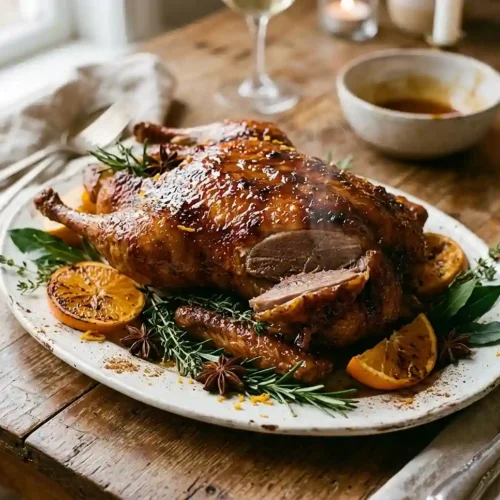
Gluten-Free Whole Roast Duck with Orange Glaze
Equipment
- Large roasting pan
- Wire roasting rack
- Paper towels
- Small saucepan
- Pastry brush
- Instant-read thermometer
- Turkey baster or ladle
- Tongs
- Large spatula
- Heatproof container (for fat)
- Aluminum foil
- Cutting board
- Microplane (for zesting)
Ingredients
For the Duck
- 1 whole duck about 6 lbs / 2.7 kg; cleaned and patted dry
- salt to taste; kosher or sea salt
For the Orange Glaze
- 1 orange zest from 1 orange; use microplane
- ⅓ cup fresh orange juice from 1-2 oranges; freshly squeezed
- 1-2 tablespoons honey or maple syrup adjust to taste
- 1 star anise whole pod
- ¼ teaspoon five-spice powder Chinese five-spice blend
- ¼ cup gluten-free soy sauce or coconut aminos tamari or coconut aminos work
Instructions
- Remove the duck from its packaging and drain any liquid. Use paper towels to pat the entire surface dry—inside the cavity, all over the skin, under the wings, and around the legs. The skin should feel tacky and slightly leathery. If you have time, place the duck uncovered on a rack in the fridge overnight to air-dry for maximum crispiness.
- Preheat your oven to 375°F (190°C). Season the duck inside and out with a generous amount of salt—use about 1-2 tablespoons total, rubbing it into the skin and cavity.
- Place a wire rack inside a large roasting pan to elevate the duck above the drippings. Position the duck breast-side up on the rack, tucking the wing tips under the body so they don’t burn.
- Slide the roasting pan into the preheated oven and roast for 1 hour. After 1 hour, carefully remove the pan and use a turkey baster or ladle to drain the rendered fat from the bottom of the pan into a heatproof container.
- Using tongs and a large spatula, carefully flip the duck so it’s breast-side down. Return it to the oven and roast for 45 minutes. Drain the fat again after this phase.
- Flip the duck back to breast-side up for the final roasting phase. Roast for another 30-45 minutes, until the skin is deeply golden and crispy all over. The duck is done when an instant-read thermometer inserted into the thickest part of the thigh reads 165°F and the juices run clear.
- While the duck finishes roasting, combine the orange zest, orange juice, honey (or maple syrup), star anise, five-spice powder, and gluten-free soy sauce (or coconut aminos) in a small saucepan. Bring to a simmer over medium heat, then reduce to low and cook for 8-10 minutes, stirring occasionally, until the glaze has thickened slightly and coats the back of a spoon. Remove the star anise before using.
- During the last 15 minutes of roasting, brush the duck generously all over with the orange glaze using a pastry brush. Return it to the oven and let the glaze caramelize into a shiny, sticky coating.
- Remove the duck from the oven and transfer it to a cutting board. Tent it loosely with aluminum foil and let it rest for 10-15 minutes before carving.
- Carve the duck by removing the legs and thighs first, then slicing the breast meat against the grain into thin slices. Serve with the remaining warm glaze drizzled over top.