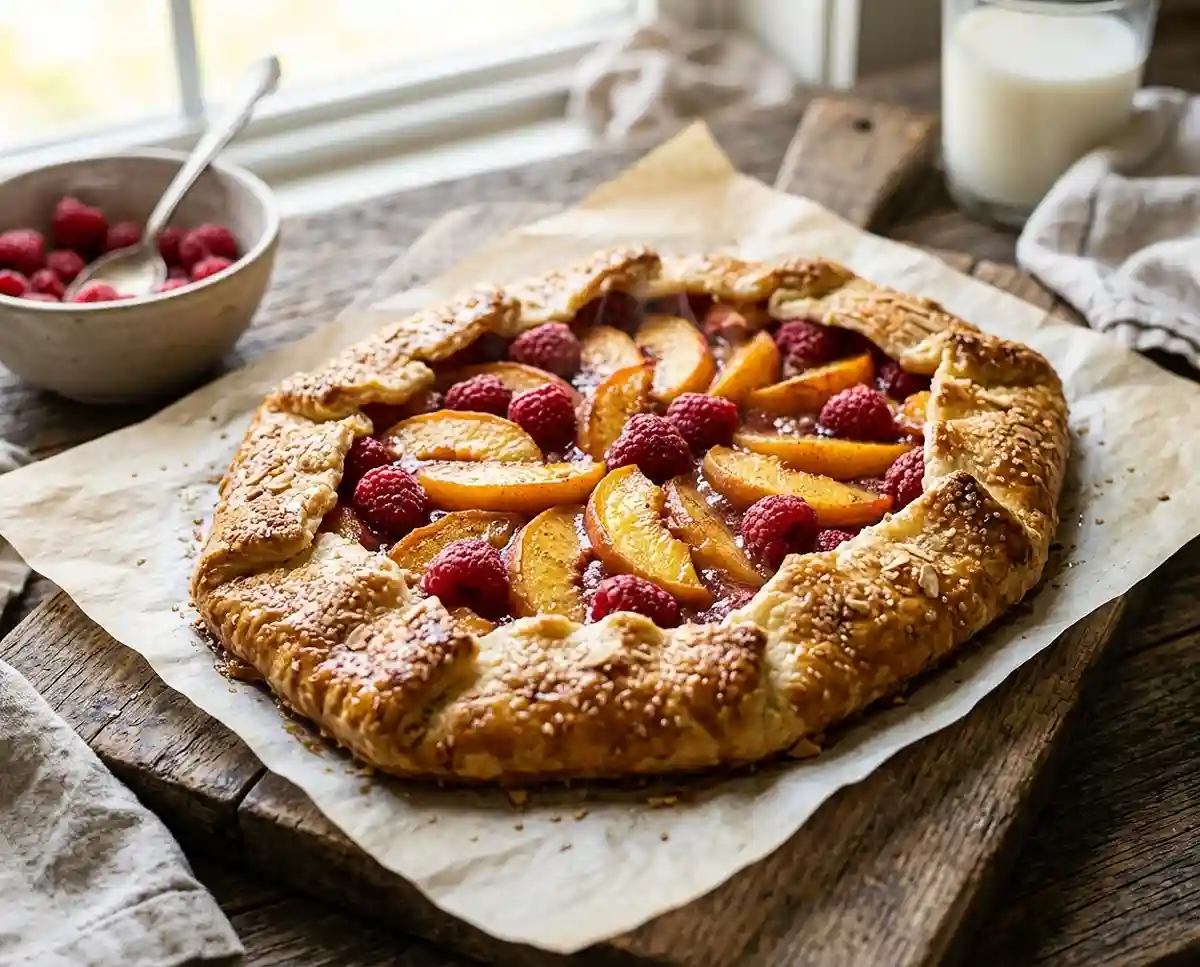
Gluten-Free Peach Raspberry Galette
Gluten-free peach raspberry galette with flaky butter crust & cinnamon filling. Rustic summer dessert ready in 90 minutes—easier than pie!
Two years ago, I attempted my first galette for a family reunion and completely panicked when my gluten-free pastry cracked apart as I tried to fold it over the filling. I nearly threw the whole thing in the trash, but my sister convinced me to just patch it with scraps and bake it anyway.
You know what? That “disaster” galette—with its rustic, imperfect edges and slightly crumbly crust—became the most talked-about dessert of the day, with three aunts asking for the recipe before we even cut into it.
That’s when I learned the beautiful truth about this gluten-free peach raspberry galette: the rustic, free-form nature actually hides any imperfections, making it infinitely more forgiving than a traditional pie.
Why You’ll Love This Gluten-Free Peach Raspberry Galette
• Easier than pie: No pie plate needed, no crimping skills required, no blind baking—just roll, fill, fold, and bake on a single sheet pan
• Naturally impressive: The rustic, free-form shape looks bakery-fancy even though it’s simpler to make than traditional gluten-free pie crust
• Peak summer flavor: Fresh peaches and raspberries with cinnamon and vanilla create that classic summer fruit dessert taste without being overly sweet
• Dairy-free adaptable: Made with dairy-free butter block (like Earth Balance or Miyoko’s), so it works for multiple dietary restrictions at once
The Secret to Perfect Gluten-Free Peach Raspberry Galette
• Cold butter creates flaky layers: Using 175g of cold, cubed dairy-free butter block (not spread or margarine) and rubbing it into the flour until it resembles breadcrumbs creates pockets of fat that steam during baking, producing the flaky texture you want in pastry. According to King Arthur Baking’s pastry science guide, keeping butter cold until it hits the oven is the single most important factor for tender, flaky gluten-free pastry.
• Ground almonds prevent soggy bottom: Sprinkling 2 tablespoons of ground almonds (almond flour) on the pastry base before adding the fruit filling creates a moisture barrier that absorbs excess juice released during baking. This technique, borrowed from French patisserie, ensures your galette bottom stays crisp and flaky instead of turning soggy and gummy—a common problem with gluten-free fruit desserts.
• Chilling the dough is non-negotiable: Refrigerating the formed pastry dough for at least 1 hour (or up to 2 days) allows the xanthan gum to fully hydrate, the butter to firm up, and the flour to absorb the liquid evenly. Skipping this step results in pastry that’s impossible to roll out, tears easily, and bakes up tough instead of tender. Chilled dough is also much easier to handle and fold without cracking.
• Cornflour thickens without adding texture: The 1 tablespoon of cornflour (cornstarch) mixed with the peach filling absorbs the fruit’s natural juices as they heat and release during baking, creating a lightly thickened sauce rather than a watery puddle. This keeps your galette slices neat and prevents the pastry from getting waterlogged, while remaining virtually undetectable in the final texture.
Table of Contents
Ingredients
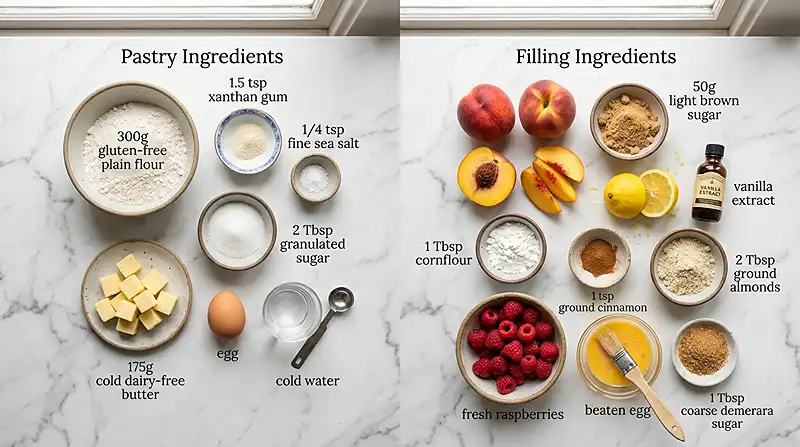
Serves 6:
For the Gluten-Free Pastry:
| Ingredient | Amount | Notes |
|---|---|---|
| Gluten-free plain flour | 300g | Use a blend with xanthan gum or add separately |
| Xanthan gum | 1½ tsp | Skip if your flour blend already contains it |
| Salt | ¼ tsp | Fine table or sea salt |
| Granulated sugar | 2 Tbsp | For the pastry, not the filling |
| Dairy-free butter block | 175g | Cold and cubed; Earth Balance or Miyoko’s |
| Medium egg | 1 | Plus 1 more for egg wash |
| Cold water | 3-4 Tbsp | Add gradually until dough forms |
For the Peach Raspberry Filling:
| Ingredient | Amount | Notes |
|---|---|---|
| Medium peaches | 4 | Destoned and sliced |
| Light brown sugar | 50g | About ¼ cup |
| Fresh lemon juice | 1 Tbsp | From about ½ lemon |
| Vanilla extract | 2 tsp | Pure, not imitation |
| Cornflour (cornstarch) | 1 Tbsp | For thickening |
| Ground cinnamon | 1 tsp | Adds warmth |
| Ground almonds | 2 Tbsp | Also called almond flour or almond meal |
| Fresh raspberries | Handful | About ½ cup |
| Demerara sugar | 1 Tbsp | For sprinkling on top |
About the butter: You must use a firm, cold dairy-free butter block (not soft spread or margarine) for proper flaky pastry. Brands like Earth Balance Buttery Sticks, Miyoko’s Creamery, or Flora Plant Butter work best.
Step-by-Step Instructions
Making the Gluten-Free Pastry
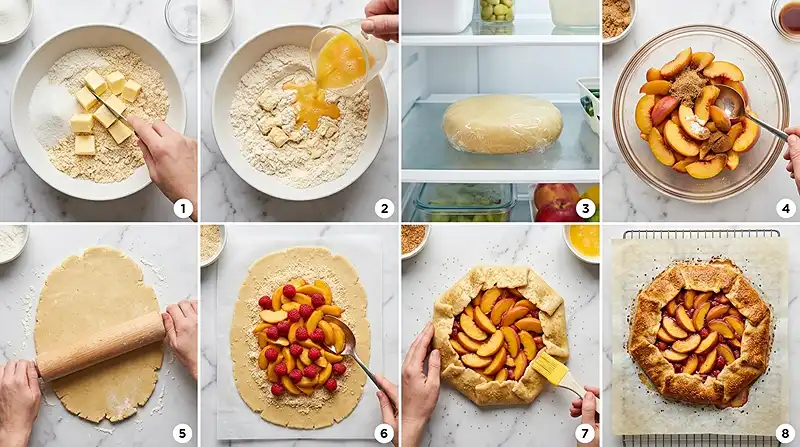
1. Mix the dry ingredients: To a large mixing bowl, add 300g gluten-free plain flour, 1½ teaspoons xanthan gum (if your flour doesn’t already contain it), ¼ teaspoon salt, and 2 tablespoons granulated sugar. Mix everything together with a whisk or fork for 30 seconds until well combined and any lumps are broken up.
2. Rub in the cold butter: Add 175g of cold, cubed dairy-free butter to the flour mixture. Using a fork or your fingertips, rub the butter into the flour until the mixture starts to look like coarse breadcrumbs with some pea-sized butter pieces remaining—this should take 3-4 minutes. You want visible butter bits, not a smooth paste, as these create the flaky layers.
3. Add egg and water: Crack 1 medium egg into the bowl and mix it in using a table knife, cutting through the mixture until the egg is incorporated. Add cold water 1 tablespoon at a time (you’ll need about 3-4 tablespoons total), mixing with the knife after each addition, until the dough starts to come together into clumps. Don’t add all the water at once—gluten-free flour absorbs liquid differently than wheat flour, and too much water makes the dough sticky.
4. Form and chill the dough: Turn the dough out onto a lightly floured surface and gently knead it just until it forms a smooth ball—about 10-15 seconds of kneading is enough. Wrap the dough tightly in plastic wrap (clingfilm) and place it in the refrigerator for at least 1 hour, or up to 2 days. This chilling time is crucial for easy rolling and flaky texture.
Pro Tip: If you’re short on time, you can chill the dough for 30 minutes in the freezer instead of 1 hour in the fridge, but watch it closely so it doesn’t freeze solid.
Preparing the Filling and Assembling
5. Preheat and prep the filling: Preheat your oven to 180°C (350°F/Gas Mark 4). While the oven heats, add 4 sliced, destoned peaches to a large bowl along with 50g light brown sugar, 1 tablespoon lemon juice, 2 teaspoons vanilla extract, 1 tablespoon cornflour, and 1 teaspoon ground cinnamon. Mix everything together gently until the peaches are evenly coated with the spiced sugar mixture—you’ll see the cornflour start to dissolve and cling to the fruit.
6. Roll out the chilled pastry: Remove the pastry from the fridge and place it on a sheet of parchment paper dusted with gluten-free flour. Roll it out into a rough oval or circle shape, about 12-14 inches across and about ¼ inch thick. Don’t worry about making it perfectly round—galettes are meant to be rustic and irregular. If the pastry cracks at the edges, just press it back together with your fingers.
7. Add almonds and filling: Sprinkle the 2 tablespoons of ground almonds evenly over the center of the pastry, leaving about 2-3 inches of bare pastry around the edges. Spoon the prepared peach mixture into the middle of the pastry on top of the almonds, spreading it out slightly but still leaving that 2-3 inch border all around. Scatter the handful of fresh raspberries on top of the peach mixture, distributing them evenly.
8. Fold and seal the edges: Working your way around the galette, fold the bare pastry edges up and over the filling, pleating and overlapping the pastry as you go to create a rustic border that partially covers the fruit. The center should remain open and exposed—this is what makes a galette different from a pie. If the pastry cracks while folding, just patch it with a scrap of dough and press gently to seal.
9. Egg wash and sugar topping: Beat the second egg in a small bowl and brush it generously over the folded pastry edges using a pastry brush—this creates a golden, glossy finish. Sprinkle the 1 tablespoon of demerara sugar over the egg-washed pastry for extra crunch and sparkle. Transfer the entire parchment paper with the galette onto a baking sheet.
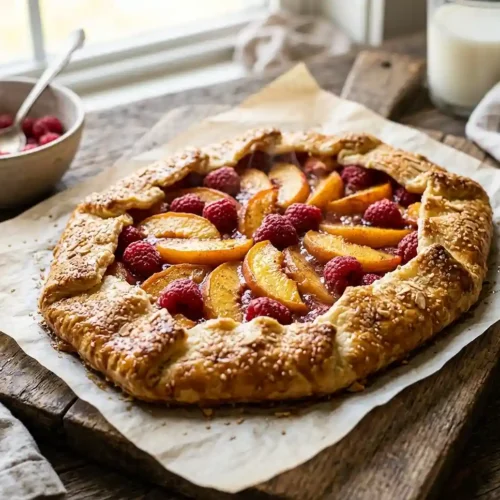
10. Bake until golden: Bake the gluten-free peach raspberry galette in the preheated oven for 40-45 minutes, until the pastry is golden brown and cooked through and the fruit filling is bubbling vigorously in the center. The edges should be deeply golden and crispy, and you should be able to slide a knife into the pastry and feel no resistance. Let the galette cool on the baking sheet for at least 15 minutes before slicing—this allows the filling to set slightly so it doesn’t run everywhere when you cut it.
Pro Tip: If the pastry edges are browning too quickly while the center is still pale, loosely tent the edges with aluminum foil for the last 10-15 minutes of baking.
Make It Your Own
Fruit combinations: Swap the peaches and raspberries for other summer fruits like sliced strawberries and rhubarb, blueberries and nectarines, or plums and blackberries. You can also use frozen fruit in the winter—just thaw it completely and drain off excess liquid before mixing with the sugar and cornflour. Each fruit combination brings a different flavor profile but the technique remains the same.
Nut-free version: Replace the 2 tablespoons of ground almonds with gluten-free oat flour, coconut flour, or additional cornflour to absorb excess juice from the filling. The texture won’t be quite as rich, but it will still prevent a soggy bottom and keep the galette safe for nut allergies. You can also skip this layer entirely if your fruit isn’t overly juicy.
Spice variations: Experiment with different warming spices in the filling—try cardamom instead of cinnamon, add ¼ teaspoon of nutmeg or ginger, or use 1 teaspoon of chai spice blend for a more complex flavor. Fresh herbs like torn basil or thyme also work beautifully with stone fruits, adding an unexpected savory note that balances the sweetness.
Sweetener adjustments: If your peaches are very ripe and sweet, reduce the brown sugar in the filling to 30-40g. If they’re underripe or tart, increase the sugar to 60-70g and taste the mixture before assembling to check sweetness. You can also substitute coconut sugar, maple sugar, or even honey (though honey isn’t vegan) for the brown sugar.
Pastry variations: Man, oh man, you can make the pastry with regular dairy butter if you’re not dairy-free—just use the same 175g amount and follow the same method. For a richer pastry, replace 2 tablespoons of the water with cold milk (dairy or plant-based). You can also add ½ teaspoon of almond extract to the pastry for a subtle nutty flavor that complements the fruit.
Individual galettes: Instead of one large galette, divide the pastry into 6 portions, roll each into a 6-inch circle, and make individual mini galettes. Reduce the baking time to 25-30 minutes and adjust the filling portions accordingly. These individual servings are perfect for picnics, potlucks, or portion control.
Common Problems & Solutions
Pastry dough won’t come together: You didn’t add enough water, or your gluten-free flour blend is particularly dry. Add water 1 teaspoon at a time beyond the 4 tablespoons called for, mixing gently, until the dough just holds together when squeezed. Different gluten-free flour blends absorb liquid differently, so you may need up to 6 tablespoons total—don’t be afraid to trust your judgment.
Dough is too sticky to roll: You added too much water, or you didn’t chill it long enough. Put the dough back in the fridge for another 30 minutes, then roll it between two sheets of parchment paper generously dusted with gluten-free flour. If it’s still impossibly sticky, you can knead in an extra 2-3 tablespoons of gluten-free flour, though this will make the pastry slightly less tender.
Pastry cracks and tears when folding: The dough is too cold (yes, that’s possible), or it’s too dry, or you rolled it too thin. Let it sit at room temperature for 5 minutes to soften slightly, then patch any cracks by pressing them together with your fingers or adding small scraps of dough to fill gaps. Remember, galettes are meant to look rustic, so imperfections are part of the charm—don’t stress about making it perfect.
Filling leaked out during baking: You overfilled the galette, didn’t leave a wide enough pastry border, or the fruit released more juice than expected. Next time, use a slotted spoon to transfer the fruit to the pastry, leaving some of the accumulated juice behind in the bowl. Make sure you leave at least 2 inches of bare pastry around the edges for folding, and consider adding an extra tablespoon of cornflour if your fruit is very juicy.
Bottom crust is soggy: You skipped the ground almond layer, used too-wet fruit, or didn’t bake it long enough. Always sprinkle that moisture-absorbing layer on the base, drain any excess juice from your filling before assembling, and bake until you see vigorous bubbling in the center of the galette. If the bottom is still pale when you lift it to check, return it to the oven for another 5-10 minutes.
Pastry tastes gummy or dense: Your gluten-free flour blend doesn’t contain enough starch, you added too much xanthan gum, or you overworked the dough. Use a well-balanced gluten-free flour blend (like Bob’s Red Mill 1-to-1 or King Arthur Measure for Measure), don’t add xanthan gum if it’s already in your flour, and handle the dough as little as possible—just enough to bring it together.
Storage & Meal Prep
| Method | Duration | Notes |
|---|---|---|
| Counter | 1-2 days | Cover loosely with foil; best eaten fresh |
| Refrigerator | 3-4 days | Store in airtight container; bring to room temp |
| Freezer (unbaked) | 2 months | Freeze assembled galette before baking |
| Freezer (baked) | 1 month | Wrap well; reheat to crisp up pastry |
This gluten-free peach raspberry galette is best eaten the day it’s baked, when the pastry is at peak crispness and the filling is still juicy. If you have leftovers, store them loosely covered at room temperature for 1-2 days—don’t seal them airtight or the pastry will get soggy from trapped moisture.
For longer storage, refrigerate the galette in an airtight container for up to 4 days, then bring slices to room temperature or warm them in a 160°C oven for 10 minutes to refresh the pastry. The crust won’t be as crisp as day one, but it will still taste good.
To make ahead, you can prepare the pastry dough up to 2 days in advance and keep it wrapped in the refrigerator, or freeze it for up to 3 months. You can also assemble the entire unbaked galette, freeze it on a baking sheet until solid, then wrap it well and freeze for up to 2 months—bake from frozen, adding 10-15 minutes to the baking time.
Gluten-Free Peach Raspberry Galette FAQs
Can I use regular butter instead of dairy-free butter?
Yes, regular dairy butter works perfectly in this recipe if you’re not avoiding dairy—use the same 175g amount and follow the exact same method. The texture and flavor will be slightly richer with real butter, but the technique remains identical. Just make sure the butter is cold and firm before you start.
What if I don’t have xanthan gum?
If your gluten-free flour blend already contains xanthan gum or guar gum (check the label), don’t add extra or your pastry will be gummy and unpleasant. If your flour blend doesn’t contain any binder, you must add the 1½ teaspoons called for, or the pastry will crumble apart and won’t hold its shape. Xanthan gum is what replaces the gluten’s binding properties in this recipe.
How do I know when the galette is fully baked?
The pastry edges should be deeply golden brown and crispy, the fruit filling should be bubbling vigorously in the center, and a knife inserted into the pastry should meet no resistance—it should slide through easily. If you’re unsure, it’s better to overbake slightly than underbake, since undercooked gluten-free pastry tastes gummy and raw. The total baking time is usually 40-45 minutes at 180°C.
Can I make this without eggs?
The egg in the pastry can be replaced with a “flax egg” (1 tablespoon ground flaxseed mixed with 3 tablespoons water, left to gel for 5 minutes) or with 3 tablespoons of unsweetened applesauce. For the egg wash, brush the pastry with non-dairy milk or melted dairy-free butter instead—it won’t get quite as golden but will still look appealing. The texture will be slightly different but still good.
Why did my pastry shrink during baking?
You didn’t chill the dough long enough before rolling, you stretched the dough while rolling it out, or you overworked it and developed too much elasticity. Always chill for at least 1 hour, roll gently without stretching, and handle the dough minimally. If your pastry does shrink, it’s still edible—the filling might just be more exposed than intended, which actually looks more rustic and authentic.
Serving Suggestions
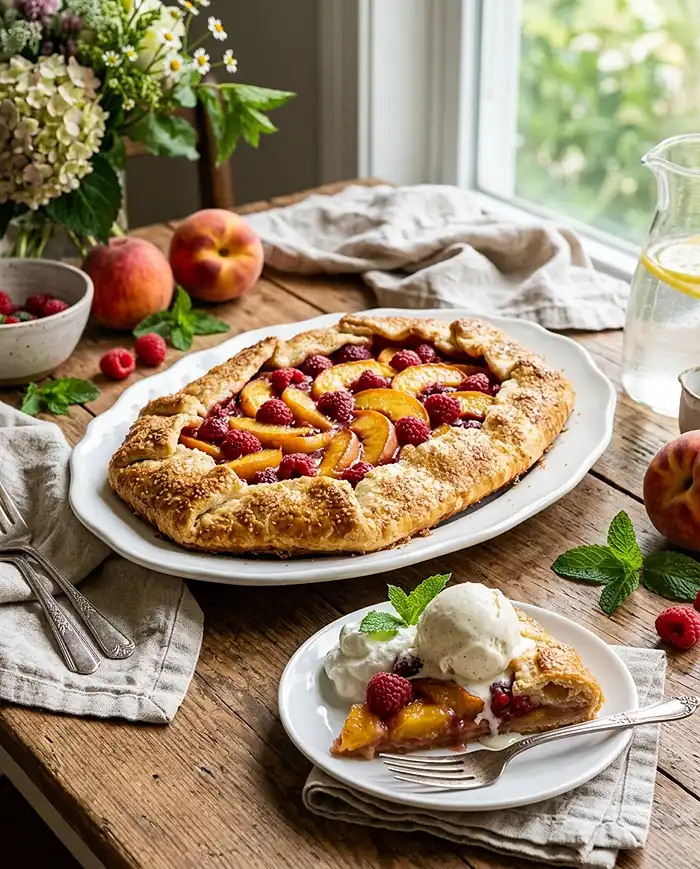
This gluten-free peach raspberry galette is the ultimate summer dessert for Fourth of July cookouts, backyard barbecues, or lazy Sunday dinners when you want something that looks impressive but doesn’t require pie-making skills. Serve it warm from the oven with a scoop of vanilla ice cream (dairy or non-dairy) melting into the juicy fruit filling, or top each slice with freshly whipped cream.
It pairs beautifully with coffee or tea for brunch, and it’s elegant enough for dinner parties yet casual enough for weeknight family desserts. The combination of sweet peaches, tart raspberries, and buttery crust makes it a crowd-pleaser that works for any occasion where you need a show-stopping gluten-free dessert.
For a complete summer menu, serve this galette after gluten-free chili lime shrimp bowls or alongside crispy smashed potatoes. Wash it all down with a refreshing pineapple cucumber drink for a balanced meal that celebrates fresh, seasonal ingredients.
Let’s Get Baking
Give this gluten-free peach raspberry galette a try this weekend and let me know if it becomes your new favorite summer dessert like it has for my family. Pin this recipe to your gluten-free baking board so you’ll have it ready when stone fruit season hits and you need something that looks bakery-fancy but is actually beginner-friendly.
If you’ve made this with different fruit combinations or have questions about the pastry technique, drop a comment below—I love hearing about your variations and helping troubleshoot any challenges you encounter!
Gluten-Free Peach Raspberry Galette
Equipment
- Large mixing bowl
- Fork or pastry cutter
- Table knife
- Plastic wrap (clingfilm)
- Rolling Pin
- Parchment paper
- Baking sheet
- Pastry brush
- Small bowl for egg wash
- Large bowl for filling
- Whisk
Ingredients
For the Gluten-Free Pastry
- 300 g gluten-free plain flour use a blend with xanthan gum or add separately
- 1½ tsp xanthan gum skip if your flour blend already contains it
- ¼ tsp salt fine table or sea salt
- 2 Tbsp granulated sugar for the pastry, not the filling
- 175 g dairy-free butter block cold and cubed; Earth Balance or Miyoko’s
- 1 medium egg plus 1 more for egg wash
- 3-4 Tbsp cold water add gradually until dough forms
For the Peach Raspberry Filling
- 4 medium peaches destoned and sliced
- 50 g light brown sugar about ¼ cup
- 1 Tbsp fresh lemon juice from about ½ lemon
- 2 tsp vanilla extract pure, not imitation
- 1 Tbsp cornflour cornstarch for thickening
- 1 tsp ground cinnamon adds warmth
- 2 Tbsp ground almonds also called almond flour or almond meal
- 1 handful fresh raspberries about ½ cup
- 1 Tbsp demerara sugar for sprinkling on top
Instructions
- To a large mixing bowl, add 300g gluten-free plain flour, 1½ teaspoons xanthan gum (if your flour doesn’t already contain it), ¼ teaspoon salt, and 2 tablespoons granulated sugar. Mix everything together with a whisk or fork for 30 seconds until well combined and any lumps are broken up.
- Add 175g of cold, cubed dairy-free butter to the flour mixture. Using a fork or your fingertips, rub the butter into the flour until the mixture starts to look like coarse breadcrumbs with some pea-sized butter pieces remaining—this should take 3-4 minutes.
- Crack 1 medium egg into the bowl and mix it in using a table knife, cutting through the mixture until the egg is incorporated. Add cold water 1 tablespoon at a time (you’ll need about 3-4 tablespoons total), mixing with the knife after each addition, until the dough starts to come together into clumps.
- Turn the dough out onto a lightly floured surface and gently knead it just until it forms a smooth ball—about 10-15 seconds of kneading is enough. Wrap the dough tightly in plastic wrap (clingfilm) and place it in the refrigerator for at least 1 hour, or up to 2 days.
- Preheat your oven to 180°C (350°F/Gas Mark 4). While the oven heats, add 4 sliced, destoned peaches to a large bowl along with 50g light brown sugar, 1 tablespoon lemon juice, 2 teaspoons vanilla extract, 1 tablespoon cornflour, and 1 teaspoon ground cinnamon. Mix everything together gently until the peaches are evenly coated.
- Remove the pastry from the fridge and place it on a sheet of parchment paper dusted with gluten-free flour. Roll it out into a rough oval or circle shape, about 12-14 inches across and about ¼ inch thick. Don’t worry about making it perfectly round—galettes are meant to be rustic.
- Sprinkle the 2 tablespoons of ground almonds evenly over the center of the pastry, leaving about 2-3 inches of bare pastry around the edges. Spoon the prepared peach mixture into the middle of the pastry on top of the almonds, spreading it out slightly but still leaving that 2-3 inch border. Scatter the handful of fresh raspberries on top of the peach mixture.
- Working your way around the galette, fold the bare pastry edges up and over the filling, pleating and overlapping the pastry as you go to create a rustic border that partially covers the fruit. The center should remain open and exposed. If the pastry cracks while folding, just patch it with a scrap of dough.
- Beat the second egg in a small bowl and brush it generously over the folded pastry edges using a pastry brush. Sprinkle the 1 tablespoon of demerara sugar over the egg-washed pastry. Transfer the entire parchment paper with the galette onto a baking sheet.
- Bake the galette in the preheated oven for 40-45 minutes, until the pastry is golden brown and cooked through and the fruit filling is bubbling vigorously in the center. Let the galette cool on the baking sheet for at least 15 minutes before slicing. Serve warm from the oven.