Gluten-Free Watermelon Lime Sorbet
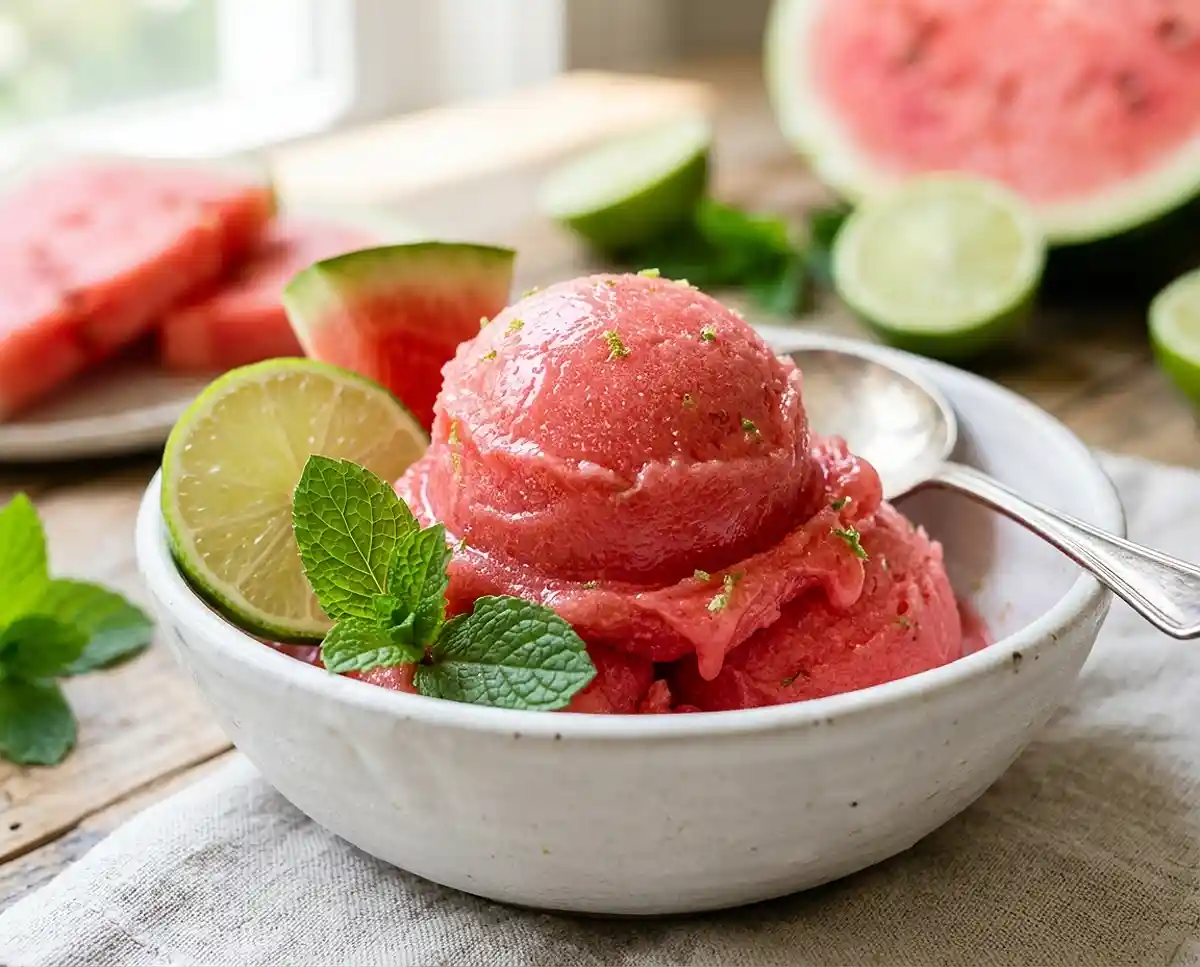
This Gluten-Free Watermelon Lime Sorbet uses just five ingredients for a bright, scoopable frozen treat that’s dairy‑free and ready for summer.
The first time I tried making sorbet at home, I dumped a bunch of watermelon into a blender, added some sugar, and tossed it straight into the ice cream maker without chilling it first. What came out was a slushy, icy mess that froze into a solid pink brick overnight. I couldn’t even get a spoon into it. That failure taught me two things — temperature matters more than you’d think, and sugar isn’t just for sweetness, it’s the secret architecture behind a smooth, scoopable texture.
Well… that was five summers ago, and I’ve been perfecting this Gluten‑Free Watermelon Lime Sorbet ever since. It’s the kind of recipe that sounds almost too simple to be worth writing down — watermelon, sugar, lime, salt — but every single element plays a critical role. And isn’t that the mark of a truly great recipe, when a handful of ingredients creates something that tastes like it took all afternoon?
Table of Contents
Why You’ll Love This Gluten‑Free Watermelon Lime Sorbet
- Intensely fruity and refreshing — real watermelon flavor with a punchy lime brightness, not the muted, artificial taste of store‑bought frozen treats.
- Completely beginner‑friendly — no tempering, no cooking, no candy thermometer. If you can blend and stir, you can make this.
- Naturally gluten‑free, dairy‑free, and vegan — safe for nearly every dietary restriction at the table without any substitutions needed.
- Ideal for hot‑weather entertaining — scoops beautifully after a short freeze, holds its texture for a solid 10 minutes on the counter, and pairs with practically everything from grilled chicken to chocolate cake.
The Secret to a Scoopable Gluten‑Free Watermelon Lime Sorbet
- The egg float test ensures the perfect sugar‑to‑water ratio. Sorbet texture depends entirely on sugar concentration. Too little sugar and you get a rock‑hard block; too much and it never freezes properly. Floating a whole egg in the base — a technique pastry chefs have used for generations — gives you an instant visual gauge without any specialized equipment. When a quarter‑sized circle of shell peeks above the surface, the ratio is spot‑on.
- Chilling the base to 40°F before churning produces smaller ice crystals. When warm liquid hits the frozen bowl, the outer edges freeze instantly while the center stays liquid, creating uneven crystals that feel gritty on your tongue. Starting with a thoroughly cold base — at least two hours, preferably overnight — means the entire mixture freezes more uniformly, resulting in a texture as smooth as gelato. According to the Penn State Ice Cream Science course materials, a colder starting temperature directly correlates with finer crystal structure in frozen desserts.
- Salt does more than season — it amplifies sweetness and suppresses bitterness. A hefty pinch of salt might seem odd in a fruit dessert, but it heightens the watermelon’s natural sugars and rounds out the lime’s tartness. Without it, the sorbet can taste one‑dimensional and flat, even with a full cup of sugar.
- Lime zest adds aromatic depth that juice alone can’t deliver. The zest contains concentrated essential oils — limonene and citral — that vaporize on your tongue and create that bright, fragrant “wow” moment before the juice’s acidity even registers. Stripping the zest and blending it directly into the puree ensures those oils disperse evenly through every scoop.
Ingredients
Sorbet Base (Makes 1 Quart)
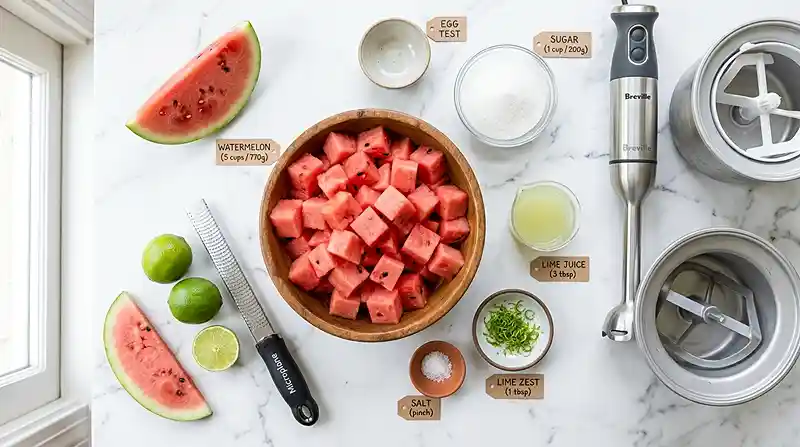
- 5 cups (about 770 grams) cubed watermelon
- 1 cup (200 grams) granulated sugar
- 3 tablespoons fresh lime juice
- 1 tablespoon lime zest
- A hefty pinch of salt
A note about the watermelon: Seedless works best here because you won’t need to strain out any gritty seed fragments. Choose a melon that feels heavy for its size and gives a hollow thump when you tap it — that’s a sign the flesh is ripe, juicy, and full of natural sugar. The sweeter the melon, the better your sorbet will taste before any granulated sugar goes in.
A note about the sugar: You may not need the full cup. The egg float test in step 4 will tell you exactly how much to add based on your specific watermelon’s sweetness. Start with half and work from there.
Instructions
Prep Your Equipment
1. Freeze your ice cream maker bowl 24 hours in advance.
This step is easy to forget, but it’s the single most important piece of timing in the entire recipe. A partially frozen bowl won’t churn the sorbet fast enough, and you’ll end up with a soupy mess that takes forever to set in the freezer. Set a phone reminder the day before you plan to make this.
Make the Base
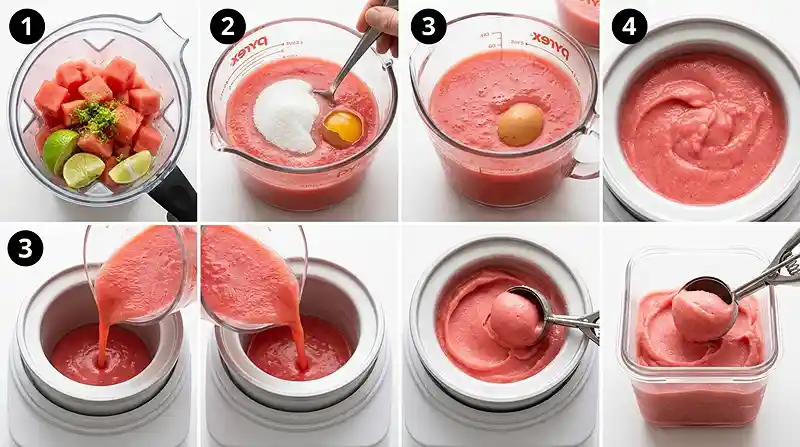
2. Blend the watermelon, lime juice, and lime zest until completely smooth.
Combine the 5 cups of cubed watermelon, 3 tablespoons of lime juice, and 1 tablespoon of lime zest in a blender, food processor, or a tall container with an immersion blender. Process for 30 to 60 seconds until there are absolutely no chunks left — you should end up with about 4 cups of silky, bright pink puree. It’ll smell incredible, like a freshly cracked watermelon with a citrus breeze floating right off the surface.
3. Add half the sugar and stir until dissolved.
Pour roughly ½ cup (100 grams) of the granulated sugar into the puree and stir steadily for about a minute until you can’t feel any grains against the bottom of the bowl. Reserve the remaining sugar for the next step — you might not need all of it.
Fine‑Tune the Sweetness
4. Perform the egg float test to dial in the sugar concentration.
Wash and thoroughly dry a whole egg in its shell, then gently lower it into the sorbet base. If the egg floats with a quarter‑sized circle of shell visible above the surface, your sugar level is exactly right. If it sinks, gradually stir in more of the reserved sugar and retest. If it floats higher than a quarter‑sized patch, add a splash more watermelon puree or lime juice to dilute slightly. This old‑school technique takes the guesswork out of sorbet and works regardless of how sweet your specific watermelon happens to be.
Pro Tip: Remove the egg carefully and rinse it off — it’s perfectly fine to use for cooking afterward. Nothing from the egg transfers into the base.
5. Season with salt, then taste and adjust.
Stir in a hefty pinch of salt and give the base a good taste. It should be noticeably sweeter than you’d want a drink to be, because freezing dulls sweetness significantly. If the lime flavor feels muted, squeeze in another teaspoon of juice. If it tastes a touch flat, add one more small pinch of salt. Trust your palate here — you know what balance tastes like, even if the terminology feels unfamiliar.
Chill and Churn
6. Chill the base thoroughly before churning.
Transfer the base to a lidded container or pitcher and refrigerate for at least 2 hours, though overnight is ideal. You want the mixture at 40°F or below before it hits the ice cream maker. This patience pays off with a noticeably smoother, creamier texture — rushing this step is the most common mistake I see beginners make.
7. Churn according to your ice cream maker’s instructions.
Pour the chilled base into your frozen bowl and churn until the sorbet reaches a soft‑serve consistency — typically 20 to 25 minutes depending on your machine. You’ll know it’s ready when it pulls away from the sides of the bowl and holds a gentle peak when you lift the dasher. The color will lighten slightly as air incorporates, shifting from deep pink to a softer, almost rosy hue.
No ice cream maker? No problem. Pour the base into a shallow baking dish, freeze for 45 minutes, then rake through with a fork to break up crystals. Repeat every 30 minutes for about 3 hours and you’ll have a gorgeous watermelon lime granita — a little more rustic, but every bit as refreshing.
8. Transfer to an airtight container and freeze for at least 2 hours.
Scrape the freshly churned sorbet into an airtight container, press a piece of parchment or plastic wrap directly against the surface to prevent ice crystals, and seal the lid. A minimum 2‑hour freeze firms the texture from soft‑serve to a perfectly scoopable consistency. If it freezes rock‑hard after a longer stint in the freezer, let it sit on the counter for 5 to 8 minutes before scooping.
Make It Your Own
Swap limes for lemon or grapefruit. Lemon gives a slightly sweeter citrus profile, while grapefruit adds a gorgeous pink‑on‑pink color and a subtle bitterness that’s surprisingly grown‑up. Use the same quantity — 3 tablespoons of juice and 1 tablespoon of zest — and run the egg test as usual since the acidity levels differ slightly between citrus fruits.
Add fresh herbs for an elevated twist. Muddle 6 to 8 fresh mint leaves or a small handful of basil into the puree before blending. Mint turns this into a watermelon mojito‑style sorbet that’s outstanding at dinner parties, and basil leans it toward a more savory‑sweet direction. Man, oh man… the basil version with a crack of black pepper on top is something I didn’t expect to love as much as I do.
Make it a boozy adult treat. Stir in 2 tablespoons of tequila, vodka, or white rum after step 5 and before chilling. Alcohol lowers the freezing point, so the sorbet will stay softer and more spoonable straight from the freezer. Don’t exceed 2 tablespoons per quart, though — too much and the base won’t freeze properly.
Turn it into popsicles for kids. Pour the chilled base directly into popsicle molds instead of the ice cream maker and freeze for 4 to 6 hours. You’ll skip the churning entirely and still get a beautiful gluten‑free dairy‑free sorbet pop that kids devour on hot summer afternoons.
Common Problems and Solutions
Problem: The sorbet froze into a solid, unscoopable block.
Let it sit at room temperature for 5 to 8 minutes before scooping — all sorbets firm up harder than ice cream because they lack fat. If this keeps happening, your sugar concentration may be too low. Next time, rely on the egg float test and don’t shortcut the sugar. You know… sugar in sorbet isn’t just about sweetness — it’s the ingredient that physically prevents large ice crystals from locking together into a solid mass.
Problem: The texture is grainy or icy instead of smooth.
Your base was likely too warm when it hit the machine. The ice cream maker can only freeze so fast, and a warm base produces large, coarse crystals. Always chill to 40°F or below, and make sure your bowl spent a full 24 hours in the freezer. If you suspect your freezer isn’t cold enough, the USDA’s safe food storage temperature guidelines recommend keeping it at 0°F — which is also the sweet spot for ice cream maker bowls.
Problem: It tastes too sweet or not sweet enough after freezing.
Freezing suppresses sweetness, so the base should taste slightly sweeter than you’d enjoy as a drink. If it’s cloying after freezing, the egg floated too high — next batch, add a splash more puree to dilute. If it’s bland, the egg probably sank and you needed more sugar. The egg test exists precisely to solve this problem before you commit to the freezer.
Problem: The sorbet melts almost instantly when scooped.
This usually means too much sugar or alcohol in the base, which depresses the freezing point too far. Stick to the egg test guideline — quarter‑sized visibility, no more. If you added booze, keep it to 2 tablespoons maximum for a quart.
Storage and Meal Prep
| Method | Duration | Notes |
|---|---|---|
| Freezer (airtight) | Up to 2 weeks | Press parchment against surface to prevent ice crystals |
| Freezer (long‑term) | Up to 2 months | Texture may degrade slightly; let soften 8‑10 min before serving |
| Counter (served) | 10‑15 minutes | Sorbet melts faster than ice cream; serve in chilled bowls |
Sorbet is best within the first week, when the crystal structure is still fine and the watermelon flavor tastes the brightest. After two weeks, it’s still perfectly safe but can develop a slightly icier texture. To refresh it, let the container soften on the counter for 10 minutes, then re‑churn it in the ice cream maker for 5 to 10 minutes — it’ll come out almost as smooth as the first time.
If you have leftover watermelon puree that didn’t make it into the batch, freeze it in ice cube trays and toss those cubes into smoothies later. No waste, no guilt.
FAQs About Gluten-Free Watermelon Lime Sorbet
Can I make this without an ice cream maker?
Yes — the granita method works beautifully with no special equipment. Pour the chilled base into a shallow 9×13 baking dish and place it in the freezer. Every 30 to 45 minutes, pull it out and rake through the mixture with a fork, breaking up the frozen edges and mixing them back into the liquid center. After about 3 hours and 5 or 6 raking sessions, you’ll have a fluffy, crystalline granita that’s lighter in texture than churned sorbet but equally refreshing.
How do I know when the sorbet is done churning?
It should look like soft‑serve ice cream and pull cleanly away from the bowl’s sides. Most machines take 20 to 25 minutes. If you lift the dasher and the sorbet slumps immediately back into a puddle, give it another 5 minutes. If it’s stiff and pulling the machine’s motor, it’s gone too long — transfer it to the freezer right away before it over‑aerates and becomes foamy.
Why did my sorbet turn out icy even though I followed the recipe?
The most likely culprit is a base that wasn’t cold enough before churning. The liquid needs to be at or below 40°F so the ice cream maker can freeze it quickly and evenly. Overnight chilling is always safer than the 2‑hour minimum. Also double‑check that your freezer bowl had a full 24 hours in the freezer — give it a shake before using, and if you hear any liquid sloshing inside, it’s not ready yet.
Can I use frozen watermelon instead of fresh?
Frozen cubes work, but thaw them completely and drain the excess liquid first. Frozen watermelon releases a lot of water as it defrosts, which dilutes the sugar concentration and throws off the egg test. Measure your 5 cups after thawing and draining, then proceed as usual. The flavor will be slightly less vibrant than peak‑season fresh watermelon, but it’s a solid option when you’re craving this frozen treat in the off‑season.
Is this sorbet safe for people with celiac disease?
Yes — every ingredient is naturally gluten‑free, with no risk of hidden gluten. Watermelon, sugar, lime, and salt contain no gluten proteins. The only thing to verify is that your granulated sugar wasn’t processed on shared equipment with wheat‑based products, which is extremely rare but worth a quick label check if you’re highly sensitive. For a deeper dive into safe ingredient sourcing, the Celiac Disease Foundation’s guide to gluten‑free foods is an excellent and trustworthy reference.
Serving Suggestions
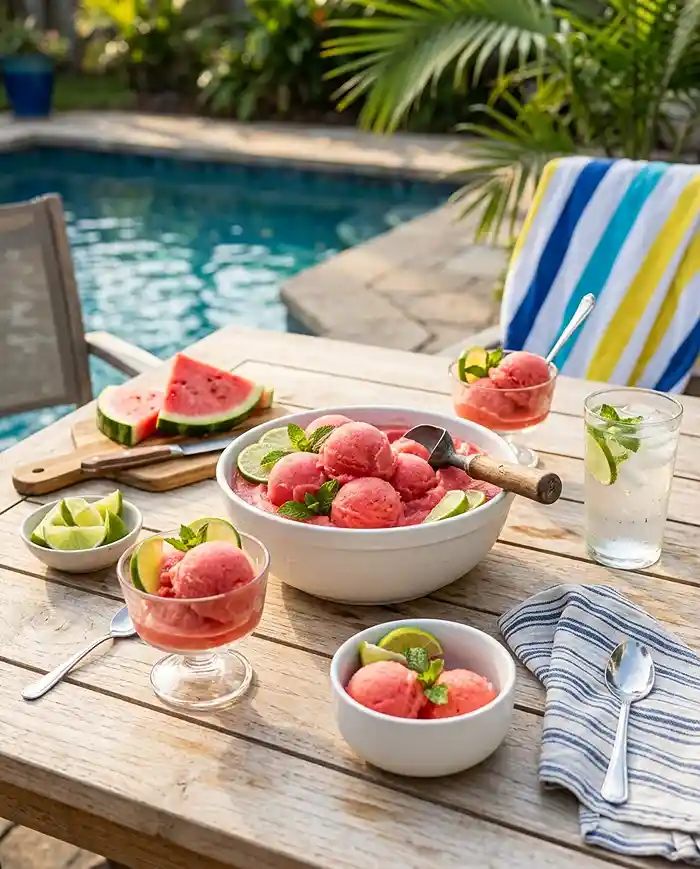
This Gluten‑Free Watermelon Lime Sorbet is the kind of dessert that elevates a simple summer meal into something people remember. Scoop it into chilled glasses alongside a slice of gluten‑free red, white, and blue cheesecake bars for a show‑stopping Fourth of July dessert spread — the tangy sorbet cuts right through the richness of the cheesecake and the color contrast on the table is gorgeous.
For a lighter pairing, serve it after a casual dinner with glasses of gluten‑free strawberry hibiscus agua fresca or as a palate cleanser between courses at a backyard dinner party. On quieter mornings, drop a scoop into a bowl alongside a jar of gluten‑free peach coconut chia pudding for a breakfast that feels like a vacation.
Go Ahead — Make the Sorbet
I really think you’re going to love how simple and rewarding this one is. Grab a ripe watermelon this weekend, freeze your bowl tonight, and let me know how it turns out in the comments below — I read every single one. And if you snap a photo of those rosy pink scoops, save it to Pinterest so other gluten‑free families can find it too.
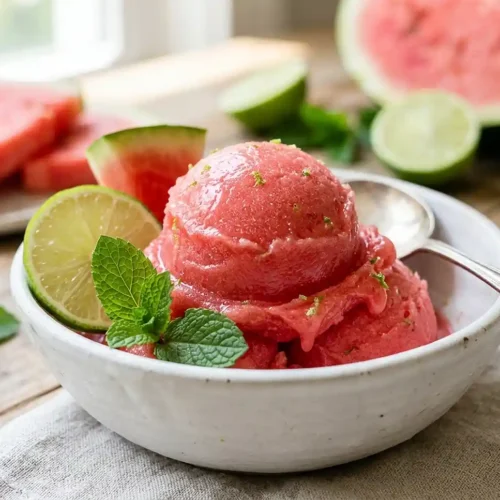
Gluten-Free Watermelon Lime Sorbet
Equipment
- Ice cream maker with freezer bowl
- Blender, food processor, or immersion blender
- Large mixing bowl or pitcher
- Airtight freezer-safe container
- Measuring cups and spoons
- Spoon or spatula
Ingredients
Sorbet Base
- 5 cups cubed watermelon about 770 grams, seedless recommended
- 1 cup granulated sugar 200 grams; you may not need all of it — use the egg float test
- 3 tablespoons fresh lime juice
- 1 tablespoon lime zest
- 1 hefty pinch salt
Instructions
- Freeze your ice cream maker bowl 24 hours in advance. A partially frozen bowl won’t churn the sorbet fast enough and will result in a soupy texture that takes much longer to set.
- Combine 5 cups of cubed watermelon, 3 tablespoons of fresh lime juice, and 1 tablespoon of lime zest in a blender, food processor, or tall container with an immersion blender. Process for 30 to 60 seconds until completely smooth with no chunks remaining. You should end up with about 4 cups of silky, bright pink puree.
- Add about half of the sugar (roughly 1/2 cup) to the puree and stir steadily for about a minute until the grains are fully dissolved. Reserve the remaining sugar for the next step.
- Perform the egg float test: wash and thoroughly dry a whole egg in its shell and gently lower it into the sorbet base. If the egg floats with a quarter-sized circle of shell visible above the surface, the sugar concentration is correct. If it sinks, gradually stir in more of the reserved sugar and retest. If it floats higher than a quarter-sized patch, add a splash more watermelon puree or lime juice to dilute.
- Stir in a hefty pinch of salt. Taste and adjust — the base should be noticeably sweeter than you’d want a drink to be, because freezing dulls sweetness. Add more salt or lime juice as needed for balanced flavor.
- Transfer the base to a lidded container or pitcher and refrigerate for at least 2 hours, though overnight is ideal. The mixture should reach 40°F or below before churning for the smoothest possible texture.
- Pour the chilled base into the frozen ice cream maker bowl and churn according to your machine’s instructions, typically 20 to 25 minutes. The sorbet is ready when it reaches a soft-serve consistency, pulls away from the sides of the bowl, and holds a gentle peak when the dasher is lifted. Alternatively, for a granita method, pour the base into a shallow baking dish, freeze for 45 minutes, then rake with a fork every 30 minutes for about 3 hours.
- Transfer the freshly churned sorbet to an airtight container. Press a piece of parchment paper or plastic wrap directly against the surface to prevent ice crystals, seal the lid, and freeze for at least 2 hours before serving. Let sit at room temperature for 5 to 8 minutes before scooping if frozen solid.