
Gluten-Free Eggless Vanilla Cake Recipe
Make a soft, tender gluten-free eggless vanilla cake recipe with step-by-step instructions, simple ingredients, troubleshooting tips, and storage advice.
My nephew has both a gluten intolerance and an egg allergy, and for years his birthday cake was an afterthought—a dry, dense block that crumbled the second you sliced it. I spent months testing gluten-free eggless vanilla cake recipes before I finally cracked the combination that works every single time.
The secret turned out to be two things most recipes skip: homemade buttermilk and a cornstarch slurry as the egg replacer. Together, they give the crumb moisture, structure, and that soft, tender bite you expect from a real birthday cake.
Well… if you’ve ever pulled a gluten-free cake out of the oven only to watch it collapse in the center, this is the recipe that’s going to change that experience for good.
Table of Contents
Why You’ll Love This Gluten-Free Eggless Vanilla Cake
- Genuinely soft crumb: The homemade buttermilk and vegetable oil team up to keep this cake moist for days—no dry, crumbly edges by day two.
- Beginner-friendly: If you own a hand mixer and an 8-inch cake pan, you have everything you need. No special techniques or hard-to-find ingredients.
- Egg-free and easily dairy-free: Swap the butter for a vegan baking stick and the milk for oat or almond milk, and this becomes a fully plant-based celebration cake.
- Scales beautifully for gatherings: This recipe yields 12 small slices, which is exactly right for a family birthday or a small holiday dessert table.
The Secret to Perfect Gluten-Free Eggless Vanilla Cake
- The cornstarch slurry does the binding work eggs normally would. Cornstarch dissolved in water acts as a binding agent in baked goods, holding the wet and dry ingredients together in the absence of eggs. That’s why you mix it until fully smooth before adding it to the batter.
- Homemade buttermilk activates the leavening: Stirring white vinegar into milk creates an acid that reacts with the baking soda, generating lift and tenderness in the crumb. This is what keeps the cake from turning dense and heavy.
- Alternating wet and dry ingredients prevents toughening: Adding the flour and buttermilk in stages—starting and ending with flour—keeps the gluten-free flour from over-hydrating, which can lead to a gummy, rubbery texture.
- Xanthan gum in your flour blend is non-negotiable: Without it, gluten-free cakes have nothing to provide elasticity and structure. Using a multipurpose gluten-free flour that already contains xanthan gum simplifies the process and produces consistent results.
Ingredients
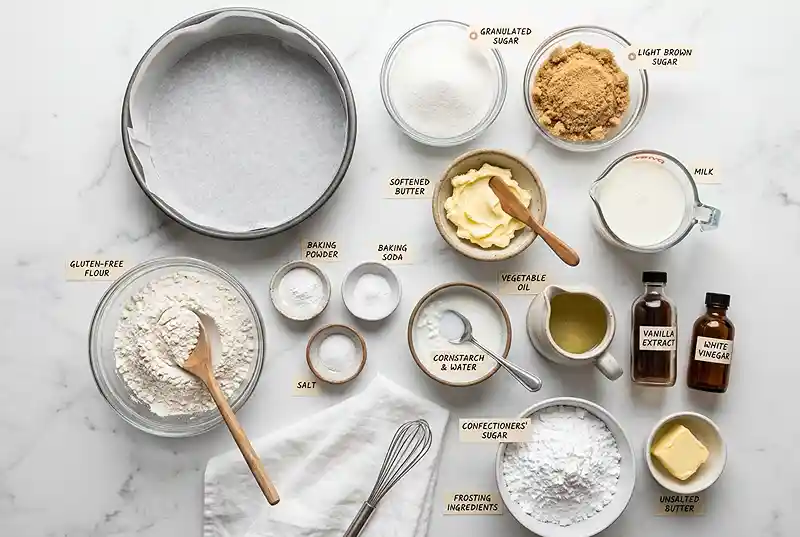
Everything is straightforward and most items are pantry staples. Here’s the full list for one 8-inch single-layer cake with vanilla frosting, serving 12.
For the Cake
| Ingredient | Amount | Notes |
|---|---|---|
| Unsalted butter or vegan baking stick | ¼ cup | Room temperature; softened butter creams more evenly |
| Light brown sugar, packed | 2 tablespoons | Adds a subtle caramel depth to the vanilla flavor |
| Granulated sugar | ½ cup | |
| Milk | 1 cup | Any milk works; use oat or almond for dairy-free |
| White vinegar | 1 tablespoon | Creates homemade buttermilk with the milk above |
| Cornstarch | 2 rounded tablespoons | Mixed with water to replace eggs |
| Water | 3 tablespoons | For the cornstarch slurry |
| Multipurpose gluten-free flour | 1¼ cups | Use a blend with xanthan gum already included |
| Baking powder | 1¼ teaspoons | |
| Baking soda | ¼ teaspoon | Works with the vinegar-milk for lift |
| Kosher salt | ¼ teaspoon | |
| Vegetable oil | 2 tablespoons | Adds moisture that stays soft even after refrigerating |
| Pure vanilla extract | 1 teaspoon | Use pure, not imitation, for the cleanest flavor |
For the Vanilla Frosting
| Ingredient | Amount | Notes |
|---|---|---|
| Unsalted butter or vegan baking stick | ¼ cup | Room temperature |
| Confectioners’ sugar | 2¼ cups | Sift if lumpy to avoid a grainy frosting |
| Pure vanilla extract | 1 teaspoon | |
| Water | 2 tablespoons | Add gradually—you may not need all of it |
Instructions
Step 1: Prep Your Pan and Oven
Preheat the oven to 350°F. Grease an 8-inch cake pan thoroughly, then line the bottom with parchment paper. Set aside while you prepare the batter.
Step 2: Cream the Butter and Sugars
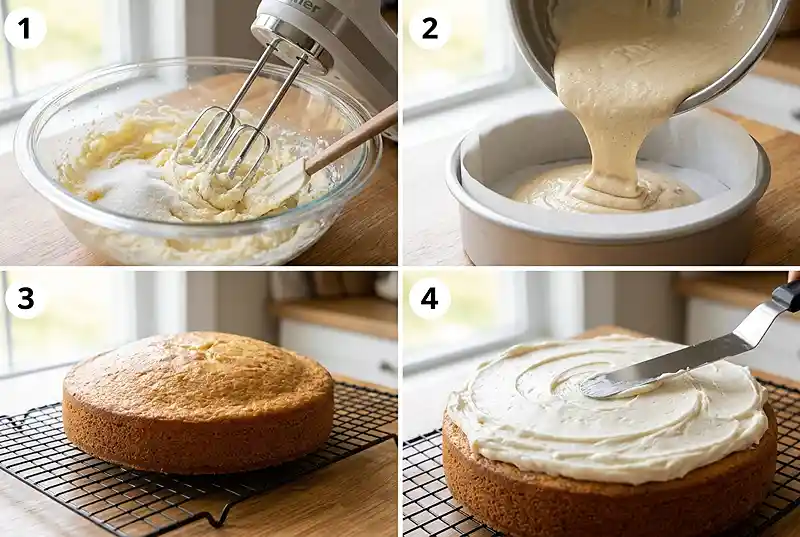
In a large bowl using an electric mixer with the paddle attachment, beat together the ¼ cup unsalted butter or vegan baking stick, the 2 tablespoons light brown sugar, and the ½ cup granulated sugar until light and fluffy—about 2–3 minutes. The mixture should look pale and noticeably increased in volume.
Step 3: Make the Buttermilk
In a large measuring cup, measure out 1 cup of milk. Stir in 1 tablespoon of white vinegar and set aside. The milk will begin to curdle slightly within a few minutes—that’s exactly what you want.
Step 4: Prepare the Cornstarch Slurry
In a small bowl, mix together the 2 rounded tablespoons of cornstarch and 3 tablespoons of water using a spoon. It will be thick and tacky at first—keep stirring until it becomes thin and watery. This is your egg replacer and it needs to be fully dissolved before going into the batter.
Pro Tip: Don’t rush this step. Undissolved cornstarch can leave starchy pockets in the finished cake.
Step 5: Combine Wet Ingredients
Beat the cornstarch water mixture, the 2 tablespoons of vegetable oil, and 1 teaspoon pure vanilla extract into the creamed butter and sugar until combined. The batter will look chunky and a little broken at this stage—that’s completely normal. It comes together once you add the flour.
Step 6: Whisk the Dry Ingredients
In a separate large bowl, whisk together the 1¼ cups gluten-free flour, 1¼ teaspoons baking powder, ¼ teaspoon baking soda, and ¼ teaspoon kosher salt until evenly distributed.
Step 7: Alternate Wet and Dry
With the mixer on low, add some of the flour mixture, then some of the buttermilk, alternating until both are incorporated. Start and end with the flour mixture. Once everything is combined, stop the mixer and use a spatula to scrape down the sides—don’t overmix or the crumb will be tough.
Step 8: Bake the Cake
Using a spatula, scoop the batter into the prepared 8-inch cake pan and smooth the top with a butter knife. Bake on the center rack at 350°F for 37 minutes, until the top is golden and springs back slightly when carefully touched in the center.
Pro Tip: Avoid opening the oven door in the first 25 minutes. A sudden temperature drop can cause gluten-free cakes to sink.
Step 9: Cool Completely
Let the cake cool almost completely in the pan before attempting to remove it. Then transfer to a wire cooling rack and let it cool completely—don’t rush this. Frosting a warm cake melts the buttercream and creates a sliding, soupy mess.
If the cake has a dome on top, use a thin knife to carefully level it off for a flat frosting surface. You can absolutely leave the dome if you prefer a more rustic look.
Step 10: Make the Vanilla Frosting
While the cake bakes, beat the ¼ cup unsalted butter until smooth and creamy—about 2 minutes. With the mixer on very low speed, slowly add in the 2¼ cups confectioners’ sugar and 1 teaspoon pure vanilla extract. Beat until combined.
With the mixer still running, slowly drizzle in the 2 tablespoons of water a little at a time until you reach a spreadable, fluffy consistency. You may not need all the water. The finished frosting should be as light as whipped cream and hold its shape without drooping.
Step 11: Frost and Decorate
Using an icing spatula or a butter knife, frost the sides and top of the cake. To create pretty swirls or designs, use the back of a spoon or the tip of the icing spatula. Pipe additional swirls around the rim of the cake and top with sprinkles if desired.
Make It Your Own
You know… this simple eggless vanilla cake recipe is genuinely one of the most flexible bases I’ve ever worked with. For a fully dairy-free version, swap the butter for a quality vegan baking stick and use oat milk in place of regular milk. The vinegar still curdles oat milk into a usable buttermilk, so the chemistry stays exactly the same.
Want a lemon vanilla version? Add 1 tablespoon of fresh lemon zest to the batter and swap 1 tablespoon of the water in the frosting for fresh lemon juice. The citrus brightens every bite without competing with the vanilla.
For a chocolate twist on this eggless vanilla cake, replace 3 tablespoons of the gluten-free flour with unsweetened cocoa powder and add an extra tablespoon of granulated sugar to compensate for cocoa’s bitterness. The result is a light, fudgy layer cake that’s far from what most people expect of a gluten-free chocolate cake.
If you enjoy working with cottage cheese in your gluten-free baking, you might love exploring this gluten-free cottage cheese tortilla wrap as a savory counterpart to all your gluten-free baking adventures.
Common Problems & Solutions
Man, oh man… gluten-free eggless cakes have a reputation for going sideways, but almost every problem has a simple fix.
Problem: The cake sank in the center. The oven door was likely opened too early, or the cake was underbaked. Bake for the full 37 minutes and test with the springback method before pulling it out—a toothpick that comes out with wet batter means it needs more time.
Problem: The crumb is gummy in the middle. This usually means the cornstarch slurry wasn’t fully dissolved before mixing, or the batter was overmixed after the flour went in. Mix only until the ingredients are just combined once the flour is added.
Problem: The cake is dry and crumbly. The most common cause is overbaking or using a gluten-free flour blend without xanthan gum. According to Beyond Celiac’s guidance on gluten-free baking, xanthan gum is critical for providing the elasticity and moisture retention that gluten normally would. Check your flour label.
Problem: The frosting is too thin and slides off the cake. Add confectioners’ sugar a tablespoon at a time until the frosting thickens. Add water very gradually—a few drops at a time—and only if the frosting is genuinely stiff. Room-temperature butter is also essential; cold butter won’t cream properly.
Storage & Meal Prep
| Method | Duration | Notes |
|---|---|---|
| Counter | 2–3 days | Airtight container; keep away from direct sunlight |
| Fridge | 5–7 days | Bring to room temperature before serving for best texture |
| Freezer | 2–3 months | Wrap individual slices tightly; thaw overnight in fridge |
To serve refrigerated cake at its best, pull it out 30–45 minutes before slicing and let it come to room temperature. Cold gluten-free cake can taste denser than it actually is—a few minutes at room temp makes a noticeable difference.
For a no-waste strategy, crumble any leftover unfrosted cake into a bowl and layer it with whipped cream and fresh berries for a quick trifle. It’s a genuinely satisfying way to use every last slice.
Gluten-Free Eggless Vanilla Cake Recipe FAQs
How do I make a gluten-free cake without eggs?
Replace eggs with a cornstarch slurry made from 2 rounded tablespoons of cornstarch mixed with 3 tablespoons of water. This binds the batter together while baking powder and soda handle the lift. The result is a tender, fully set cake that doesn’t taste egg-free.
Can I make this recipe dairy-free?
Yes. Swap the butter for a vegan baking stick and use oat or almond milk in place of regular milk. The vinegar still curdles non-dairy milk into a usable buttermilk, so the leavening chemistry stays the same. The frosting can be made dairy-free the same way.
What’s the best gluten-free flour to use in this cake?
Use a multipurpose gluten-free flour blend that already contains xanthan gum. Xanthan gum provides the elasticity and structure that gluten normally gives, and blends with it already included remove the guesswork. Single-ingredient flours like almond or rice flour alone won’t produce the same result.
Can I freeze this gluten-free eggless vanilla cake?
Yes. Wrap individual slices tightly in plastic wrap, then store in a zip-top freezer bag for up to 2-3 months. Thaw overnight in the fridge and bring to room temperature before serving for the best texture.
Why did my eggless gluten-free cake sink in the center?
The most common causes are opening the oven door too early or underbaking. Bake for the full 37 minutes and test with the springback method before removing. A toothpick with wet batter means it needs more time.
Serving Suggestions
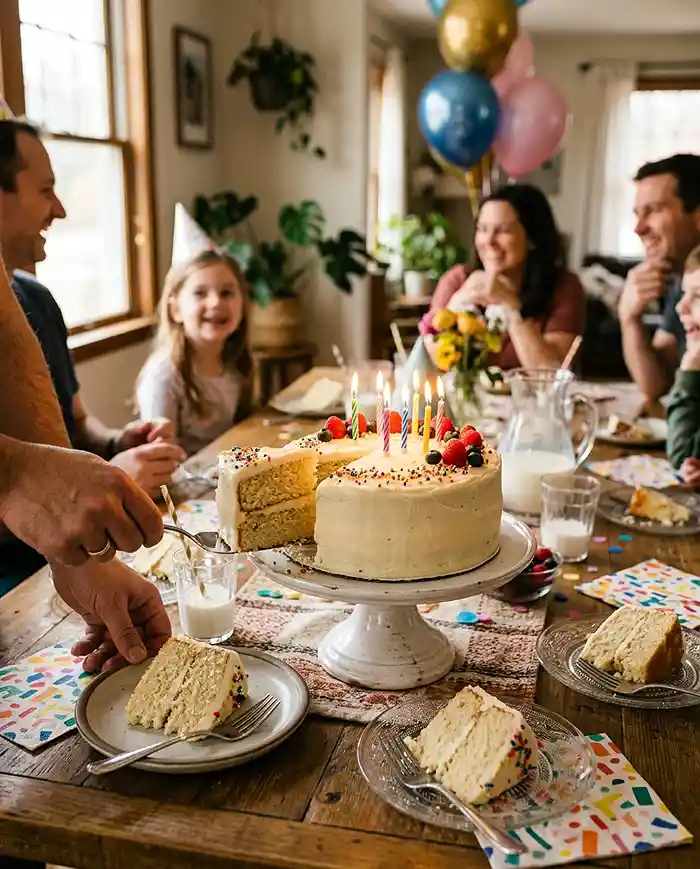
This cake holds its own as a classic layer cake, but it also makes a beautiful sheet cake for larger gatherings. Slice it into squares, dust the top with powdered sugar, and serve it with a bowl of fresh strawberries alongside—it’s been a reliable centerpiece at our family’s Easter dessert spread for three years running.
For a fancier presentation, pair the vanilla cake with a scoop of vanilla bean ice cream or a spoonful of lightly sweetened whipped cream. The clean vanilla flavor in this gluten-free simple eggless vanilla cake makes it a natural canvas for fresh fruit, warm berry compote, or a drizzle of caramel sauce.
If you love building gluten-free meals from scratch across every course, explore this protein-packed cottage cheese chicken wrap as a satisfying savory lunch before dessert, or try this cottage cheese wrap quiche recipe for a brunch that pairs beautifully with a slice of this vanilla cake.
Give this recipe a try for your next birthday, gathering, or any occasion that deserves a real homemade cake. Drop a comment below and let me know how it turned out—and if you tweaked anything, I genuinely want to hear about it. If it made someone at your table smile, sharing it on Pinterest helps other families find it too.

Simple Gluten-Free Eggless Vanilla Cake Recipe That Works
Equipment
- 8-inch cake pan
- Electric mixer
- Mixing bowls
- Whisk
- Measuring cups
- Spatula
- Wire cooling rack
- Icing spatula
Ingredients
For the Cake
- ¼ cup Unsalted butter or vegan baking stick Room temperature
- 2 tablespoons Light brown sugar Packed
- ½ cup Granulated sugar
- 1 cup Milk Any milk works; oat or almond for dairy-free
- 1 tablespoon White vinegar For homemade buttermilk
- 2 rounded tablespoons Cornstarch For egg replacer
- 3 tablespoons Water For cornstarch slurry
- 1 ¼ cups Multipurpose gluten-free flour Use blend with xanthan gum
- 1 ¼ teaspoons Baking powder
- ¼ teaspoon Baking soda
- ¼ teaspoon Kosher salt
- 2 tablespoons Vegetable oil
- 1 teaspoon Pure vanilla extract
For the Vanilla Frosting
- ¼ cup Unsalted butter or vegan baking stick Room temperature
- 2 ¼ cups Confectioners’ sugar Sift if lumpy
- 1 teaspoon Pure vanilla extract
- 2 tablespoons Water Add gradually as needed
Instructions
- Preheat oven to 350°F. Grease an 8-inch cake pan and line the bottom with parchment paper.
- Cream together the butter, brown sugar, and granulated sugar until light and fluffy, about 2–3 minutes.
- Make the buttermilk by stirring the vinegar into the milk and letting it sit for a few minutes.
- Whisk together the cornstarch and water until fully dissolved to create the egg replacer slurry.
- Beat the cornstarch slurry, vegetable oil, and vanilla extract into the creamed mixture until combined.
- In a separate bowl, whisk together the gluten-free flour, baking powder, baking soda, and salt.
- Alternately add the flour mixture and buttermilk to the wet ingredients, beginning and ending with the flour mixture. Mix just until combined.
- Transfer the batter to the prepared pan, smooth the top, and bake for 37 minutes until golden and springy in the center.
- Cool the cake in the pan, then transfer to a wire rack and cool completely before frosting.
- For the frosting, beat the butter until creamy. Gradually add confectioners’ sugar and vanilla, then add water until light and spreadable.
- Frost the cooled cake, decorate as desired, and serve.