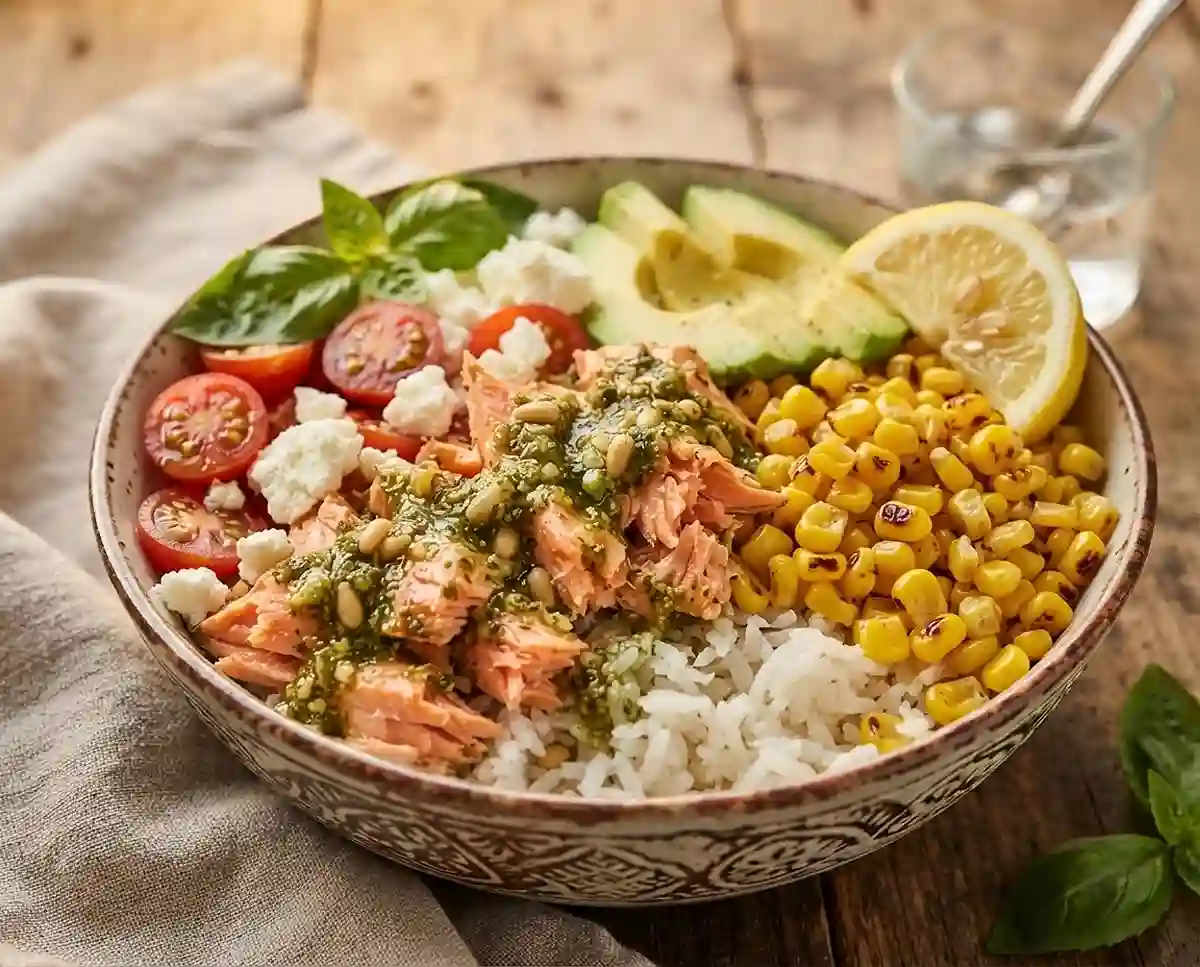
Pesto Salmon Corn Rice Bowls
Gluten-Free Pesto Salmon Corn Rice Bowls — here’s the recipe, ingredients, and step-by-step guide to a high-protein dinner that comes together in under 30 minutes.
The first time I made gluten-free salmon bowls, I overcooked the fish into dry, flaky sadness and drowned it in pesto trying to compensate. Not my finest hour. But that failure taught me the one thing that changes everything: pull the salmon out the moment it flakes at the thickest part, then let it rest for two minutes before tossing it with the pesto. That small adjustment turns dinner from mediocre to genuinely satisfying.
What makes these bowls work is how every component earns its place. The warm, lightly charred corn adds a sweetness that plays off the herby pesto. The avocado brings that rich creaminess — smooth as warm butter against the bright lemon finish. You get color, texture, and a complete meal in one bowl without any complicated steps.
Does it get any better than a weeknight dinner that looks like it came from a restaurant but takes less than 30 minutes? Well… I don’t think so. And the whole family agrees, which is honestly the harder vote to win.
Why You’ll Love These Gluten-Free Pesto Salmon Corn Rice Bowls
- High-protein and filling: Each serving delivers a solid hit of protein from the salmon, making this a genuinely satisfying high-protein dinner without relying on supplements or heavy starches.
- Beginner-friendly: The instructions are straightforward — oven-baked salmon, skillet corn, and bowl assembly. No advanced technique required.
- Naturally gluten-free: When you use a certified gluten-free basil pesto, this recipe is completely safe for anyone avoiding gluten, with no substitutions needed.
- Flexible and customizable: Works beautifully with white rice, brown rice, or even cauliflower rice for a lower-carb version. Feta is optional, and the bowl is dairy-free without it.
The Secret to Perfect Gluten-Free Pesto Salmon Corn Rice Bowls
- Bake, don’t pan-fry: Oven baking at 400°F gives the salmon even, gentle heat that prevents the outside from overcooking before the center is done. This is especially important with thicker fillets.
- Char the corn dry: Cooking corn in a dry or lightly oiled skillet over medium-high heat without crowding it creates those slightly caramelized edges that add sweetness and depth. Watery, steamed corn won’t deliver the same flavor.
- Split the pesto intentionally: Tossing the salmon in half the pesto and drizzling the rest over the assembled bowls gives you layered flavor rather than a one-note, uniformly coated result.
- Season the salmon directly: Garlic powder and smoked paprika applied before baking form a light crust that seasons the fish from the outside in, complementing — not competing with — the pesto finish.
Table of Contents
Ingredients
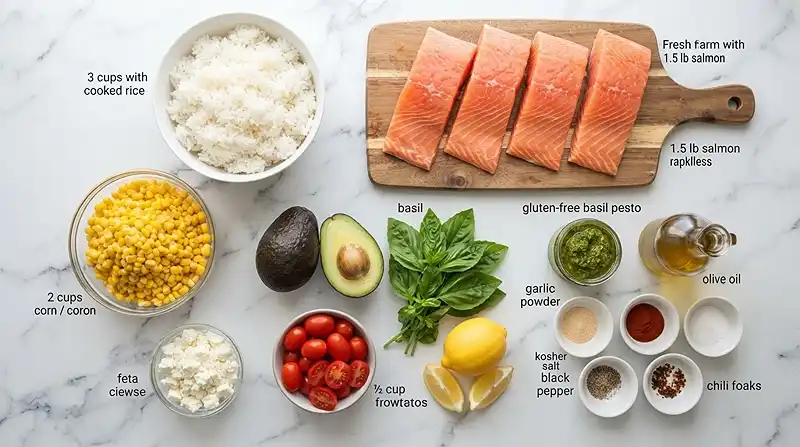
| Category | Ingredient | Amount | Notes |
|---|---|---|---|
| Protein | Salmon fillets, skin removed | 1½ lbs | Fresh or thawed; pat dry for best bake |
| Base | Cooked white or brown rice | 3 cups | Day-old rice works great here |
| Vegetable | Corn kernels, fresh or frozen | 2 cups | Thaw frozen corn fully before cooking |
| Sauce | Gluten-free basil pesto | ½ cup | Check the label — many store pestos contain wheat |
| Fat | Olive oil | 1 tbsp | For brushing the salmon |
| Seasoning | Garlic powder | 1 tsp | |
| Seasoning | Smoked paprika | ½ tsp | |
| Seasoning | Salt | ½ tsp | |
| Seasoning | Black pepper | ¼ tsp | |
| Toppings | Avocado, sliced | 1 | Slice just before serving |
| Toppings | Cherry tomatoes, halved | ½ cup | |
| Toppings | Crumbled feta cheese | ¼ cup | Optional; omit for dairy-free |
| Finish | Fresh basil, chopped | 2 tbsp | |
| Finish | Lemon, cut into wedges | 1 | Don’t skip — brightens the whole bowl |
Pesto label check: Traditional pesto is gluten-free, but some store-bought versions include fillers or are processed on shared equipment. The trusted celiac research from the Celiac Disease Foundation recommends looking for a certified gluten-free label, especially with sauces and condiments.
Instructions
-
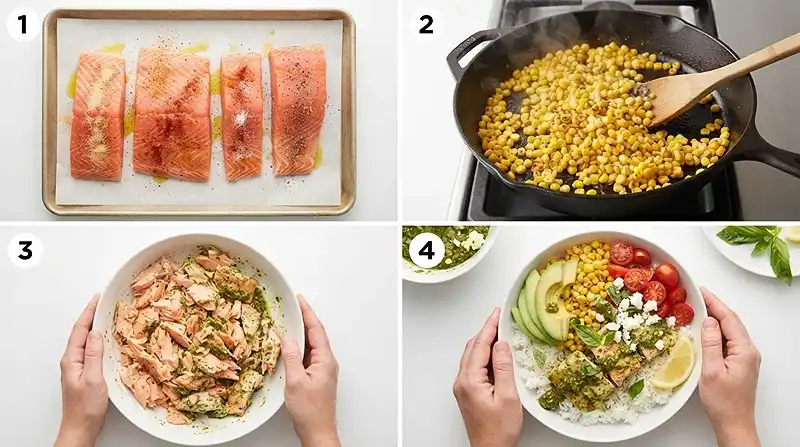
Preheat the oven to 400°F (200°C) and line a baking sheet with parchment paper. This temperature gives the salmon a firm exterior while keeping the center tender and moist.
-
Place the salmon on the baking sheet and brush with 1 tbsp olive oil. Season with 1 tsp garlic powder, ½ tsp smoked paprika, ½ tsp salt, and ¼ tsp black pepper. Make sure the seasoning covers the entire top surface evenly.
-
Bake for 10–14 minutes, or until the salmon flakes easily when pressed gently with a fork at its thickest point. Thinner fillets will be done closer to 10 minutes — watch for that just-opaque center.Pro Tip: Pull the salmon out slightly early. It’ll continue cooking on the hot pan for a minute or two after you remove it from the oven.
-
While the salmon bakes, cook the corn. Heat a skillet over medium-high heat — no oil needed if using a non-stick pan. Add 2 cups corn kernels and cook for 4–6 minutes, stirring occasionally, until edges turn golden brown and you catch that faint nutty aroma.
-
Flake the cooked salmon into large, chunky pieces using a fork. Don’t over-shred — you want satisfying bites, not fish paste. Gently toss with about half of the pesto (roughly ¼ cup).
-
Divide the cooked rice evenly among four bowls, about ¾ cup per bowl.
-
Layer the toppings: Add pesto salmon, warm charred corn, avocado slices, and halved cherry tomatoes to each bowl.
-
Finish and serve. Drizzle the remaining pesto over the bowls. Sprinkle with ¼ cup crumbled feta and 2 tbsp fresh basil if using. Serve immediately with fresh lemon wedges on the side.
Make It Your Own
Swap the Rice Base
Brown rice adds a nuttier flavor and more fiber to these gluten free salmon bowls, while cauliflower rice keeps things lower-carb without losing the satisfying bowl format.
Quinoa is another great option — it’s naturally gluten-free and adds a complete protein profile alongside the salmon. Just cook it according to package directions and use it as a 1:1 swap for rice.
Change Up the Protein
You know… shrimp works beautifully in this bowl if salmon isn’t your thing. Toss peeled shrimp with the same seasonings and cook in a hot skillet for 2–3 minutes per side until pink and slightly curled.
Canned salmon is a budget-friendly shortcut that still delivers on flavor. Drain it well, toss with pesto, and skip the baking step entirely for a five-minute assembly.
Make It Dairy-Free
Simply skip the feta and this bowl becomes completely dairy-free. The pesto, avocado, and fresh herbs provide enough richness and flavor that you genuinely won’t miss the cheese.
If you want a creamy element, a thin drizzle of dairy-free sauces from other gluten-free recipes can work beautifully here as a topping variation.
Adjust the Pesto
Homemade pesto gives you full control over ingredients, and it’s easier than most people think. Blend fresh basil, pine nuts, garlic, olive oil, lemon juice, and nutritional yeast if you’re skipping parmesan — the result is bright, punchy, and 100% verified gluten-free.
Sun-dried tomato pesto or arugula pesto are fun variations that shift the flavor profile entirely while keeping the same technique.
Common Problems & Solutions
Dry, Overcooked Salmon
Problem: The salmon is dry and tough after baking. Solution: Reduce your bake time and start checking at the 10-minute mark.
Salmon continues cooking off heat, so pulling it out while the very center still looks slightly translucent is the right call. The residual heat finishes the job. Use a fork — if it flakes with gentle pressure, it’s done.
Watery, Flavorless Corn
Problem: The corn tastes bland and wet instead of sweet and charred. Solution: Pat frozen corn completely dry before it hits the pan, and resist the urge to stir constantly.
Corn needs direct contact with a hot surface to caramelize. Stirring too often steams it instead of charring it. Let it sit for 60–90 seconds between stirs for those golden edges.
Pesto That Tastes Too Sharp
Problem: The pesto flavor is overwhelming or too bitter. Solution: Squeeze fresh lemon over the assembled bowl immediately before eating.
Man, oh man… acid is the fix for almost every overseasoned sauce. A generous squeeze of lemon brightens and balances the pesto without diluting it. A pinch of extra salt can also help if bitterness is the issue.
Bowls That Go Soggy
Problem: The rice gets wet and mushy after assembly. Solution: Use rice that’s cooked and cooled slightly — not just-steamed and piping hot.
Excess steam from very hot rice will make your toppings wilt and your bowl feel heavy. Day-old rice from the fridge, reheated in the microwave and fluffed with a fork, gives you the ideal texture for bowl meals. According to nutrition guidance from Harvard’s School of Public Health, cooled and reheated rice also has a slightly lower glycemic impact, which is a bonus.
Storage & Meal Prep
| Method | Duration | Notes |
|---|---|---|
| Counter | Not recommended | Fish should not sit at room temperature |
| Fridge | 3–4 days | Store components separately for best texture |
| Freezer | Up to 2 months | Freeze salmon and rice only; add fresh toppings after thawing |
For meal prep, store the pesto salmon, rice, and corn in separate airtight containers in the fridge. Add avocado, tomatoes, feta, and basil fresh when you’re ready to eat — those toppings don’t hold well.
Reheat the salmon gently in a skillet over low heat with a splash of water, or in the microwave at 50% power in 30-second bursts. High heat dries it out fast. Check out these no-bake gluten-free meal prep ideas for more ways to plan ahead without cooking stress.
Pesto Salmon Corn Rice Bowls FAQs
Can I use store-bought pesto for this recipe?
Yes, store-bought pesto works well here. The key is to check the label carefully — many commercial pestos are naturally gluten-free, but some contain fillers or are processed on shared equipment with wheat. Look for a certified gluten-free label to be safe.
How do I know when the salmon is fully cooked?
The salmon is done when it flakes easily with a fork at its thickest point and turns from translucent to opaque throughout. This typically happens at 10–14 minutes at 400°F. Start checking at 10 minutes, especially with thinner fillets.
What’s the best rice to use for salmon bowls?
White rice gives you a neutral, fluffy base that lets the pesto and toppings shine. Brown rice adds more fiber and a nuttier flavor. Cauliflower rice is a low-carb alternative that works well if you want a lighter bowl.
Why did my corn turn out soggy instead of charred?
Soggy corn usually means the pan wasn’t hot enough or the corn was too wet. Pat frozen corn completely dry before adding it to the skillet, use medium-high heat, and avoid stirring constantly. Let it sit for 60–90 seconds at a time to develop those golden, caramelized edges.
Can I make this recipe ahead for the week?
Yes. Cook the salmon, rice, and corn in advance and store each in a separate airtight container in the fridge for up to 3–4 days. Keep the avocado, tomatoes, feta, and basil separate and add them fresh when assembling each bowl.
Serving Suggestions
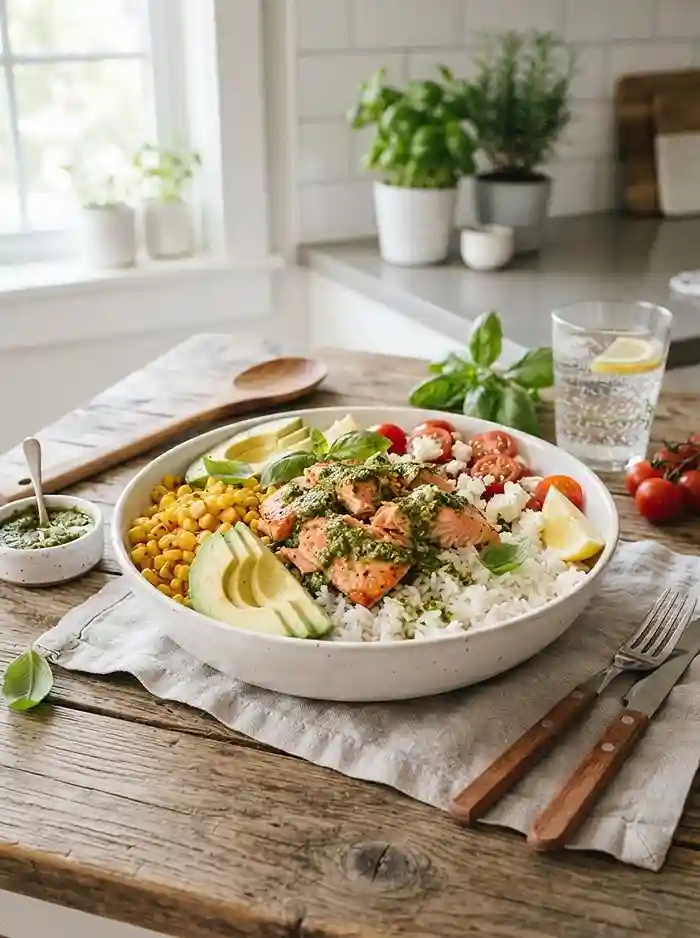
These bowls are complete on their own, but a warm mug of something on the side makes the meal feel more intentional. Try pairing them with the earthy gluten-free mushroom tea for a grounding finish to dinner.
For a Fourth of July cookout or a casual summer gathering, these bowls scale beautifully for a crowd. Set up the components buffet-style and let everyone build their own — it’s a low-stress way to feed people with different dietary needs at the same table.
If you’re serving these as part of a meal prep week, pair with a light green salad or a citrus-dressed slaw on the side to add freshness and volume without extra cooking.
Give these gluten-free pesto salmon corn rice bowls a try this week and let me know how it goes in the comments below. If you swapped something out or found a variation your family loved, I’d genuinely love to hear about it.
And if this recipe made it into your weeknight rotation, sharing it to Pinterest helps other gluten-free families find it too — every save makes a real difference.
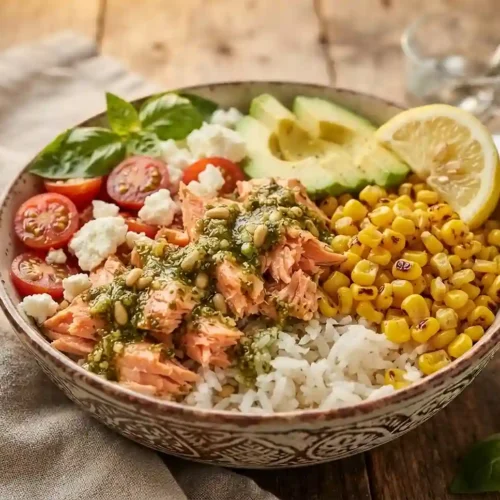
Gluten-Free Pesto Salmon Corn Rice Bowls
Equipment
- Oven
- Baking sheet
- Parchment paper
- Skillet
- Fork
- Four serving bowls
Ingredients
Protein
- 1½ lbs Salmon fillets, skin removed Fresh or thawed; pat dry for best bake
Base
- 3 cups Cooked white or brown rice Day-old rice works great here
Vegetable
- 2 cups Corn kernels, fresh or frozen Thaw frozen corn fully before cooking
Sauce
- ½ cup Gluten-free basil pesto Check the label; many store pestos contain wheat
Fat
- 1 tbsp Olive oil For brushing the salmon
Seasoning
- 1 tsp Garlic powder
- ½ tsp Smoked paprika
- ½ tsp Salt
- ¼ tsp Black pepper
Toppings
- 1 Avocado, sliced Slice just before serving
- ½ cup Cherry tomatoes, halved
- ¼ cup Crumbled feta cheese Optional; omit for dairy-free
Finish
- 2 tbsp Fresh basil, chopped
- 1 Lemon, cut into wedges Don’t skip; brightens the whole bowl
Instructions
- Preheat the oven to 400°F (200°C) and line a baking sheet with parchment paper.
- Place the salmon on the baking sheet and brush with 1 tbsp olive oil. Season with 1 tsp garlic powder, ½ tsp smoked paprika, ½ tsp salt, and ¼ tsp black pepper, covering the top surface evenly.
- Bake for 10–14 minutes, or until the salmon flakes easily when gently pressed with a fork at its thickest point. Start checking at 10 minutes, especially for thinner fillets.
- While the salmon bakes, heat a skillet over medium-high heat. Add 2 cups corn kernels and cook for 4–6 minutes, stirring occasionally, until the edges turn golden brown and lightly charred.
- Flake the cooked salmon into large, chunky pieces using a fork. Gently toss with about half of the pesto, roughly ¼ cup.
- Divide the cooked rice evenly among four bowls, about ¾ cup per bowl.
- Add the pesto salmon, warm charred corn, avocado slices, and halved cherry tomatoes to each bowl.
- Drizzle the remaining pesto over the bowls. Sprinkle with ¼ cup crumbled feta and 2 tbsp fresh basil if using. Serve immediately with fresh lemon wedges.