Gluten-Free Lemon Curd Blueberry Loaf
Make this gluten-free lemon curd blueberry loaf with step-by-step instructions, layered lemon curd filling, fresh blueberries, and storage tips.
The first time I layered lemon curd into a loaf cake, I stood at my counter in total disbelief when it sank straight to the bottom. I’d skipped the step of spreading a thin batter layer first, and I paid for it. That failure taught me everything about how this gluten-free lemon curd blueberry loaf actually works—and now it comes out beautifully layered every single time.
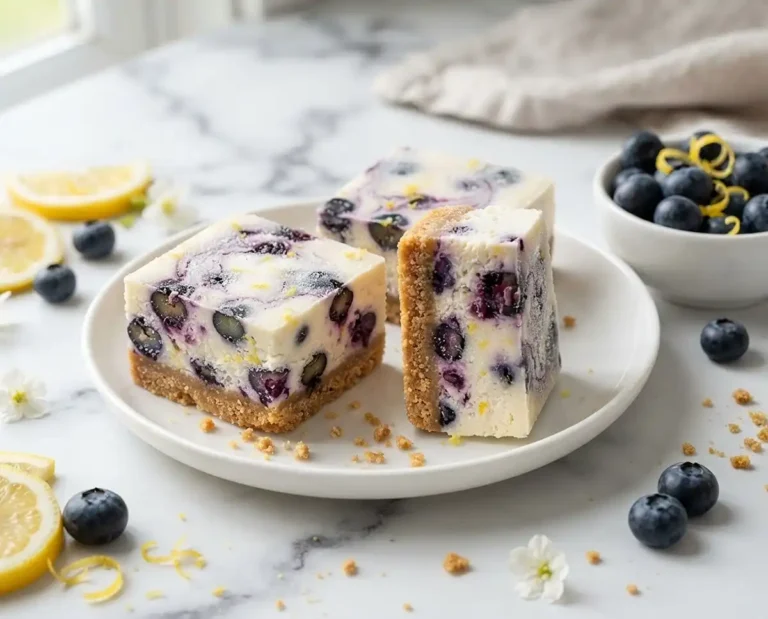
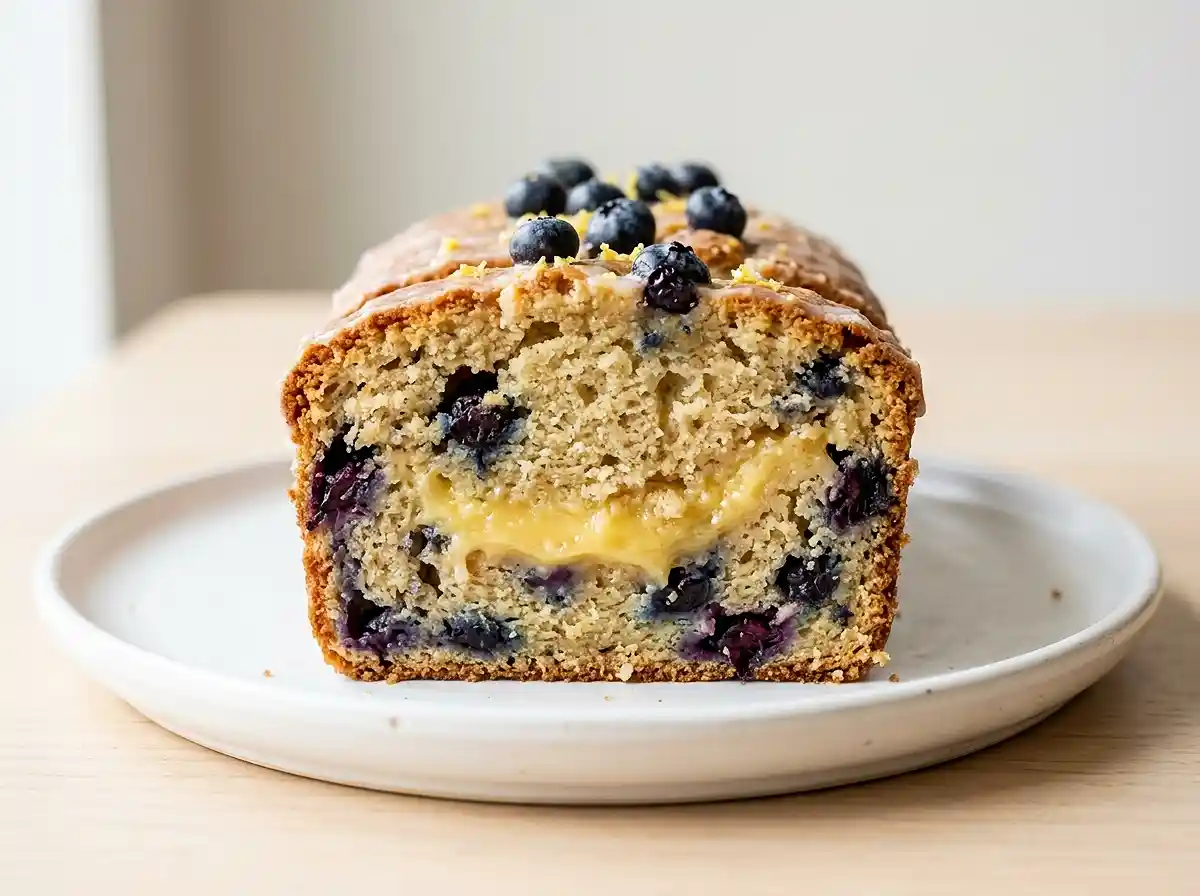
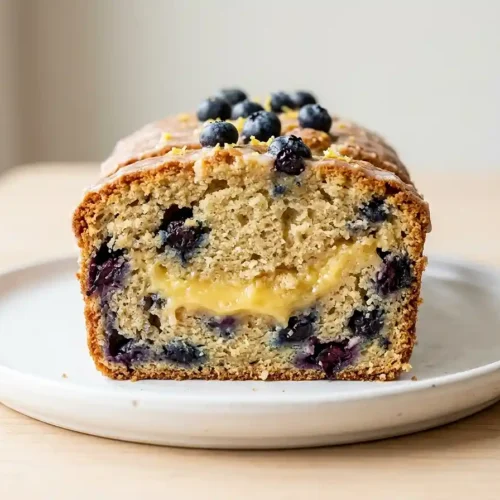
This isn’t a quick-mix-and-dump recipe. It’s the kind of loaf that earns compliments, the kind where people cut a slice, see those ribbons of golden curd between blueberry-flecked crumb, and immediately ask for the recipe.
What’s the secret to getting those layers right without the whole thing collapsing? It comes down to technique—and I’m going to walk you through every step.
Table of Contents
Why You’ll Love This Lemon Curd Blueberry Loaf Cake
- Tender, moist crumb — kefir or buttermilk keeps every slice soft for days, not just the first hour out of the oven.
- Beginner-friendly layering — the batter is thick enough to hold the curd in place without any special tools or tricks.
- Naturally adaptable — works with store-bought lemon curd or your own homemade batch, and dairy-free swaps are easy.
- Works for any occasion — ideal for weekend brunch, afternoon tea, or a beautiful addition to an Easter or Mother’s Day dessert table.
The Secret to Perfect Gluten-Free Lemon Curd Blueberry Loaf
- Reverse creaming method — mixing the butter into the dry ingredients first coats every flour particle in fat, which limits gluten development and produces an exceptionally fine, tender crumb.
- Kefir or buttermilk — the acidity activates the baking powder properly and adds moisture that keeps the loaf from drying out, a common struggle with gluten-free baking.
- Layering strategy — starting and ending with batter (not curd) prevents the filling from sinking and creates those defined, beautiful ribbons inside the finished loaf.
- Sugar crust on top — that optional sprinkle of granulated sugar before baking creates a delicate crunch that contrasts perfectly with the soft interior.
Ingredients

Gather everything before you start. The reverse creaming method moves quickly once you begin.
Dry Ingredients
- 260g (2 cups) all-purpose gluten-free flour
- 200g (1 cup) granulated sugar, plus extra for topping
- Zest of 2–3 lemons
- ½ teaspoon fine sea salt
- 2 teaspoons baking powder
Wet Ingredients
- 170g (¾ cup) butter, softened
- 2 large eggs
- 165g (⅔ cup) kefir or full-fat buttermilk
Filling
- 1 cup fresh blueberries
- Lemon curd — half a batch, or use a full mason jar lemon curd recipe
Note on lemon curd: Make it a day ahead so it’s fully set and cold. Warm curd will bleed into the batter rather than holding its layer.
Instructions
Step 1: Prepare the Lemon Curd
Make the lemon curd ahead of time—ideally the day before. It needs to be fully cooled and set to hold its shape as a layer inside the loaf. Warm or runny curd will sink and disappear into the batter during baking.
Step 2: Prep the Pan
Preheat your oven to 350°F. Butter and flour your loaf pan thoroughly, then line it with parchment paper, leaving an overhang on both long sides. This makes lifting the finished loaf out clean and easy.
Step 3: Mix the Batter Using Reverse Creaming
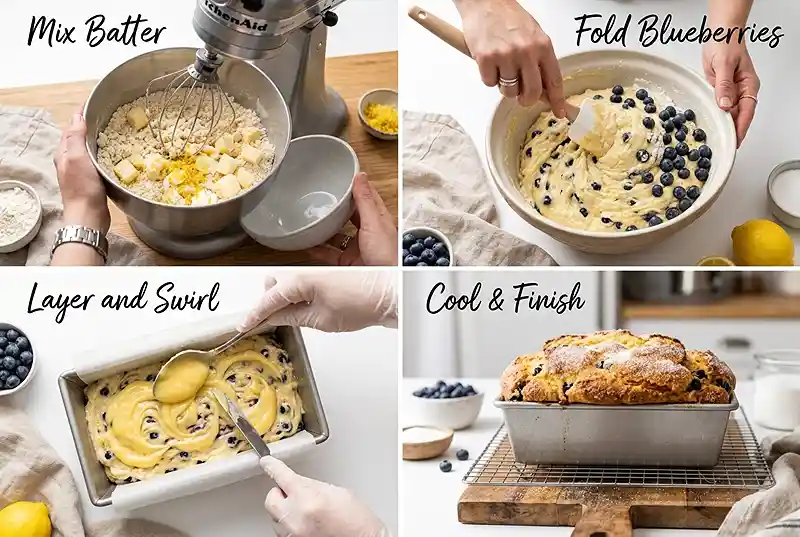
In the bowl of a stand mixer fitted with the paddle attachment, add the flour, softened butter, sugar, lemon zest, salt, and baking powder all at once. Cover the top of the bowl with a clean tea towel to catch any flour dust, then turn the mixer on low.
Run it for about 5 minutes until the mixture resembles damp, coarse sand with no visible chunks of butter. The goal here is for the fat to completely coat the flour—this is what gives the crumb its fine, tender texture. Pro Tip: Don’t rush this step. Under-mixed batter at this stage leads to a denser final loaf.
Step 4: Add Eggs and Kefir
With the mixer on medium speed, add the eggs one at a time. Let each egg fully incorporate before adding the next—you’ll see the batter shift from sandy to smooth. Then pour in the kefir and beat for 3–5 minutes.
You’re looking for a batter that’s airy, fluffy, and visibly lightened—almost like a thick whipped cream. Man, oh man, when it gets to that stage, you’ll know the leavening is going to do its job. Fold in the fresh blueberries gently with a spatula so they stay whole.
Step 5: Layer the Batter and Curd
Spread a quarter of the batter into the bottom of the prepared pan in an even layer. Dollop spoonfuls of lemon curd over the batter, then smooth it gently into an even layer using an offset spatula or the back of a spoon. Repeat—another layer of batter, another layer of curd—until you’ve used all the curd.
Finish with a final layer of pure batter on top. You should have roughly four batter layers and three curd layers. Pro Tip: Don’t leave any curd exposed on the very top—it will caramelize and burn before the center is cooked through.
Step 6: Sugar Top and Bake
Sprinkle a couple of tablespoons of granulated sugar evenly over the top of the loaf. This is optional but creates a beautifully crisp crust that contrasts with the soft interior—as satisfying as cracking through crème brûlée with a spoon.
Bake for approximately 60 minutes, until a cake tester or skewer inserted into the center comes out clean. Because this loaf is heavy with filling, it will sink slightly when it comes out of the oven—this is completely normal and doesn’t affect flavor or texture.
Step 7: Cool and Store
Enjoy the loaf warm, or let it cool completely to room temperature. Once cooled, transfer it to an airtight container to prevent it from drying out. It keeps beautifully for several days and actually slices more cleanly once fully cooled.
Make It Your Own
Dairy-free version: Swap the butter for a high-quality vegan butter block (not a spread) and replace the kefir with full-fat coconut milk mixed with a teaspoon of apple cider vinegar. Let the mixture sit for 5 minutes to curdle before using. The fat content in coconut milk keeps the texture rich and moist.
Raspberry curd swap: You know, lemon curd gets all the glory, but raspberry curd works brilliantly in this loaf—especially with the fresh blueberries. The two berries complement each other in a way that feels almost like summer in every bite. Use it in the same quantities as the lemon curd.
Lemon blueberry and lemon curd loaf with almond flavor: Add ½ teaspoon of pure almond extract to the batter along with the kefir. It deepens the fruit flavors without overwhelming them and pairs exceptionally well with the lemon zest already in the batter.
Frozen blueberries: If fresh aren’t available, frozen work fine. Don’t thaw them first—fold them in straight from frozen to prevent them from bleeding purple streaks through the entire batter. Expect an extra 5 minutes of bake time.
Common Problems & Solutions
Problem: The curd sank to the bottom. This usually means the first batter layer was too thin, or the curd was too warm and runny. Next time, make sure your first layer covers the bottom completely with no gaps, and always use fully chilled, set curd. Well… even a quarter-inch gap is enough for the curd to slip through.
Problem: The center is still wet after 60 minutes. This loaf is dense and moisture-heavy, so it can run long. Tent the top loosely with foil to prevent over-browning and continue baking in 5-minute increments. A clean cake tester is the only reliable indicator—not color alone.
Problem: The top cracked dramatically. A crack down the center of a loaf cake is actually a sign of a well-risen, properly leavened bake—not a mistake. If the crack bothers you visually, dust with a little powdered sugar before serving.
Problem: The loaf is dry or crumbly. This typically points to overbaking or under-measuring the kefir. Use a kitchen scale for the most accurate results, and pull the loaf as soon as the tester comes out clean. Residual heat continues cooking after the pan leaves the oven. According to the Celiac Disease Foundation’s guide on gluten-free baking, moisture retention is one of the biggest challenges in GF baking—using fats like butter and acidic dairy like kefir is one of the most effective solutions.
Storage & Meal Prep
| Method | Duration | Notes |
|---|---|---|
| Counter | 2–3 days | Airtight container only — uncovered loaf dries quickly |
| Fridge | 5–7 days | Bring to room temperature before serving for best texture |
| Freezer | 2–3 months | Wrap individual slices in plastic wrap, then foil |
To reheat, warm individual slices in a 300°F oven for 8–10 minutes, or microwave for 20–25 seconds. Avoid high microwave heat—it toughens the crumb fast.
This loaf actually slices more cleanly on day two, making it a great make-ahead option. Bake it the day before an event, cool completely, wrap tightly, and slice fresh the next morning.
Your Questions Answered
Can I use store-bought lemon curd in this gluten-free loaf?
Yes, store-bought lemon curd works well. Choose a thick variety and make sure it’s fully chilled before using so it holds its layer during baking.
How do I know when the loaf is fully baked?
Insert a cake tester into the center — it should come out clean. This loaf runs dense, so check at 60 minutes and add time in 5-minute increments if needed, tenting the top with foil to prevent overbrowning.
Can I freeze slices of this lemon blueberry loaf?
Yes. Cool completely, slice, and wrap each piece individually in plastic wrap before placing in a freezer bag. Slices keep well for up to 2 to 3 months and reheat in a 300 degree oven in about 10 minutes.
Why did the lemon curd sink to the bottom of my loaf?
The first batter layer was likely too thin, or the curd was too warm. Always use chilled, fully set curd and make sure your first batter layer covers the bottom of the pan completely before adding any filling.
Can I make this loaf dairy-free?
Yes. Use a vegan butter block (not a spread) and replace kefir with full-fat coconut milk mixed with one teaspoon of apple cider vinegar. Let it sit for five minutes before using. The fat content keeps the texture rich and moist.
Serving Suggestions
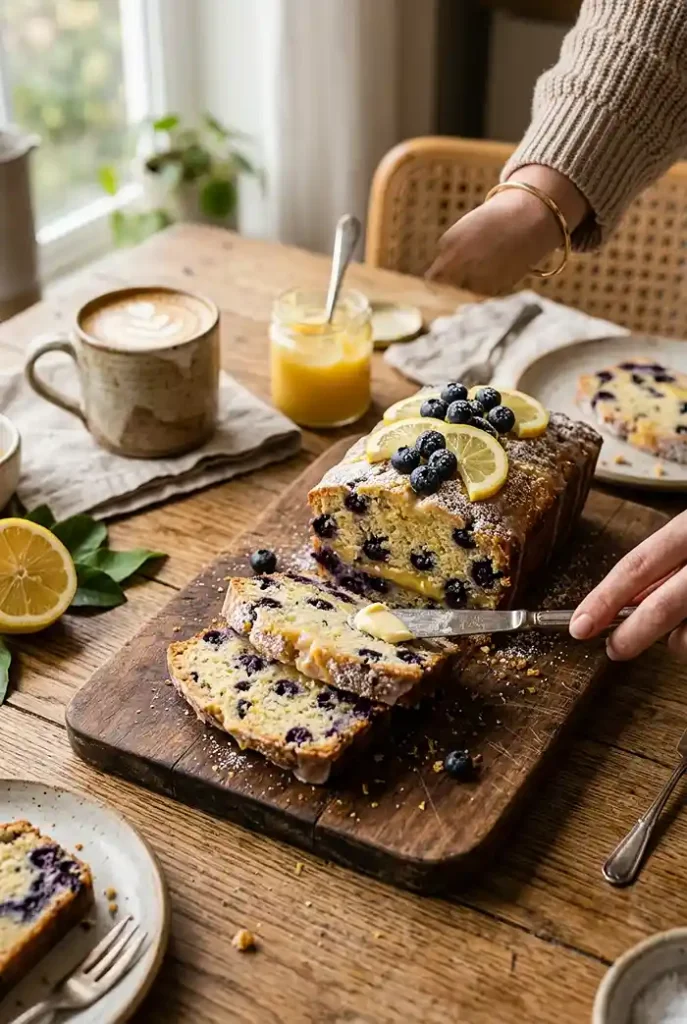
This loaf is excellent served slightly warm with a spoonful of thick Greek yogurt or a small scoop of vanilla ice cream alongside. The tang of the yogurt echoes the lemon curd beautifully and cuts through the richness of the butter.
It’s become a staple at our summer gatherings—I’ve brought it to Fourth of July cookouts where it held its own alongside pies and cobblers, getting sliced down to the last crumb. If you’re building a full brunch spread, pair it with these gluten-free blueberry corn cookie bars for a cohesive berry-forward dessert table.
For something lighter alongside it, these peach cobbler protein chia oats make an easy make-ahead breakfast that balances out the richness of the loaf. And if you’re feeding a crowd with savory items too, the BLT cottage cheese dip cups are always a hit alongside something sweet like this.
If you make this lemon curd and blueberry loaf, leave a comment below and let me know how the layers turned out—I love hearing what variations people try. Save it to Pinterest so you can find it again next time you have a jar of curd waiting to be used.
Gluten-Free Lemon Curd Blueberry Loaf
Equipment
- Stand mixer
- Paddle attachment
- Loaf pan
- Parchment paper
- Mixing bowl
- Spatula
- Offset spatula
- Cake tester or skewer
Ingredients
Dry Ingredients
- 260 g Gluten-free all-purpose flour About 2 cups
- 200 g Granulated sugar Plus extra for topping
- 2-3 lemons Lemon zest
- ½ tsp Fine sea salt
- 2 tsp Baking powder
Wet Ingredients
- 170 g Butter Softened
- 2 Large eggs
- 165 g Kefir or full-fat buttermilk
Filling
- 1 cup Fresh blueberries
- ½ batch Lemon curd Cold and fully set
Instructions
- Prepare the lemon curd ahead of time and chill until fully set before baking.
- Preheat the oven to 350°F. Grease and line a loaf pan with parchment paper.
- Using the reverse creaming method, mix the gluten-free flour, softened butter, sugar, lemon zest, salt, and baking powder until the mixture resembles coarse sand.
- Add the eggs one at a time, then beat in the kefir until the batter is light and fluffy. Fold in the blueberries gently.
- Spread a layer of batter into the prepared pan, add a layer of lemon curd, and continue alternating batter and curd. Finish with a final layer of batter on top.
- Sprinkle the top with granulated sugar if desired and bake for about 60 minutes, or until a cake tester inserted into the center comes out clean.
- Cool completely before slicing and store in an airtight container.